#1918women - the fascinating stories of the women who fought for the right to vote
An aristocrat who dressed as a servant, the first female to be force-fed in a prison and the woman who smashed the case containing the crown jewels are just three of the women featured by the BBC’s local and regional services, who are marking the centenary of women winning the right to vote in a special suffragette project.
Published: 6 February 2018
I hope #1918women will celebrate the contributions of many notable women whose stories may not be so well known today, and encourage our audiences to share their own stories
Others featured include the woman known as the Leicester Pimpernel because of her skill at avoiding the attention of the authorities.
The BBC’s local and regional services will broadcast more than 40 stories of women from communities across the country who campaigned for the right to vote.
The #1918women suffrage project will begin airing on BBC local radios and BBC regional news programmes in England from Tuesday February 6 - exactly 100 years to the day when the law changed to allow some women the right to vote.
The women a featured include Hilda Burkitt, one of the first women to be force fed at a prison; Lady Constance Lytton, who disguised herself as a servant to expose the class bias of the prison authorities; and Leonora Cohen, who smashed the glass case containing the crown jewels. Others include Lilian Lenton, called the Leicester Pimpernel because like the Scarlet Pimpernel she successfully evaded the authorities.
The #1918women suffrage project will examine the legacy of these stories and many more and encourage audiences to share them, comment and talk about their own connections. Photographs of the women from museums, libraries and other places across the country will help to tell these stories. In some instances, the voices of these women will be heard thanks to access to a collection of sound recordings recorded by Sir Brian Harrison and held by the Women’s Library at the LSE.
Suffrage historian and author Elizabeth Crawford, who helped compile the collection for the BBC based on her research, says: “I am delighted that this centenary has given us the opportunity to discover more about the women who thought that full citizenship was a goal worth fighting for, whether by militant or peaceable means.
"Although it is the militants who still attract the headlines, it must not be forgotten that in 1914 some 50,000 women were campaigning for the vote in what they termed a ‘law-abiding’ manner. Most towns in Britain had a suffrage society and I’m hoping that after hearing our stories listeners will want to discover whether a suffrage campaigner was living in their street.”
Kathryn Morrison, Senior Producer, BBC English Regions, says: "I hope #1918women will celebrate the contributions of many notable women whose stories may not be so well-known today and encourage our audiences to share their own stories of people and places connected to women’s suffrage.”
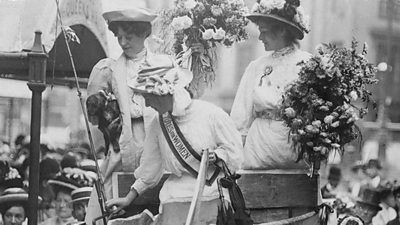
Pictured: Edith New. Image Credit: The Womens Library Collection, LSE
CM7
Highlights to mark #1918women around the country include:
BBC Radio Manchester
The city of Manchester has a proud history of support for the suffragette campaign through the Pankhurst family, whose home in Nelson Street became the first meeting place of the Women's Social and Political Union. BBC Radio Manchester will be broadcasting its Breakfast programme live from the Pankhurst home, now the Pankhurst Centre, on 6 February. The great-granddaughter of Emmeline Pankhurst, Helen Pankhurst, will be a guest on the Breakfast show and the programme will also look at the Greater Manchester landmarks that formed the backdrop of the fight for votes.
Emmeline: The Making of a Militant, BBC One June 8 at 7.30pm (North West)
Presenter Sally Lindsay takes a rare look at Emmeline Pankhurst’s personal story - the loves, losses, political passions and tragedies that motivated her and asks why so little is known about this world-famous figure as we celebrate 100 years.
With the help of Emmeline’s surviving relatives, including her great-granddaughter Dr Helen Pankhurst, Sally delves deep into the archive to reveal her roots in radical Victorian Manchester. She finds out more about young Emmeline’s political heroines, and unearths amazing archive of a Manchester woman who voted in an election 50 years before the landmark act of 1918.
Stepping back in time to the very birthplace of the Suffragettes – Emmeline’s house in Nelson Street, Manchester – Sally finds out how she was motivated by her daughters to take the final steps towards militant action. And how she carefully transformed her image into the feminine yet formidable picture we know today – to inspire a nation of women to follow in her footsteps.
BBC Radio London
Jo Good presents an hour-long documentary exploring the Suffragette Campaign in London. Airing on Tuesday 6 February at 3pm, the programme will explore the activity of the suffragettes in London to find out more about the enormous political upheaval that helped transform women's lives and our democracy.
Jo walks around Westminster in the footsteps of the suffragettes with historian Diane Atkinson, and find out about the lives of some of the lesser known suffragettes with a visit to the Museum of London. Helen Pankhurst, great grand-daughter of Emmeline Pankhurst, also sheds light on what, as a society, we are doing in terms of equality 100 years on from female enfranchisement.
BBC Tees
As well as telling the story of suffragette and Middlesbrough’s first female councillor Alice Schofield Coates, BBC Tees will have teenagers interviewing two of Middlesbrough Council’s longest serving female councillors in the historic council chamber - the same place where the town’s first two female councillors Alice Schofield Coates and her sister-in-law Marion Coates Hanson fought for better health care and housing from 1919.
BBC Radio Cumbria
Three generations of women talk about what it means to have the vote. Radio Cumbria also tells the story of Catherine Marshall, who established a branch of the National Union Of Women’s Suffrage Society in Keswick in 1908.
BBC Radio Lancashire
BBC Radio Lancashire begins a year of celebrations on to mark the remarkable ‘Wonder Women Of Lancashire’. On Tuesday, the Breakfast show will tell the story of suffragette Edith Rigby, and a Preston businessman reveals why he’s prepared to start the funding of a statue of Edith. The mid-morning show will tell the story of Selina Cooper, the mill girl from Nelson, who met the Prime Minister to campaign for women’s rights.
BBC Radio Wiltshire
Radio Wiltshire tells the story of Swindon Suffragette Edith New (pictured above), who was the first woman to use stone throwing as a tactic, which was later adopted as policy by the WSPU. On Tuesday, there will also be a live debate between 9am and 10am, asking: How Equal Are Men And Women Now?
BBC Radio Kent
Tunbridge Wells suffragette Olive Walton was one of the first women to enrol in the Women Police Volunteers. Her story will be as a springboard to debate the role of women in modern day politics.
South East Today
A week of coverage on South East Today includes, on Tuesday, the stories of suffragists from Sussex and the roles they played in securing the vote for women. Millicent Fawcett was married to Henry Fawcett, the Liberal Democrat MP for Brighton from 1865 to 1874, who was as committed as she was to the idea of votes for women.
Midlands Today
On Tuesday, Midlands Today will be speaking to a relative of Hilda Burkitt, the first suffragette to be force-fed in prison.
BBC East
Three films on BBC East will explore suffragettes and women’s rights in the region, including Constance Lytton who changed her identity to Jane Warton to expose force feeding horrors. There will also be focus on leader of the suffragist movement, Millicent Fawcett, including the unveiling of a blue plaque at her former home in Cambridge. And looking at the modern day, young female voters will discuss the vote.
South Today
On Tuesday at 6.30pm, on the 100th anniversary of the Representation of the people Act, which granted women the right to vote, BBC South Today will be telling the story of two Oxfordshire suffragettes, Helen Craggs and Norah Smyth, who plotted to commit arson. The two women used a boat to access the grounds of Nuneham Courtney House, owned by Lewis Harcourt who was a prominent opponent of women’s suffrage.
BBC South reporter Chrissy Sturt and Dr Katherine Bradley of the Open University trace the suffragettes’ footsteps and reveal that although the plan was foiled by a passing policeman the resulting court case was a turning point in the campaign as arson became a feature of future suffragist protests.
BBC Radio Oxford
Radio Oxford will feature the suffragette movement across the week with a selection of packages and live guests. On the mid-morning show, 'Suffragette City' will look at the important role Oxford played in both the pro- and anti-suffrage movements. Highlights include Philippa Bilton whose great grandmother was the cousin of Emily Wilding Davison.
Notes to Editors
The hashtag #1918Women will be launched on 6 February. Audiences on social media will be encouraged to share these important and often lesser-known stories of suffrage.
CM8/TG
