Dame Hilary Mantel to begin recording Reith Lectures for BBC Radio 4
BBC Radio 4 has today confirmed the details and broadcast dates for Dame Hilary Mantel’s Reith Lectures as she begins to record them around the UK. The first of her five lectures, exploring the trade of historical fiction, will be recorded tomorrow evening at Halle’s St Peters in Manchester.
Published: 21 May 2017
Facts and alternative facts, truth and verisimilitude, knowledge and information, art and lies: what could be more timely or topical than to discuss where the boundaries lie?
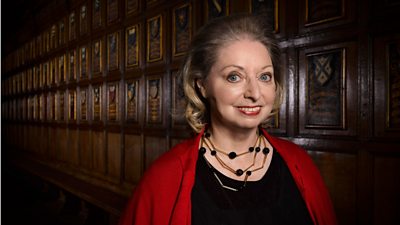
Radio 4 has also today released the first official Reith 2017 portrait of Hilary Mantel, by award-winning photographer Richard Ansett, from a collection of images that will accompany the series. The lectures will broadcast over five weeks this summer, from Tuesday 13 June at 9am on BBC Radio 4, and will be available as a podcast.
Throughout her five lectures titled Resurrection: The Art And Craft, Hilary Mantel will ask questions about the legitimacy and usefulness of historical fiction, examine the role of research, and explore how a writer might serve the recorded facts whilst giving breathing space to the imagination. Her lectures will seek to address how a writer might deal with the gaps and erasures of history and whether there is a kind of truth that only fiction can tell.
Hilary Mantel says: “Facts and alternative facts, truth and verisimilitude, knowledge and information, art and lies: what could be more timely or topical than to discuss where the boundaries lie? Is there a firm divide between myth and history, fiction and fact: or do we move back and forth on a line between, our position indeterminate and always shifting? In my lectures I shall explore historical fiction both as art and craft, and try to say how, as a working writer, I deal with the theoretical and practical challenges of the form.
“It is apt for me to open the series in Manchester, as well as a pleasure to revisit a city that is almost home ground: I grew up on the fringe of the Peak District as a child of a mill-working family. In the first lecture I will talk about what I know of their Irish roots, and introduce the figure of my great-grandmother, who - though she could not read or write - helped me construct my own identity as someone who reverences the past.”
Gwyneth Williams, Controller of BBC Radio 4 says: “The Reith Lectures are always a high point in Radio 4's year as we engage with some of the most significant thinkers and ideas of our times. But this year I can promise you even more. Hilary Mantel's language, as she explores her art of bringing the dead from the past to life through fiction, is lyrical and utterly seductive. Her lectures will be a treat for us all.”
Hilary Mantel will record her five lectures around the UK and in Belgium starting at Halle’s St Peters in Manchester (22 May), followed by Middle Temple in London (30 May), The Vleehuis in Antwerp (1 June), The University of Exeter (6 June) and finishing at The Art House in Stratford-Upon-Avon (13 June). The Reith Lectures are introduced and chaired by Sue Lawley and each is recorded in front of a live audience with the opportunity to put questions to Dame Hilary in a question and answer session at the end.
Over the course of these five lectures, Hilary discusses the role that history plays in our lives. How do we view the past, she asks, and what is our relationship with the dead? The details of the lectures are:
Lecture 1: The Day Is For The Living
Tuesday 13 June, 9am, BBC Radio 4
Art can bring the dead back to life, argues Hilary Mantel, starting with the story of her own great-grandmother. "We sense the dead have a vital force still," she says. "They have something to tell us, something we need to understand. Using fiction and drama, we try to gain that understanding.” She describes how and why she began to write fiction about the past, and how her view of her trade has evolved. "We cannot hear or see the past" she says, "but we can listen and look".
This lecture is recorded at Halle’s St Peter’s in Manchester.
Lecture 2: The Iron Maiden
Tuesday 20 June, 9am, BBC Radio 4
How do we construct our pictures of the past, asks Hilary Mantel: Where do we get our evidence? In this second of five lectures she warns against two familiar errors: either romanticising the past, or seeing it as a gory horror-show. It is tempting, but often condescending to seek modern parallels for historical events. "Are we looking into the past, or looking into a mirror?" she asks. "Dead strangers...did not live and die so we could draw lessons from them."
This lecture is recorded at Middle Temple in London.
Lecture 3: Silence Grips The Town
Tuesday 27 June, 9am, BBC Radio 4
The story of how an obsessive relationship with history killed the young Polish writer Stanislawa Przybyszewska, told by Hilary Mantel. The brilliant Przybyszewska wrote gargantuan plays and novels about the French Revolution, in particular about the revolutionary leader Robespierre. She lived in self-willed poverty and isolation and died unknown in 1934, but her work, so painfully achieved, did survive her. Was her sacrifice worthwhile? "She embodied the past until her body ceased to be," Dame Hilary says. "Multiple causes of death were recorded, but actually she died of Robespierre.”
This lecture is recorded at the ancient Vleehuis in Antwerp, a city which features in Mantel’s novels about Thomas Cromwell and the cosmopolitan world of the early Tudors.
Lecture 4: Can These Bones Live?
Tuesday 4 July, 9am, BBC Radio 4
Hilary Mantel analyses how historical fiction can make the past come to life. She says her task is to take history out of the archive and relocate it in a body. "It's the novelist's job: to put the reader in the moment, even if the moment is 500 years ago." She takes apart the practical job of ‘resurrection,' and the process that gets historical fiction on to the page. “The historian will always wonder why you left certain things out, while the literary critic will wonder why you left them in," she says. How then does she try and get the balance right?
This lecture is recorded at The University of Exeter, near Mantel's adopted home in east Devon.
Lecture 5: Adaptation
Tuesday 11 July, 9am, BBC Radio 4
Hilary Mantel on how fiction changes when adapted for stage or screen. Each medium, she says, draws a different potential from the original. She argues that fiction, if written well, doesn’t betray history, but enhances it. When fiction is turned into theatre, or into a film or TV, the same applies - as long as we understand that adaptation is not a secondary process or a set of grudging compromises, but an act of creation in itself. And this matters. "Without art, what have you to inform you about the past?" she asks. "What lies beyond is the unedited flicker of closed-circuit TV."
This final lecture is recorded at The Art House in Stratford-Upon-Avon.
The Reith Lectures are produced by Jim Frank in London for BBC Radio 4.
The 2017 Reith Lectures: Resurrection: The Art and Craft by Hilary Mantel will broadcast on BBC Radio 4 and BBC World Service over five weeks from Tuesday 13 June at 9am. The lectures will be available as podcasts and there will be accompanying content on the Radio 4 website at bbc.co.uk/radio4/reith
Notes to Editors
Hilary Mantel is an English writer whose work includes personal memoirs, short stories and historical fiction. She has written 14 novels and is the two-time winner of the Man Booker Prize for her bestselling novels, The Wolf Hall Trilogy, and its sequel, Bring Up The Bodies.
The Reith Lectures were inaugurated in 1948 by the BBC to mark the historic contribution made to public service broadcasting by Sir John (later Lord) Reith, the corporation's first director-general.
John Reith maintained that broadcasting should be a public service which enriches the intellectual and cultural life of the nation. It is in this spirit that the BBC each year invites a leading figure to deliver a series of lectures on radio. The aim is to advance public understanding and debate about significant issues of contemporary interest.
The very first Reith lecturer was the philosopher, Bertrand Russell who spoke on "Authority and the Individual". Among his successors were Arnold Toynbee (The World and the West, 1952), Robert Oppenheimer (Science and the Common Understanding, 1953) and J.K. Galbraith (The New Industrial State, 1966). The Reith lectures have also been delivered by the Chief Rabbi, Dr Jonathan Sacks (The Persistence of Faith, 1990), Dr Steve Jones (The Language of the Genes, 1991), Michael Sandal (A New Citizenship, 2009), Martin Rees (Scientific Horizons, 2010) and Aung San Suu Kyi and Eliza Manningham-Buller (Securing Freedom, 2011). Most recently the Reith Lecturers have been Niall Ferguson (The Rule of Law and Its Enemies, 2012), Grayson Perry (Playing to the Gallery, 2013), Dr. Atul Gawande (The Future of Medicine, 2015), Stephen Hawking (Black Holes, 2016) and Kwame Anthony Appiah (Mistaken Identities, 2016).
Since 2002, the Reith Lectures have been presented by Sue Lawley.
Hilary Mantel’s Reith portraits were commissioned by BBC Pictures in an ongoing collaboration with award-winning photographer Richard Ansett. A selection of Reith portraits are also now part of the National Portrait Gallery's permanent collection.
SW