Cassian Harrison announces new titles for BBC Four
Speaking at the Edinburgh TV Festival, BBC Four Channel Editor Cassian Harrison today announced a wide range of new commissions.
Published: 24 August 2017
BBC Four continues to go from strength to strength, offering a highly distinctive, award-winning and much loved range of programming to our audiences.
- BBC Four continues to innovate in form with a new Slow TV mindfulness special and box set history titles that delve into pivotal moments from the past with gripping detail and story-telling
- BBC Four returns to single drama, with a new feature comedy drama telling the story of Eddie Braben, the man behind Eric and Ernie
- BBC Four continues to explore our deep cultural and creative history with new seasons on the 500th anniversary of the Reformation, Ovid and Opera
- BBC Four opens the BBC’s doors to new talent with ‘artist-first’ original programming from celebrated creatives including Phil Collins, Akala, and the RSC.
New Slow TV series include a mindfulness special that immerses viewers into the daily world of Benedictine monks and a new series of Slow natural history programmes that leverage the Natural History Unit’s unmatched expertise to present the natural world as it is lived. Two gripping in-depth history series take a detailed look at the lives of Lady Jane Grey and Ruth Ellis. Also announced were new seasons on Opera and the Reformation, and new arts programmes that bring acclaimed video-artist Phil Collins and Hip-Hop poet Akala to the channel.
Cassian Harrison says: "BBC Four continues to go from strength to strength, offering a highly distinctive, award-winning and much loved range of programming to our audiences.
"Today I’m delighted to be announcing ambitious new content that demonstrates how we continue to innovate, pushing boundaries of form and content and welcoming new and diverse talent, while maintaining our commitment to an uncompromising spread of programming that delves into the worlds of Arts, Music, History and Culture with a depth of expertise that is unmatched in UK television.”
EDA
Please note: All titles are working titles.
SLOW TV
New Slow TV series include a mindfulness special that immerses viewers into the daily world of Benedictine monks and a new series of Slow natural history programmes that leverage the Natural History Unit’s unmatched expertise to present the natural world as it is lived.
BBC Four has enjoyed great success taking viewers on Slow journeys aboard a bus, a canal boat, train and a sleigh ride. Now, the channel takes Slow TV a step further by inviting viewers to celebrate the mindful frame of mind as we follow the monks of three different monasteries. This new Slow special will give viewers the chance to take a step back from the hurly-burly of everyday life and enter a world of quiet contemplation as we experience life at a monk’s pace.
The Monastery is a three-part series which immerses viewers fully into the world of Benedictine monks, taking a look at this idiosyncratic but incredibly peaceful existence and allowing us to share the unique experience of living in a monastery.
The monks’ lives are the antithesis of our own and have remained largely unaffected by changes outside the monastery walls for over a thousand years. This series will enable us to slow down to their speed and provide a welcome retreat from the hectic pace of our own daily lives.
The series will visit three different monasteries in Britain and follow individual monks that live there. The structure of their day will define the pace and emphasis of the film - we’ll rise at dawn when they do, we’ll eat with them in silence, we’ll eavesdrop on the ancient rituals they conduct. We’ll follow them as they perform their daily duties to keep the monastery up and running - cooking supper, cleaning the cloisters, doing the laundry, growing fruit and vegetables in the abbey gardens. And we’ll observe the traditional crafts which occupy them - weaving, beekeeping and collecting honey, baking bread, calligraphy, icon painting and carpentry.
To accompany the BBC Four programme, Radio 3 will broadcast their own five part series of short Slow Radio broadcasts which will allow the listener to appreciate life at a monk’s pace, reflecting the gentleness and calm of monastic life. Recorded in binaural sound and following the course of the monastic day, listeners will hear musings from the monks themselves, interspersed with sounds of their singing and of the surrounding natural world. The monks expound on why repeating the same activities again and again is good for the soul, and an effective way of achieving tranquillity in a busy world. This series will also be available for download as a podcast and is produced by Radio 3 Production.
The Monastery was commissioned by Fatima Salaria and Clare Paterson for the BBC. The Executive Producer is Nikki Parrot for Tigerlily Productions. The Monastery is a collaboration between BBC Documentaries and BBC Religion. The Producer/Director is Luke Korzun Martin.
This autumn, BBC One is showing two major new natural history series from The Natural History Unit, BBC Studios, Blue Planet II and Animals with Cameras, and to complement these landmark programmes, BBC Four is bringing viewers a very different take on the natural world. Slowing down the pace, BBC Four’s programmes will enable viewers to experience the natural world in real time through the eyes of three of the animals featured in the BBC One series.
Using onboard wearable technology, each of the three episodes will be led by one animal showing us the world from their unique perspective - a cheetah on the African savannah, a green turtle cruising the reefs of Indonesia and a white tailed sea eagle as it flies around the Western coast of Scotland.
Each 30 mins programme will be beautifully paced with embedded graphics to give further insight into the animals’ worlds, their adventures and encounters in an utterly immersive experience.
Slow Natural History (3x30) was commissioned by Cassian Harrison and Tom McDonald and the BBC Commissioning Editor is Craig Hunter. It is being made by The Natural History Unit, BBC Studios, where the Executive Producer is Doug Hope.
BOX SET HISTORY
Taking the lead from its incredibly successful broadcast of the multi-part OJ: Made In America earlier this year, BBC Four takes an in depth, box set approach to two stories from the British past that continue to fascinate and intrigue us, taking viewers on a gripping roller coaster journey through two seminal moments in our history. Both series focus on a central female figure - Lady Jane Grey and Ruth Ellis - and explore how two women from very different worlds had their fates decided by men and by the justice systems of the time.
Lady Jane Grey: To Kill A Queen
In 1553 the country is taken to the brink of a bloody civil war when the dying King Edward VI, son of Henry VIII, leaves the throne, not to his elder sister, Mary, but to his cousin, the Lady Jane Grey.
This is a story of intrigue, conspiracy, political manoeuvring and a capital city preparing to be attacked. It is also the story of a young woman, ferociously manipulated by powerful men in the palace, who ends up losing her life as a result.
The life of Lady Jane Grey is a tragic narrative. From the moment Edward VI draws Jane into the line of succession, her terrible fate, on the block in the Tower of London, is sealed.
Helen Castor is a historian and a medievalist who has studied the She Wolves, those women who held power in various ways throughout the medieval period. Now she sets out to take a close look at the first woman to sit on the English throne, not as consort, but as a reigning Queen. But Helen discovers far more than a story about a Tudor Queen. The story of Jane Grey is surrounded by myth, confusion and propaganda. Images turn out not to be Jane, well known stories turn out to be fake and many of the books disagree on the details. Helen asks why the first woman to be proclaimed Queen of England has attracted so much bending of the truth.
Helen discovers some Tudor detective work and turns back to the primary sources in an attempt to separate the truth from the fiction. She builds the real story of Jane Grey and those dark figures that surrounded her, and traces her world, and the nine days she spent on the throne.
Lady Jane Grey: To Kill A Queen, presented by Helen Castor, features some of the best known Tudor historians, including Leanda DeLisle, John Guy, J. Stephan Edwards and Anna Whitelock. The film features The Tower of London, Greenwich, Hampton Court, Framlingham Castle and many of the primary sources currently held in leading museums and libraries. It also uses new graphic-drama sequences throughout.
The series was commissioned by Cassian Harrison, channel editor BBC Four and Tom McDonald, Head of commissioning, Natural History and Specialist Factual. The commissioning editor is Abigail Priddle. The series is being made by Darlow Smithson Productions.
Ruth Ellis
In July 1955, Ruth Ellis was the last woman to be hanged in Britain. Her crime: the cold-blooded murder of her lover David Blakely.
This investigative three-part series brings a true crime ethos to history and re-examines the Ruth Ellis case. With an honest, open and questioning approach, this box-set history series is a 21st century re-examination of the case behind one of Britain’s most infamous crimes. What do we think we know? How do we know it? And is there still evidence to uncover?
Chronicling the arrest, trial and failed reprieve - and enduring aftermath - we discover that nothing is certain in one of Britain’s most renowned cases.
Ruth Ellis will provide viewers with a forensic examination of the original investigation, prosecution and defence of Ellis - from her arrest on the April 10, through her shockingly short trial in June and her execution in July. The series unpicks all the decisions of the past with the help of those who knew Ruth, as well as present-day detectives and top legal experts who discover holes that raise questions about competency and corruption. The programmes also look at the evidence with a contemporary lens: did Ruth get the right verdict then and would she get a different one now?
The series also uncovers the story of a key witness who was never questioned by the police at the time, but who would be now: Ruth’s son, Andre who was ten years old at the time. Andre’s testimony is pieced together in order to tell his own story - one that ended tragically in suicide. He is key to unlocking what really happened on that Easter Weekend, which culminated in Ruth shooting her lover. It is a story that carries into the 1970s and 80s - right up to the present day.
The series was commissioned by Cassian Harrison, channel editor BBC Four and Tom McDonald, head of commissioning Specialist Factual. The commissioning editor is Diene Petterle. The series will be executive produced by Cate Hall and series produced and directed by Gillian Pachter for Wall to Wall.
COMEDY
BBC Four returns to single drama, with a new feature comedy drama telling the story of Eddie Braben, the man behind Eric and Ernie.
Eric, Ernie And Me
This new one off drama tells the story of comedy scriptwriter Eddie Braben.
They were called The Golden Triangle - Morecambe, Wise and Braben. For over a decade, the writer Eddie Braben penned Morecambe and Wise’s material, and reshaped the double act into the Eric and Ernie that the nation took to its heart. But it wasn’t all sunshine.
Written by Neil Forsyth (Bob Servant, Waiting for Andre), Eric, Ernie And Me celebrates the man behind Morecambe and Wise’s greatest successes, culminating in their iconic 1977 Christmas Show, whilst showing the pressure and pain he went through to help create Britain's most beloved double act.
The 1x60 drama was commissioned by Gregor Sharp, Commissioning Editor, BBC Comedy and will be produced by Objective Fiction, part of Objective Media Group. Ben Farrell and Toby Stevens are executive producers with Alison Sterling line producing.
REFORMATION SEASON
BBC Four marks the 500th anniversary of the Reformation with new arts, music and drama commissions.
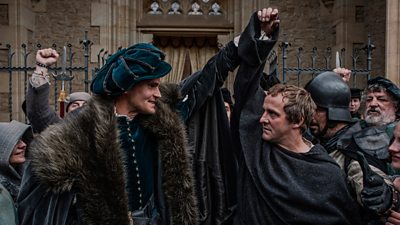
Reformation: The Story Of Martin Luther
Marking 500 years since the Reformation, this is the story of Martin Luther, the visionary reformer and one of the most important religious figures in history.
500 years ago a revolutionary priest changed the face of Christendom and the path of European civilization forever. Risking his life, academic reputation, facing damnation and purgatory in 1517, he pinned his inflammatory 95 Theses to the church door in the Catholic Church and the Western World would never be the same again. His name was Martin Luther.
This German drama is directed by Uwe Janson and stars Maximilian Brückner as Martin Luther. It was written by Stefan Dähnert and Marianne Wendt, directed by Uwe Janson and its Creative Producer is Martin Bromber.
Reformation: The Story Of Martin Luther (2x90) has been acquired by Cassian Harrison and Sue Deeks, Head of Programme Acquisition, for BBC Four. The series is distributed internationally by FremantleMedia International and will be broadcast later this year on BBC Four.
Evensong: The Story Of England’s Greatest Musical Legacy
For the BBC’s Reformation Season in autumn 2017 Lucy Worsley will investigate the story of the most remarkable creation from that tumultuous and violent era: Choral Evensong.
Henry VIII loved religious music, but he loved power more - when he instigated his English Reformation he dramatically split from the ancient Catholic Church that controlled much of his country. But in doing so set into motion changes that would fundamentally transform the religious music he loved.
Following Elizabeth I’s personal story Lucy will recount how she and her two siblings were shaped by the changes their father instigated. Elizabeth witnessed both her radically puritan brother Edward bring Church music to the very brink of destruction and the terrifying reversals made by her sister Mary - which saw her thrown in the tower of London forced to beg for her life.
When Elizabeth finally took power she was determined to find a religious compromise - she resurrected the protestant religion of her brother but kept the music of her beloved father - music that she too adored. And it was in the evocative service of choral Evensong that her ideas about religious music found their ultimate expression.
Evensong: The Story Of England’s Greatest Musical Legacy was commissioned by Cassian Harrison and Jan Younghusband, Head of BBC Music Television Commissioning. The Executive Producer is Ross Wilson for Matchlight Productions.
Books Of The Reformation With Janina Ramirez
To mark the 500th anniversary of the Reformation, Nina Ramirez tells the story of three books that defined this radical religious revolution in England.
Tyndale’s New Testament, The Book of Common Prayer and Foxe’s Book of Martyrs are no longer commonly recognised titles. Yet, for over four hundred years, these works formed the backbone of British life. Their words shaped the English language; fuelled religious division; and sparked wars.
In this programme (1x60), Nina discovers how the trio of texts had a powerful cumulative effect. Tyndale’s Bible made the word of God accessible to the common man for the first time, The Book of Common Prayer established a protestant liturgy and Foxes Book of Martyrs enshrined a hatred of Catholicism. Nina reveals how they formed the nation’s protestant identity, the impact of which can be seen even today.
The BBC Commissioner was Mark Bell. Mike Smith is the Exec Producer for BBC Studios, and it was Produced/Directed by Anna Cox.
ARTS
BBC Four marks 2000 years since the death of the great writer Ovid with two new commissions celebrating his life and work.
Ovid: The Poet And The Emperor With Michael Wood
This film looks at the life and work of one of the world's greatest writers, who died 2000 years ago this autumn. Using his own words, performed by one of Britain’s leading actors, Simon Russell Beale, it uncovers the extraordinary story of a poet's clash with power.
Ovid rose to spectacular fame with his poems Love Affairs (Amores) and The Art of Love (Ars Amatoria) - an amoral guide to seduction and adultery. His greatest and most influential work Metamorphoses, a compendium of the great tales of Greek myth, made him a literary superstar in Rome and has been called the most influential secular book in Western culture. But out of the blue Ovid was banished by the Emperor Augustus to the farthest edge of the empire, to the wilds of the Black Sea coast and the marshes of the Danube Delta. It's a tale full of sex, drama and scandal; his books banned for reasons that are still a mystery - as he put it, "all because of a poem - and a mistake".
His immense legacy in world literature and art is discussed with leading Ovid experts, who trace his influence on, among others, Dante, Titian, Botticelli, and even Bob Dylan, whose Modern Times album quarries Ovid’s exile poetry. Artistic Director of the RSC, Greg Doran, looks at Ovid and Shakespeare and the myths in The Metamorphoses that pervade our art, music, literature and ballet. Actor Lisa Dwan - the world’s leading Beckett interpreter - explores Ovid’s use of the female voice and the poetry of exile which has been shaped by Ovid over the last two millennia.
Travelling with Michael Wood from Sulmona to Rome and then to the place of Ovid's exile in today’s Romania, the film brings Ovid’s tale to life with the help of his poems and letters. Ovid is "funny, irreverent, focused on pleasure and obsessed with sex" says Prof Roy Gibson, but he also raises very modern questions about the fluidity of identity and gender, the relationship between writers and power, and our understanding of the natural world. But above all says Michael Wood - he is a the poet of love, and 2000 years after his death he is coming back into focus as one of the world’s greatest poets: profound, relevant and urgent.
Ovid: The Poet And The Emperor With Michael Wood (1x60) was commissioned by Mark Bell. The Producer/Director is Rebecca Dobbs for Maya Vision International, and the Writer/Presenter is Michael Wood.
Ovid: The World's Greatest Storyteller (w/t)
Many of William Shakespeare’s best lines reference the shape-shifting characters of Ovid's Metamorphoses. But do audiences know why Niobe was "all tears", or of Phaethon and his "unruly jades"? In Ovid: The World's Greatest Storyteller (w/t) (2x30), BBC Four partners with the Royal Shakespeare Company to introduce highlights from Metamorphoses to a new audience, with the aim of demystifying some of the bard's most enigmatic references.
Delivered in a series of dramatic monologues and interspersed with behind the scenes preparations for the RSC's Ovid series this October, these two half hour programmes will feature some of the finest actors from RSC productions past and present, all directed by Artistic Director Gregory Doran. By letting Ovid's original tales speak for themselves, we see exactly why the Roman poet is still regarded as one of the world's greatest storytellers, two thousand years after his death.
The series is made by The Documentary Unit, BBC Studios. The Executive Producer is Janet Lee and it is produced and directed by John O'Rourke. Emma Cahusac is the BBC Commissioner.
ARTISTS FIRST
BBC Four opens the BBC’s doors to new talent with artist-first original programming from celebrated creatives including Phil Collins, Akala, and the RSC.
Akala’s Odyssey (w/t)
Akala explores the world of Homer and The Odyssey, to discover how an epic poem became the cornerstone of Western literature and how his own experiences as a poet have been impacted by a 3,000-year-old classic.
What happens when one of the UK’s most acclaimed contemporary urban poets attempts to re-discover one of the oldest epics in human history and writes a new poem inspired by the ancient work?
In Akala’s Odyssey we follow Akala on a personal journey from the ruins of Troy to the high city of the Acropolis and all that lies in between in this ambitious authored film. Akala looks at how language can create national identity and how The Odyssey endures today as the inspiration for all that followed it.
The film is a love letter to poetry, song and narrative that links Akala’s life and experience to that of a blind bard who (may have) lived across the sea 3,000 years ago, as it takes a fresh look at one of the most celebrated and influential literary works in human history.
Akala’s Odyssey (w/t) (1x60) was commissioned by Emma Cahusac, BBC Commissioning Editor for Arts. The Executive Producers for GreenAcre Films/Immovable are Amanda Jenks, Nadine Marsh-Edwards and Chanelle Newman.
Ceremony
Friedrich Engels - philosopher, writer and radical thinker - is coming back home.
Turner Prize-nominated artist Phil Collins is returning Engels to the city where he made his name - in the form of a Soviet-era statue, driven across Europe and permanently installed in the centre of Manchester as the closing event of this year’s Manchester International Festival.
Directed by Phil Collins, with a soundtrack by Mica Levi (Jackie, Under The Skin) and Demdike Stare, and a new anthem composed by Gruff Rhys (Super Furry Animals), this film will mark one hundred years since the ideas in The Communist Manifesto, written by Engels and Karl Marx, changed the course of history by inspiring the Russian Revolution.
Engels arrived in Manchester in 1842 and documented the plight of the city’s working classes in The Condition of the Working Class in England. Collins’ film for BBC Four will not only document the statue’s journey but also the lives of Manchester workers today and a live event specially created to welcome the statue to the city.
Ceremony was commissioned by Emma Cahusac, Commissioning Editor, Arts and Music and being produced by Tigerlily Productions. It is backed by Manchester International Festival, HOME and 14-18 NOW.
MUSIC
BBC Four announces new programmes as part of the BBC’s Opera season including a documentary on tenor Jonas Kaufmann as well as a reflection on the anniversary of English Cellist Jacqueline du Pré.