BBC unveils major new line-up of innovative Natural History commissions
Tom McDonald, BBC Head of Commissioning, Natural History and Specialist Factual, today announces six brand new commissions for BBC One and BBC Two.
Published: 12 October 2016
Our new Natural History commissions show the range and ambition we have for the genre and our commitment to Natural History up to 2019 and beyond
These include an ambitious BBC One series for 2019 on the continents; a once-in-a lifetime special with Sir David Attenborough, a series where the animals film themselves using the latest technology; and a powerful conservation documentary from the Natural World strand.
Tom McDonald says: “Our new Natural History commissions show the range and ambition we have for the genre and our commitment to Natural History up to 2019 and beyond. From blue-chip landmarks to special event pieces, all-access documentaries to truly surprising and innovative ways of delivering stories, Natural History at the BBC goes from strength to strength.”
Earlier this year, Attenborough and the Giant Dinosaur was watched by more than eight million viewers, making it the most watched natural history programme on the BBC since 2011. In this follow up programme, David Attenborough will once more be out filming, this time on the Jurassic Coast.
A remarkable chance discovery could reveal secrets that have lain hidden for 200 million years and David is on a quest to uncover them.
A super predator that ruled the ocean at the time of the dinosaurs has been found in a crumbling cliff face on the Jurassic Coast. It’s a huge ichthyosaur - a kind of dinosaur-dolphin - thought to be a completely new species, and potentially the biggest ever found in the UK.
In this one-hour special for BBC One, the huge fossil will be excavated, prepared, scanned, and a perfect replica of its skeleton constructed. Then its physical attributes will be scientifically tested. What it reveals could change our understanding of these extraordinary creatures and the Jurassic world in which they lived.
David will be there every step of the way, meeting the excavators and scientists to uncover the secrets of this superbly adapted ocean-predator.
Looking at evidence from animals across the world, from sharks to dolphins and from marine iguanas to turtles, he will piece together how it behaved and lived. Tests on the 3D computer and physical model will reveal new science about these pre-historic monsters. In a visual climax David will meet the complete skeleton and, with the help of CGI animation, we will get a glimpse of this formidable sea dragon and the world in which it lived.
Attenborough and the Giant Sea Dragon, a 1x60’ for BBC One, will be Executive Produced by Mike Gunton for the BBC’s Natural History Unit. The Commissioning Editor is Tom McDonald, Head of Commissioning, Natural History and Specialist Factual.
Seven Worlds
Seven Worlds is a brand new, ambitious landmark 7x60’ series for BBC One.
Each one-hour episode will transport viewers to a single continent and tell the story of its spectacular wildlife and iconic landscapes.
The series will reveal just how the particular characteristics of each continent - their shape, size, climate, ancient past and position on our planet - have given rise to and shaped the unique animal life found on each of our seven worlds.
In this series we will discover why Australasia is full of weird and venomous wildlife; why North America is a land of opportunity where pioneers succeed; and what the consequences are for life racing to compete on the richest of all continents, South America.
The series will have its own signature look and style, developed using cutting-edge technology. Stabilised camera systems, drones and mini cameras will be deployed to capture new wildlife behaviour. Epic landscapes will be filmed using the very latest techniques, allowing audiences to experience each continent like never before.
The programme will view the continents through their greatest natural wonders: the Congo, the Amazon, the Sahara, the Himalayas -and by telling dramatic animal stories in those extraordinary wildernesses, it will uncover the fundamental truth about what makes each one of the seven worlds unique.
Seven Worlds, a 7x60’ series for BBC One, is Executive Produced by Jonny Keeling for the BBC’s Natural History Unit and is co-produced with BBC America. The Commissioning Editor is Tom McDonald, Head of Commissioning, Natural History and Specialist Factual. It will be distributed globally by BBC Worldwide.
Animals With Cameras
What if animals could tell their own stories? Animals spend so much time in places where human camera operators can’t go, filming wildlife is often impossible. But that’s going to change in this groundbreaking series, where the cameras are given to the animals.
Presenter and wildlife cameraman Gordon Buchanan deploys specially developed on-board cameras to answer vital questions about their secret lives. How do young chimps learn to avoid deadly snakes high in the jungle canopy? How do cheetahs manage to hunt in tangled woodlands in Namibia? Who tends baby meerkats deep in their underground burrows, when mum is out foraging?
Gordon will works closely with scientists for whom on-board cameras are a vital new research tool, helping them better understand and protect animals. The delightful new perspective these cameras allow will take us deeper into the lives of some of our favorite animals than ever before.
Animals with Cameras, a 3x60’ for BBC One, is Executive Produced by Tim Martin for the BBC’s Natural History Unit, and is co-produced with PBS. The Commissioning Editor is Craig Hunter. It will be distributed globally by BBC Worldwide.
Rituals
Rituals, from BBC Studios’ world-renowned Natural History Unit, will immerse the viewer in the spectacular and emotional human stories that form our global rituals.
From intimate ceremonies to welcome a new born child into a remote Amazonian tribe, to the millions of pilgrims who have piercings in the name of their God in Malaysia, rituals teach us how to be human and keep society together. Through colourful ceremonies of birth, marriage and death, this series will reveal how we love and are loved.
In Sulawesi the dead are exhumed and honoured many years after their funeral, with relatives posting selfies with the corpses on Facebook.
In India, Jain novice nuns must pass three final temptations before plucking out all their hair and embarking on a solitary religious life where they will never see their family again. Only the novice herself can explain why she feels this path is her destiny.
In Siena, Italy, 60,000 people from different districts gather for a bareback horse-race around a mediaeval square as their ritual battle to keep the peace, and when 60 million devotees gather at the Kumbh Mela on the banks of the Ganges, it provides one of the greatest human spectacles on earth.
And we visit the surreal world of Burning Man in the Nevada desert, showing that even in places where we are losing traditional rituals, we are making new ones to serve our emotional needs.
Rituals, a 4x60’ for BBC Two, is Executive Produced by Lucy Carter for the BBC’s Natural History Unit. The Commissioning Editor is Craig Hunter. It will be distributed globally by BBC Worldwide.
Cherry Blossom: The Greatest Spring On Earth
The spectacular blossoming of cherry trees across Japan is one of the world’s most iconic spring events. This one-off special immerses us in this beautiful and intriguing natural event and looks at not only how nature responds, but how the people of Japan embrace the moment in surprising ways, both ancient and modern - making the 'Sakura', or Cherry Blossom Festival, the most important cultural moment in the Japanese calendar.
From the wild and beautiful Mount Yoshino to the bustling city streets of Kyoto, the sudden and brief flourish of pink flowers changes everything. Animals, from macaques to deer to bees and the curious Raccoon Dog and White Eye, arrive for a wild feast.
Meanwhile, Japan’s people embrace the blossom. Some perform ancient dances and other artistic rituals; huge crowds gather for special picnics under the trees and join beautiful lantern-lit night vigils; Japan’s entrepreneurs respond accordingly to suit the occasion, with everything from blossom-forecasts to blossom-themed bento boxes and sweets - even McDonald's turn their hamburgers pink for the event!
We take the viewers behind the scenes to reveal the extraordinary effort that goes into making this iconic event tick, as Japan is gripped by Sakura-mania.
Cherry Blossom: The Greatest Spring On Earth (w/t) is Executive Produced by Tim Scoones for the BBC’s Natural History Unit. The Commissioning Editor is Tom McDonald, Head of Commissioning, Natural History and Specialist Factual.
Sudan's Story: A Rhino's Last Stand - Natural World Special
This film will tell the remarkable story of the last remaining male Northern White Rhino on the planet, as scientists battle to bring his subspecies back from the brink of extinction.
In February 1975, in the Shambe game reserve, South Sudan a young Northern White Rhino was captured by a team working to supply the rapidly-expanding European zoo and safari trade. They called him Sudan, after his homeland, and he was shipped 7,000 miles to a remote zoo in the north of former Czechoslovakia.
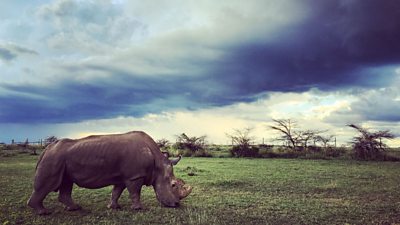
Over the next four decades of Sudan’s life, the Northern White Rhinos were annihilated by aggressive poaching in the wild and a failure to breed in captivity. Today, 43 year-old Sudan is the only male of his kind left on earth. He’s kept under 24-hour armed guard in Ol Pejeta conservancy in Kenya alongside the two remaining females. Sudan’s lonely status has earned him a bizarre infamy; he’s regularly photographed with concerned celebrities from around the globe and even has his own Twitter handle.
When Sudan dies, a subspecies that has walked the earth for five million years will die with him. Faced with this impending tragedy, a team of scientists have hatched a rescue plan for Sudan. Using cutting-edge animal assisted reproduction techniques, they’re hoping to use egg and sperm cells from the last living creatures and breed a new generation of Northern Whites Rhinos.
Following the scientists’ audacious battle to save a species, the film will be a timely exploration of whether humans have the power to bring back to life that which we have unwittingly destroyed.
Sudan’s Story: A Rhino’s Last Stand - A Natural World Special, is Executive Produced by Sacha Mirzoeff for the BBC’s Natural History Unit, and Fred Kaufman for PBS. It is a co-production of Thirteen Productions LLC and BBC in association with WNET. The Commissioning Editor is Tom McDonald, Head of Commissioning, Natural History and Specialist Factual. The Series Editor is Roger Webb and the Director is Rowan Deacon.
Pictured: Sudan
Notes to Editors
About BBC Worldwide
BBC Worldwide is the main commercial arm and a wholly owned subsidiary of the British Broadcasting Corporation (BBC). Its vision is to build the BBC’s brands, audiences, commercial returns and reputation across the world. This is achieved through investing in, commercialising and showcasing content from the BBC around the world, in a way that is consistent with BBC standards and values. The business also champions British creativity globally.
About BBC Earth
BBC Earth seeks to inspire audiences by sharing the incredible wonders of the universe, taking them on a thrilling journey of discovery, from the smallest creature under the microscope to the limitless expanses of space. Commercially and internationally the brand is managed by BBC Worldwide, the commercial arm of the BBC.
TD