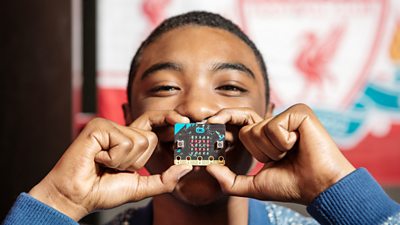
The BBC and Wellcome Trust announce major citizen science project, The Big Food Survey
The BBC and the Wellcome Trust have announced The Big Food Survey, a major initiative encouraging students to get involved in the UK’s biggest ever food and health survey for 12 and 13 year-olds.
Published: 16 May 2016

We’re delighted to put the BBC micro:bit at the centre of the survey and help bring it to life for students, collect data and make digital creativity and coding part of non ICT lessons.
The Big Food Survey will take place next school year in the autumn, targeting year eight or equivalent students across the UK, and forms part of The Crunch, the Wellcome Trust’s yearlong initiative of activities, experiences and discussions about food, health and the planet. Students will be asked to use their BBC micro:bits, pocket-sized codeable devices, to gather data about their eating habits over the course of one day.
To kick start the initiative, on 16 May, ambassador and former member of pop group JLS-turned-farmer, JB Gill, will launch The Big Food Survey... First Course. It’s a fun workshop that schools can deliver in a single lesson at any point during the remainder of the summer term. Aimed at current year sevens ahead of their move into year eight, students from around the UK can join JB to find out more about The Big Food Survey, and will be challenged to come up with their own Big Food Question, using the BBC micro:bit to bring it life.
The Big Food Survey... First Course also doubles as a hands-on session to start using and getting the most out of the BBC micro:bit. This will enable students to ask their question in a variety of creative ways, including animations, games, emojis, and even connecting their micro:bit to other devices and everyday objects. Some of the questions and designs could also be included in The Big Food Survey in the autumn.
When The Big Food Survey takes place later this year, year eight students across the UK will be able share their behaviours and opinions on food, using the BBC micro:bit to capture data and their responses. It gives students the chance to have their say on one of today’s most pressing topics, and will reveal what the UK’s 12 to 13 year-olds are eating and drinking, and how their schools, homes, parents, carers and friends affect their nutrition and health.
Sinead Rocks, Head of BBC Learning, says: “The Big Food Survey will help shed light on some of the most important questions around children’s health. It’s one of the biggest citizen science projects the UK has ever seen, and we want to encourage as many schools and students as possible to get involved. We’re delighted to put the BBC micro:bit at the centre of the survey and help bring it to life for students, collect data and make digital creativity and coding part of non ICT lessons."
Simon Chaplin, Director of Culture and Society at the Wellcome Trust, adds: “We know that the food we eat has a huge impact on our well-being, our long-term health and the health of the planet. That’s why we’re so excited to be running The Big Food Survey to help us understand what the UK’s 12-13 year-olds are eating and drinking, and to encourage them to explore how their food choices connect to their health and the environment. We can’t wait to see what questions they come up with!”
JB Gill comments: “As a farmer, I am passionate about making sure young people learn more about the food they enjoy every day, and it’s why I feel The Big Food Survey is really important. During the rest of the school year, I want to encourage year sevens to use their BBC micro:bits and think about questions we can include in the survey next year. There is a real connection between our health and our food, and getting children to understand about their food choices early on in life is vital for their futures.”
Every school in the UK is receiving a free pack of resources from the Crunch in May 2016, including science equipment, lesson notes and short plays. In addition to the packs, each school can download a lesson plan for the Big Food Question workshop. The workshop will use games to help students work out how to use the BBC micro:bit and give examples and ideas to inspire them to ask their own Big Food Questions. Schools can then submit their students’ questions, which may be included in the final survey.
The Big Food Survey has been created by The Crunch and the BBC with Lancaster University. Researchers from Lancaster will process the results of the survey and the results will be published later this year.
TL