Paul Williams, Series Producer, BBC Studios Natural History Unit
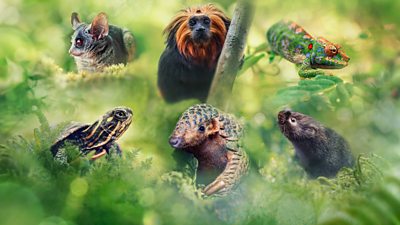
Our series Big Little Journeys transports viewers into the lives of tiny animals. The journeys they take may be huge, but the heroes at the centre of each episode are tiny – and that presented a huge challenge to our team from BBC Studios’ Natural History Unit trying to capture them
Every story is backed by science
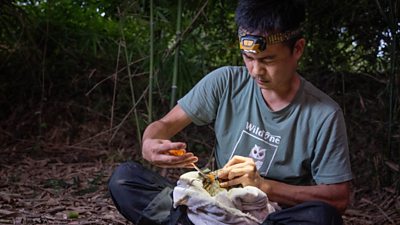
To transport the audience into the lives of tiny animals and to follow their journeys, we relied on the support of scientific and conservation projects on five continents.
The research and experience of these dedicated scientists gave us a unique insight into the lives of these animals.
Every journey depicted in the series is based on the real journeys and experiences of animals studied by these scientists and observed by our production team during an extensive period of research prior to filming. It was sometimes difficult to know for sure if we were following the same individual - even the scientists that study them lose track of them. So this means we sometimes use multiple animals to depict the journey of an individual, as well as filming techniques such as composites and archive.
Painted turtles in Canada
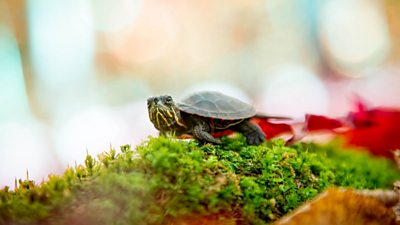
To film painted turtles we worked with Dr Patrick Moldowan from the University of Toronto, who is part of a project that has been studying and tracking painted turtles in Algonquin provincial park for more than 50 years.
It's the world’s longest and most continuous study of turtles so Patrick and his team know everything that these tiny reptiles get up to on their journeys from the nesting ground to the safety of a wetland. They discovered only 1% of hatchlings make it to adulthood – such is the danger that awaits them at every turn.
But it is not only Canadian giants, like black bears, that these walnut-sized turtles must watch out for. In the 1930s, highway 60 was built straight through Algonquin Park, and since then its sandy slopes have become turtle nesting grounds.
The turtles have warm, dry sandy soil perfect for digging nests – but once the hatchlings emerge, they are in mortal danger, dodging huge trucks while predators patrol the highway in search of a meal. Capturing this on film took a huge amount of collaboration and coordination. Each scene is composed of shots of an individual turtle, which was the most active turtle identified by the scientists on the day. Other turtles are filmed and intercut with it. This was done for ethical purposes to ensure the well-being of the turtle and to not disturb the scientist’s research. By working with the scientists and the park authorities we ensured that no turtle was ever in danger!
It is the dramatic scene, portraying how hatchlings cross a road, that opens the first episode, showing the greatest challenge that all small animals face – the impact of the human world.
Bushbabies in South Africa
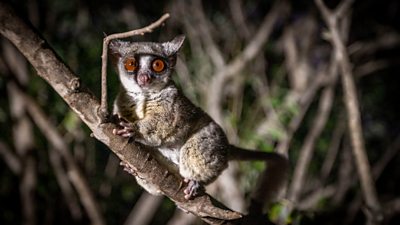
Another impact of the human world on many species is habitat loss. In episode one we reveal how bushbabies are finding new homes in cities as their natural acacia forest is intruded by human development.
The positive news is that here people are working to give them a helping hand. We filmed with local communities who are installing ropes to connect patches of forest – a new way for bushbabies to travel over roads and through urban areas. They also install specially designed bushbaby boxes where families can move in and have ‘bushbaby tables’ where they leave food out for them.
Bushbabies live high in the trees, are tiny, super-fast and leap 5 metres in a single bound - blink and they are gone! What makes filming them in the wild even more challenging is that they are active at night. We employed low light cameras and camera traps, high speed cameras and 6-metre-long gyro-stabilised camera cranes. We relied on the help from many South African experts to work out the routes that bushbabies take through the trees, but due to the secretive nature of these nocturnal primates it is difficult to know exactly how many individuals were filmed but for each scene the field team attempted to focus on an individual bushbaby, around which the sequence was built, and filmed shots of as many as 4 others to ensure that they had enough coverage to tell the story.
By working with researchers at Pretoria Zoo we used camera traps to film as a bushbaby family ‘broke’ into the grounds of the zoo to raid nectar from white bird of paradise flowers. The films scientific advisor Dr Juan Scheun, at Tshwane University of Technology, has discovered that in the city, because there is an abundance of food, bushbabies form larger ‘families’ of unrelated individuals, something that rarely happens in the wild.
While city living, and interactions with people, pets and vehicles can be stressful for bushbabies, the abundance of food means that they can feed all year round and weigh a quarter more.
Lion Tamarins in Brazil
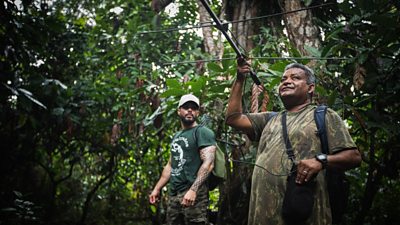
Habitat loss is strikingly obvious in Brazil’s Atlantic Forest which is now only 12% of its original size. And this has a knock-on effect on the animals that sustain their ecosystems, like the Golden Headed Lion Tamarins whose numbers in the wild have plummeted to around 6000.
The remarkable story of the Lion Tamarins that have found a way to survive in a changing world is one that we wanted to tell – but how do you follow pint-sized primates that are the size of a polar bears’ nose and which spend most of their time 10 metres in the air?
The only way we could film them was to team up with conservationist Dr Joanison Vicente, of the Almada Mata Atlântica Project, who uses miniature light-weight radio collars to follow Golden Headed Lion Tamarins, learning how best to conserve them. We were fortunate that he was following a family, who had just had twins - giving us the opportunity to film intimate family moments as the twins grew up, and became bolder, in front of our eyes.
What Vicente and his team have discovered is how a traditional farming practice provides a vital lifeline for these tiny monkeys, teaching them how to survive in an otherwise depleted forest. You’ll see in the second episode how tamarins are enriching reforested areas by dispersing seeds in their droppings as they travel.
Chameleons in Madagascar
In another forest, Kirindy, in Madagascar, we wanted to tell the story of one of the most remarkable journeys of all. One that spans an entire lifetime from birth to death. Kirindy Forest Chameleons not only have a fleeting life, but they start it when only half the size of a matchstick. In order to tell the full story we needed to film several individuals at each life stage and to find them we needed the help of a team of local scientists. This included Ludo Mitchel Raoelina a PhD student from the University of Mahajanga, who along with Dr Christopher Raxworthy from the American Museum of Natural History, has been monitoring these chameleons for decades.
The chameleon’s journey is extremely short from a human perspective and their lives are only a few months long, programmed to expire before the dry season arrives. However, every step of their journey is full of herculean challenges, such as climbing trees - the equivalent of a human scaling the empire state building! In the film we show how our characters efforts come to nothing when we show that she has climbed a stump at the very edge of the forest. Where once there were trees all the way to the horizon, now there is nothing - her only chance is to turn around and go back into the forest. Over 80% of Madagascar’s forests have been cut down but as Chris Raxworthy says, “the great news now is that there is a lot more forest that is protected within reserves” and Kirindy is one such area.
Pangolins in Taiwan
Many small animals are at risk of extinction, and so developments in scientific tracking techniques and a greater understanding of how these species travel is crucial to their conservation. In Taiwan such work is helping to save the critically endangered Pangolin. They are the worlds most trafficked animal. Every year more than 300,000 are illegally poached for their meat and scales to be used in traditional medicines. On the rare occasion that they do grace our screens its usually in the context of the illegal trade. What we wanted to do is show a Pangolin, in it's world, it’s vital role in ecology and how it is connected to other species. There is one place, where their numbers are stable - the island of Taiwan.
I documented the story at a conference with scientists at Taipei Zoo (a world leader in Pangolin conservation) and they were very excited that their research would finally be visualised for a wide audience. In the field we filmed Pangolins with Dr Nick Sun from the National Pingtung University of Science & Technology who monitors a small population using camera traps and GPS tags that he has developed to attach to their scales. The Pangolin in the film is primarily a single male (although there are some shots of other Pangolins that being tracked).
Through the work of Nick and his colleagues it has been discovered that Taiwan is home to the world’s densest population of Pangolins - as many as 13 in a square kilometre.
Water voles in Scotland
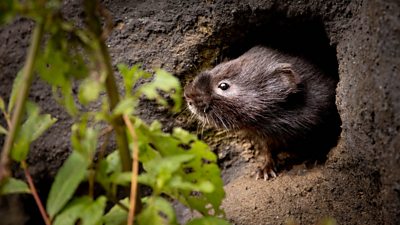
Following small animals has meant we’ve also made discoveries on our own doorstep in the UK!
Water voles have a reputation of living an idyllic streamside life style, an image made famous by the book Wind in the Willows, published in 1908, but Dr Xavier Lambin of the University of Aberdeen, who worked with the Big Little Journeys team, is challenging this notion.
It turns out that Britain’s shyest animal also lives a double life as one of its most adventurous, swimming huge lochs, scrambling up waterfalls and scaling mountains.
We worked with Xavier and a conservation project to film several individuals in order to reveal the extraordinary feats of Scottish water voles for the first time.
Watch Big Little Journeys from Sunday 8 October at 8pm on BBC Two and BBC iPlayer.
