Understanding audiences in wartime Ukraine
“When people flee their homes, and the power disappears, information becomes survival – especially digital information”

As a Ukrainian and a Senior Research Manager at BBC Media Action, understanding audiences and sharing this data with media outlets, I have seen first-hand how the conflict is changing the way people use media and the impact that is having on media outlets, large and small. It helps us understand what people watch, listen to or read, when and how often they do so, and which devices and platforms they use—from television and smartphones to websites, social media and messaging apps. It also provides vital demographic insights that inform content creation, media regulation and the evaluation of communication effectiveness.
At the same time, audience measurement functions as an independent industry standard and market currency, underpinning transparency and the value of advertising.
During war, its role becomes even more critical. Understanding audiences is essential for countering information warfare. Since the Russian invasion, audience measurement in Ukraine has dropped sharply and now covers less than 40% of the population—just as its importance has never been greater. I recently shared my experience on this challenge at the ASI International Television & Video Conference 2025 in Copenhagen.
Why audience media measurement matters in wartime
An audience measurement system is a complex, technology-driven research system that uses specialised tools to measure media use on a continuous basis—second by second, across multiple devices and platforms. It captures what people actually watch and listen to, rather than what they report. With participants' consent, data is collected passively through technology.
In any country, a transparent and trusted audience measurement system is the backbone of a healthy media market. It acts as a shared “currency” that allows broadcasters, advertisers and digital platforms to compete fairly, supports advertising revenues, strengthens independent media, and gives policymakers and donors reliable evidence for decision-making.
Changing media use - overnight
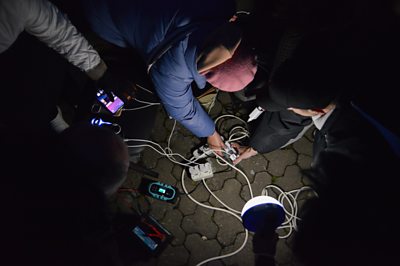
The war has fundamentally reshaped media behaviour in Ukraine, almost overnight. Frequent displacement, power outages and disrupted daily routines mean that people increasingly rely on smartphones and mobile internet to access news and information.
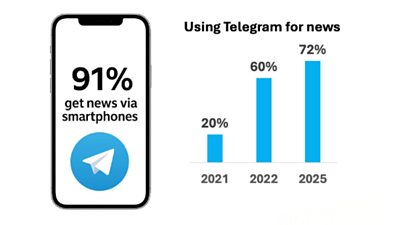
When people flee their homes and the power disappears, information becomes survival—especially digital information. Today, 91% of Ukrainians get news on a smartphone. For Ukrainians, that small screen has become an air-raid siren, an emergency lifeline, and a window to the world.
Media consumption has shifted quickly, from TV and websites to social platforms and messaging apps. Before the full-scale Russian invasion, only 20% used Telegram for news. One year later, it was 60%. Today, it is 72%. Telegram has become the main platform for news. And when the electricity goes out, the shift becomes even sharper. During blackouts in July 2024, TV ratings dropped by 43%.
When TV screens go dark, smartphones light up. And when power returns, people do return to TV, but the smartphone has now become the primary screen - anytime, anywhere.
This digital shift isn’t unique. It’s global. What is unique is the speed.
The Ukraine experience shows that in crisis – not only war, but hybrid threats, cyber-attacks, power cuts – media habits can change in weeks, not years. And measurement must keep up.
Toward a modern, resilient solution
So, what does media measurement look like in Ukraine now?
Historically, television viewing in Ukraine has been measured by a national TV panel. Before the full-scale war, this panel included nearly 3,000 households across the country and served as the market standard.
But today, that panel has shrunk to around 1,000 households, located only in large cities. This means that roughly 60% of the population— particularly those in small towns and rural areas — is excluded from measurement. Crucially, the system does not properly capture viewing on smartphones, laptops and tablets, which have become central to media consumption during the war.
As data quality has declined, trust in the system has eroded. There is also a real risk that the current measurement provider may withdraw altogether. Any modern measurement system must reflect this reality. Single-platform approaches, focused only on traditional television, can no longer capture how audiences actually behave.
The future of audience measurement in Ukraine lies in cross-media, people-centric approaches that work across all screens and devices. Smartphone-based or other portable measurement technologies are particularly well suited to wartime conditions, as they can follow users even when they move between regions and can capture real media use across TV, digital, social media and on-demand platforms.
Equally important is governance. Ukraine urgently needs representation of the whole media market, including public service and independent outlets, in a governing body that operates on clear principles of transparency, fairness and independence. Aligning with the European Media Freedom Act would also set clear expectations for audience measurement.
Without a modern audience measurement system, Ukraine risks falling behind—not only economically, but also in its ability to safeguard a pluralistic and resilient information environment.
In wartime, knowing who is reached, how people consume information, and which platforms matter most is not a luxury. It is essential.
Reliable audience measurement helps independent media survive, supports informed policy, strengthens market transparency, and ultimately contributes to democratic resilience.
For Ukraine, building a new generation of audience measurement is not just about data—it is about the future of its media system in the most challenging circumstances imaginable.
Latest news
Search by Tag:
- Tagged with InsightInsight
- Tagged with UkraineUkraine
- Tagged with Europe and CaucasusEurope and Caucasus
