| 24 September 2014 |

| |
| BBC Homepage | | |
| |||
| Contact Us | | |
AbolitionYou are in: Manchester > Abolition > Was Manchester built by slaves? 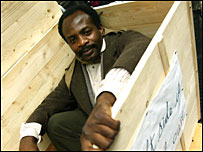 Actor Paul Etuka as Henry Box Brown Was Manchester built by slaves?Manchester: the world’s first modern city. It’s something of which many Mancunians are rightly proud. But, in truth, it’s a position in history that we owe to one commodity in particular: slave-grown cotton. ‘Was Manchester Built By Slaves?’ is the title - and central question - of a new website which seeks to explore the city’s particular relationship with slavery and the slave trade. 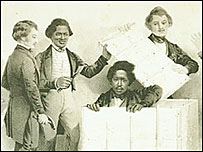 Illustration of Henry 'Box' Brown In 2007, the bicentenary of the Abolition of the Slave Trade Act prompted eight museums and galleries across Greater Manchester to do some soul searching in a joint project called Revealing Histories. They looked closely at the origins of many of the fine objects and buildings in Manchester - such as the Royal Exchange - to see how much of the region’s wealth was thanks to cotton grown by enslaved Africans. Their findings are gathered together in a free, interactive website that also encourages public debate on such uncomfortable issues as: Are Museums & Galleries Racist? And Should Britain Apologise? 'Box' BrownOne of the fascinating stories highlighted by Revealing Histories is that of Henry ‘Box’ Brown, an American slave who became famous for posting himself in a box to escape captivity and who eventually came to Manchester. 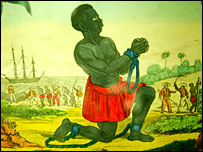 'The Slave' (People's History Museum) In 1849, Brown’s slave master in the state of Virginia refused to buy Brown’s wife and children when they were put up for sale. It was this that made Brown hatch a scheme to escape. After concealing himself in the box, Henry endured 27 hours travelling the 350 miles from Virginia to Philadelphia. The story of his journey to freedom caught the public's imagination and Henry became well-known, joining the abolitionist lecture circuit and calling himself Henry 'Box' Brown. In Britain he made a good living, touring with an exhibition called The Mirror of Slavery and lecturing for years about his remarkable story. In fact he was so successful that 1871 Census records show that Brown, along his English wife and their two children, was doing well enough to employ a servant at their home in Cheetham Hill! SlaverySpeaking at the launch of ‘Was Manchester Built By Slaves?’, Frankie Mullen, who led Revealing Histories, said: 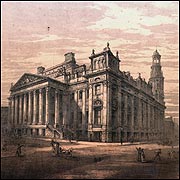 The Royal Exchange in 1855 “Slavery and the slave trade are intensely controversial areas, and we have designed the site to be as interactive and enabling as possible, giving people the tools and materials to develop their own ideas and arguments. We believe this website is unique in this respect. It is a very significant legacy for the project, and one which will grow and develop in years to come.” last updated: 21/07/2008 at 10:46 You are in: Manchester > Abolition > Was Manchester built by slaves?
|
| | About the BBC | Help | Terms of Use | Privacy & Cookies Policy |