![Emma Poulter [pic: Joel Chester Fildes]](/staticarchive/1e7d86133cdbc5f755b6963cfb0a8e7034d5693c.jpg) | | Emma Poulter [pic: Joel Chester Fildes] |
"I have always been fascinated by Museum objects and their stories. From November 2005 to May 2006 I was employed part-time as the research co-ordinator for the Revealing Histories project, working with a team of volunteers to unravel stories relating to slavery by examining objects in museums and galleries across Greater Manchester. "Most of these objects had never been on display before. This was an exciting and challenging project, entailing many hours talking to curators, looking at objects in museum and gallery stores, as well as reading old letters and other documents held in the numerous archives across the region. This research has enabled the story of Manchester’s complex relationship to slavery to be revealed, prompting further research as well as a series of exhibitions and other events on the theme." Here are just three of the fascinating stories revealed: The black servant who disappeared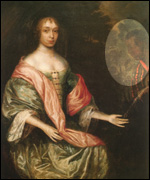 | | Butterworth portrait (c. 1660). Rochdale |
"At Rochdale Arts and Heritage Service, I came across two intriguing objects. The first was an old painting dating to around 1660 from Belfield Hall in Rochdale. This shows a young lady dressed in fine clothes: at her side a black servant pours water onto her hand. At the time this portrait was made black servants were used to show the social standing of Manchester’s wealthy families. However, by the late 1700s the abolitionist movement was growing in Britain and attitudes towards slavery were changing. It was probably around this time that the boy was painted over. It was only during conservation work in 1969 that he was rediscovered - a poignant example of the hidden histories surrounding slavery in the region." The Flour Barrel"A second object in the collections at Rochdale tells another side of the story. This is a large wooden barrel, imprinted with the words: 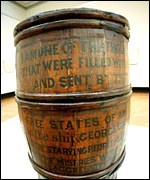 | | Flour Barrel (Touchstones, Rochdale) |
‘I am one of the thousands that were filled with flour and sent by the Free States of America in the ship George Griswold to the starving people of Lancashire whose miseries were caused by the aggressive and civil war of the slave owners in 1862-3-4’. " During the American Civil War the supply of cotton from the slave plantations of the southern states to Lancashire was severely restricted, as result many mills were closed causing great hardship for mill workers and their families. Despite this many people from Greater Manchester pledged their support for Lincoln and the northern states. To thank them, Lincoln sent a shipment of food supplies of which this barrel is probably the only surviving example. The barrel could also have easily been thrown away: In 1997, Curator Andrew Moore found it in pieces in a box in the museum store. It was only after he got it restored five years ago, that its full significance was revealed." Dresser's bird skins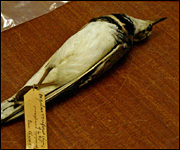 | | Killdeer bird shot by Dresser in 1864 |
"Whilst some objects we came across during the research have straightforward connections to slavery, such as sugar bowls, snuff boxes and other decorative art objects related to slave grown produce, other objects, although seemingly of little significance, on closer inspection reveal all sorts of relevant stories. One intriguing narrative is linked to a collection of birds. These were collected by Henry Dresser, a London merchant who went to Texas during the American Civil War on behalf of prominent Liverpool and Manchester merchants with a cargo of goods to trade for slave grown raw cotton. Research into Dresser’s time in America by curator Henry McGhie has shown that whilst in Texas, Dresser had some extraordinary encounters and collected 500 bird skins; his diaries and some of his bird skins from this time are in the Manchester Museum." Emma Poulter is studying for a PhD in Museology at the University of Manchester. She was the research co-ordinator for 'Revealing Histories'. See links for more info |