| 24 September 2014 |

| |
| BBC Homepage | | |
| |||
| Contact Us | | |
AbolitionYou are in: Manchester > Abolition > Revealing Histories 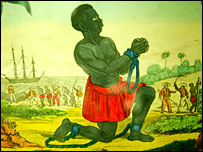 'The Slave' (People's History Museum) Revealing HistoriesIt’s a fact: Manchester was built on the back of slavery. In the 1700 and 1800s, slave-grown cotton fed the mills on which the city thrived. Yet Manchester played a key role in slavery’s ultimate abolition. So how do you tell this complex history? As the country marks 200 years since Abolition of the Slave Trade Act, a unique exhibition is being launched bringing together eight museums and galleries in Greater Manchester. By taking a fresh look at their collections, ‘Revealing Histories’ is an attempt to uncover the city’s complex involvement in the slave trade through the objects and artefacts: from Crompton's spinning mule to an American flour barrel inscribed with a thank you message to Rochdale mill workers for their support in the fight against slavery. Emma Walker of Revealing Histories said: "I was astounded by the connections Greater Manchester has with both the history of slavery and its abolition. I encourage anyone who would like to get involved to come along to one of the eight venues over the launch weekend (24/25 March) or to contact the project via the website." Here are just some of the objects and their fascinating histories: 1. Spinning Mule (1770s) – Bolton MuseumThe only surviving spinning mule made by its inventor Samuel Crompton. Crompton’s development of the spinning mule in 1779 revolutionised the cotton industry, spawning a cotton boom. And to feed the hungry cotton mills in Lancashire, a parallel slave boom occurred in the plantations of the Deep South of America. 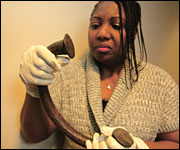 Manilla: slave currency 2. ‘The Slave’ print (c. 1820s) – People’s History MuseumAlthough the British slave trade was abolished in 1807, it was not until the 1833 Slavery Abolition Act, which granted emancipation in the British colonies, that all enslaved people were ‘set free’. This image of a kneeling African slave in chains is thought to be a reference to the continuation of slavery in non-British territories. 3. Manillas or ‘ring money’ (19th Century) – Manchester MuseumAn early form of currency in West Africa, brass manillas or 'bracelets' like these would have been exchanged for slaves, with a King manilla being worth one slave. A disturbing reminder of the monetary value placed on people used as slaves. 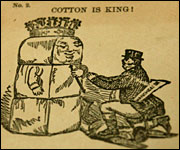 Satire: Manchester's links with slavery 4. Flour Barrel (1862) – Touchstones, RochdaleDespite the hardships, cotton workers in Rochdale supported the fight to end slavery by refusing to handle slave-grown cotton. Barrels like this were sent as food relief by the northern Union states in America to thank them for their support. This one is inscribed to ‘the starving people of Lancashire.’ 5. 'Cotton is King!' (1861) - MSIMAn envelope from the Union states of America satirising the willingness of Britain (in the form of John Bull) to ignore the plight of slaves in the southern states. John Bull kneels on the back of a prone slave and carries in his pocket a document labelled 'Manchester' denoting the link between the city and the cotton industry. The launch weekend for 'Revealing Histories' events is 24/25 March 2007 . For full listings, see web linkslast updated: 11/07/2008 at 18:02 You are in: Manchester > Abolition > Revealing Histories
|
| | About the BBC | Help | Terms of Use | Privacy & Cookies Policy |