| 28 October 2014 |

| |
| BBC Homepage | | |
| |||
| Contact Us | | |
Digital 60You are in: Manchester > Science > Digital 60 > Baby vs Horace Baby vs HoraceSo how far have computers come in 60 years? In other words: if 'Baby' was the world’s first modern computer in 1948, how would it match up to the most powerful machine in Manchester today? Step forward Horace - a Colossus of computers! 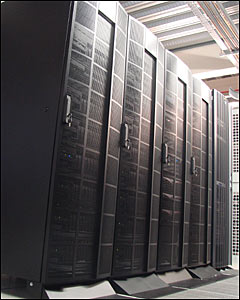 Horace: Manchester's most powerful PC Horace isn’t a supercomputer. But he’s pretty special. Horace is the University of Manchester’s single most powerful computer. Run and maintained by the Manchester Research Computing Division, this monster of information technology is housed in a temperature-controlled room in a building on the edge of the Science Park. As Manchester's most powerful computer in 2008, Horace is the current holder of Baby's crown. So how do the two machines compare? Check the specs - calculators at the ready! NB. Due to the charges in computer architecture and the way they’re built, it is not possible to do a direct comparison and it’s important to note that figures are not like for like. However, they give a rough idea of the vast explosion of computing power in the last 60 years: Baby• One processor Horace• 192 processors CalculationThe first program to run successfully on Baby, on 21 June 1948, was to determine the highest factor of a number ie. the highest number that will divide exactly into the first number. The original number used was quite small, but within a few days the team had built up to trying the program on 2¹ (2 multiplied by itself 18 times). The program tested each number down from 262,143 (2¹-1) to 131,072 (2¹), which is the initial number's highest factor. This meant that around 120,000 numbers were tested, which took about 2.1 million instructions. The correct answer was obtained in a 52 minute run. If the maths are right, Horace would perform the same task in 0.00000222857 of a second! last updated: 19/06/2008 at 16:55 SEE ALSOYou are in: Manchester > Science > Digital 60 > Baby vs Horace |
| | About the BBC | Help | Terms of Use | Privacy & Cookies Policy |