 | 28 October 2014 |

| |
| BBC Homepage | | |
| |||
| Contact Us | | |
PlacesYou are in: Manchester > Features > Places > A grand old gallery 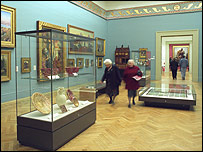 Manchester Art Gallery today A grand old galleryFor the past 125 years, Mancunians both rich and poor have been wandering through the doors of Manchester Art Gallery to marvel at and muse upon the exhibits within. To celebrates its milestone, we look at how the gallery came to be what it is today. The story of the Gallery starts not in 1883, as one might expect, but in 1823 with the proposal of a 'Manchester Institution for the Promotion of Literature, Science and the Arts'. 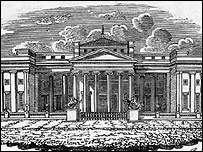 The 1826 drawing of the proposed building Manchester’s elite felt they needed a building which would provide exhibition space and lecture rooms to help produce a cultural boom to match the city’s growing wealth and economic importance. Such was the appetite for the idea that less than a year later, in January 1824, a huge £23,000 had been raised by public subscription to finance such a building. With funding in place, a competition was held to find a design for what was being called Manchester’s ‘temple to the arts’. Suitably, it was Charles Barry’s design that was the successful entry. Barry would later earn a knighthood for his work on the Palace of Westminster, but for Manchester, he chose a Greek Revivalist style, which not only fulfilled the aesthetic brief, but also hinted at a link between the independent democracy of Ancient Greece’s city states and the modern, trail-blazing Manchester. 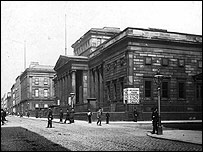 The Royal Manchester Institution in 1880 Work on the building began in 1829 and was completed in 1835, though the Royal Manchester Institution – as it came to be known after the patronage of King George IV was granted – had already started its collection, buying its first painting, James Northcote’s study of the black actor Ira Aldridge, 'Othello, The Moor Of Venice' in 1827. Interestingly, it’s thought that this purchase may well have been a political statement, prompted by Manchester’s place at the forefront of the anti-slavery movement. From the start, the building was open to the general public in an attempt to bring culture to a wider audience, though the entry cost of sixpence was a substantial outlay for the average working Mancunian. Art for the cityIn 1882, all that changed when the Royal Manchester Institution handed over their building and their collection to the Manchester Corporation on the condition that the city would spend £4,000 on art work annually for the next 20 years. 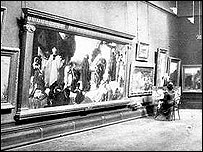 Inside in 1895 showing 'Captive Andromache' Those years saw a flurry of picture buying, with the purchase of several important works, not least of which was Ford Madox Brown’s monumental masterpiece, Work – an appropriate buy for the industrial city, given the picture’s cautionary tale of morality, society and politics. Indeed, Manchester’s taste for large pictures was such that it became common knowledge that the city’s Art Gallery Committee would be prepared to buy the biggest painting available at the annual Royal Academy exhibitions in London. In 1889, for example, the committee used their entire annual budget to purchase Lord Leighton’s 'Captive Andromache', outbidding both Birmingham and Liverpool to secure the piece. It was not only the committee’s purchases that bolstered the Gallery’s collections. Thanks to the bequests of wealthy Mancunians, the walls were filled with beautiful, powerful and significant works from the likes of JMW Turner and John Constable. Combining both ways of acquisition, the Gallery built up the basis of the collection that can be seen today. Growing the GalleryIn 1953, the closure of the Manchester Art Museum added yet more treasures to the Art Gallery’s already large collection. The museum was opened in 1877 by Thomas Horsfall, the son of a wealthy Manchester cotton merchant, with the intention of educating and inspiring the working classes. 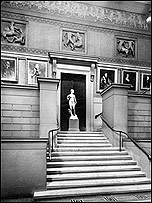 The main stairs in 1950 The museum passed into Council hands in 1918 so upon its closure, it was an obvious leap to amalgamate its collections, comprising of paintings, engravings, photographs, antiquities, ceramics, glass, metalwork, specimens of natural history and views of old Manchester, into the Art Gallery’s. It was not only Horsfall’s collections that bolstered those of the Art Gallery. Fittingly for a city so wrapped up in cotton and textiles, a costume collection was started in the 1920s, along with an industrial art one a decade later. These collections showed the Art Gallery’s commitment to more than just fine art and its attempt to reflect the city which it served. Gifts and clever buysWith limited funds in the immediate postwar period, the collections were shaped largely by gifts. 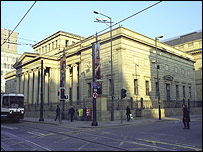 The Manchester Art Gallery (c) Len Grant There have been several major bequests since the Second World War, including Harold Raby’s donation of his entire collection of enamels in 1958, the Assheton-Bennetts’ gift of a magnificent collection of 17th century Dutch and Flemish paintings in 1979, and the founder of Granada TV, Lord Bernstein’s bequest of his fine art collection, including works by Lowry, Rowlandson, Daumier, Chagall and Modigliani. The creation of the charitable Art Fund in the 1960s also helped the Gallery acquire some of its high quality works, including Baccicio's ‘St John the Baptist’ in 1968 and George Stubbs' ‘Cheetah and Stag’ in 1970. Since then, many major acquisitions have been made with the assistance of external grants and the Friends and the Patrons of Manchester City Galleries, established in the 1980s. The modern gallery is bornAs the collections have grown, so has the desire to show them, which has meant a need for gallery space. Thankfully, that has been answered with relative ease. 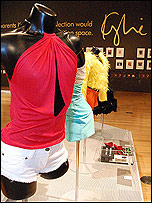 'Kylie: The Exhibition' in 2007 Either by chance or amazing vision, the City Council bought the land behind the Gallery in the 1890s, allowing for future extensions to happen unhindered. This was coupled later, in 1938, with the purchase of the Athenaeum – also designed by Sir Charles Barry and built shortly after the Gallery - which backed onto the building. The Council had originally planned to build a new gallery in Piccadilly Gardens, but these plans fell through, meaning that an extension to the existing gallery was their best way forward for extending the city’s exhibition space. That extension and the linking of the two buildings have only happened recently, with the new linking atrium and refurbishment of both buildings being completed and opened in 2002. This new space has allowed the Gallery to show more of its own collections and house travelling exhibitions, such as the hugely popular 'Kylie: The Exhibition' last year. Ever vibrant, ever progressive, the future of Manchester Art Gallery looks like being as interesting as its past. Here’s to another 125 years of Mancunian art appreciation. last updated: 28/03/2008 at 16:54 You are in: Manchester > Features > Places > A grand old gallery [an error occurred while processing this directive]  Remembering the Munich air disaster |
| | About the BBC | Help | Terms of Use | Privacy & Cookies Policy |
