| 24 September 2014 |

| |
| BBC Homepage | | |
| |||
| Contact Us | | |
History featuresYou are in: Manchester > History > History features > Sir Charles Hallé 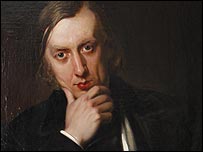 Sir Charles Halle by Victor Mottez Sir Charles HalléAs the Hallé Orchestra celebrates its 150th anniversary, we look at the life of its founder. - Karl Halle was born in Hagen, Germany on 11 April, 1819. - Having studied music in Germany, Halle went to Paris in 1836. In his 12 years there, he studied and conversed with such musical luminaries as Luigi Cherubini, Frédéric Chopin and Franz Liszt, and was friends with the writers, Alfred de Musset and George Sand. 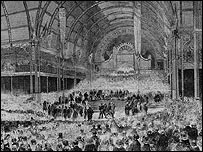 Hallé performs for Prince Albert in 1857 - He left Paris in 1848 after a revolution in the city, settling with his family in London. - After coming to England, he changed his name to Charles Hallé, adding the accent to the e of his name to stop people calling him Hall. - His first public performance in England was at Covent Garden Theatre, where he performed Beethoven’s E flat concerto. - Charles Hallé arrived in the North-West after accepting an offer to run Manchester's Gentleman's Concerts, which had its own orchestra. Apparently, the orchestra were so bad, he almost gave up the post and returned to Paris. 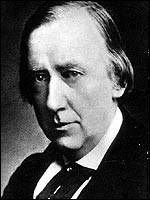 Sir Charles Hallé in 1868 - His first residence in Manchester was at 3 Addison Terrace in Victoria Park, a house he rented for £12 a month. - The Hallé orchestra grew out of Charles’ involvement with Art Treasures of Great Britain, the biggest single exhibition Manchester has ever hosted, in 1857. He was asked to put together a small orchestra to play for Prince Albert at the opening ceremony. Hallé duly obliged and decided he liked the idea so much that he kept his band of musicians together, forming the fledgling orchestra. - In 1862-3, he gave the first known cycle of Beethoven's piano sonatas. - His performances were attended by Manchester’s elite, including Elizabeth Gaskell, who lived near Hallé on Plymouth Grove. In fact, Hallé taught one of Gaskell’s daughters to play piano. 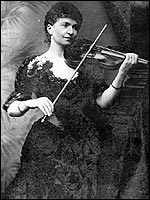 Lady Hallé - In 1888, Hallé married for a second time to Madame Norman Neruda, who was regarded as one of the finest violinists of her time. - He was knighted in the same year. - In 1890 and 1891, Hallé and his wife toured Australia - In 1891, he helped to establish the Royal Manchester College of Music, where he served as head and chief professor of pianoforte until his death in 1895. - He died in Manchester on 25 October, 1895 - His own, incomplete autobiographical account of his life was published in 1896. - He is buried in Salford’s Weaste Cemetery, which celebrated its own 150th anniversary last year. - There is a road named after him in Hulme and two blue plaques marking his homes in Manchester - at Duxbury Square in Moss Side and Addison Terrace in Victoria Park. last updated: 19/03/2008 at 15:28 SEE ALSOYou are in: Manchester > History > History features > Sir Charles Hallé   |
| | About the BBC | Help | Terms of Use | Privacy & Cookies Policy |