It seems like a massive statement to make, but the influence that the look of Factory and Saville's subsequent work has had on the world of corporate graphic design, the world of logo and brand, is probably even larger than the sound of Factory had on music. 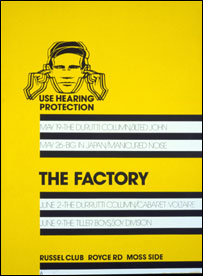 FAC1 FAC1 |
Born in Hale and a graphic design graduate of Manchester Polytechnic, Saville's desperation to follow his schoolfriend and Buzzcocks designer Malcolm Garrett brought him to the door of Tony Wilson in 1978, who commissioned a poster for his new club night that he was putting on with Alan Erasmus. The poster arrived late, but the design was so good that it is an image that still reverberates around Manchester (the now legendary FAC1). The trio went on to found Factory Records the following year and Saville moved to London to become art director at Virgin Records subsidiary, Dindisc. The new decade brought the collaboration with Ben Kelly on Factory's boldest statement, the Haçienda and in 1981, the work for which Saville would become best known, his New Order projects, begins with Movement. 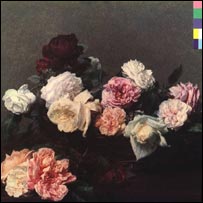 Saville's favourite cover, New Order's Power,Corruption and Lies from 1983 Saville's favourite cover, New Order's Power,Corruption and Lies from 1983 |
By the mid 80s, both his design within Factory and the wider music world were being noticed globally, and he was working with mainstream artists like Peter Gabriel and Wham! He was working for his own company, but his creative mind was being constrained by music, and he cast his eye further across popular culture. Alongside the record sleeves, he was asked to create identities for Edinburgh's Fruitmarket Gallery, London's Whitechapel Art Gallery and Centre Georges Pompidou's Magiciens de la Terre exhibition in Paris, and work on campaigns for Japanese designer Yohji Yamamoto. 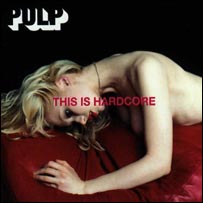 Pulp's This Is Hardcore (1998) Pulp's This Is Hardcore (1998) |
The happy times couldn't last, and by 1991, financial problems had forced him to close his studios and, as Factory collapsed under massive debts, Saville tried his luck in America, accepting a position with Frankfurt Ballard advertising agency that would show him within 12 months how ill-suited he was to the structured world of corporate work. 1995 brought his 40th birthday and Saville had misgivings about continuing his work in music. He felt uncomfortable about designing youth oriented products, like albums and singles, and creatively frustrated by the limited canvas offered by compact discs. Despite this, he still produced exciting sleeves for Suede and Pulp. 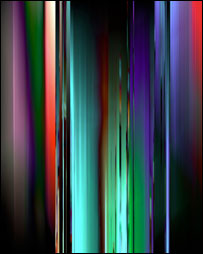 Waste Painting No. 2 (1998) Waste Painting No. 2 (1998) |
But his move away from music was accelerating, and he increased his presence in the fashion world at the turn of the millennium with consultancies for Givenchy, Pringle, Selfridges and Stella McCartney, before having the realisation that he had finally become a brand himself last year. This epiphany has released Saville from his corporate shackles, and while he continues to design record sleeves, work with fashion designers and the like, the future will be more about designing for the Peter Saville collection than designing for anyone else. He says himself that he is not becoming an artist, but chances are that increasingly, the place to see Saville's work won't be on a shelf or in a record shop, but on the walls of a gallery. In a nutshell... - The Peter Saville Show is at Urbis from Jan 23 to Apr 18. Admission is £5.
What do you want to do now? The BBC is not responsible for the content of external websites. |
|  |



 Who is Peter Saville?


 Powerhouse -Watch again