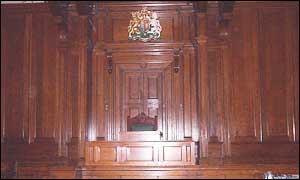
"Of all the famous trials that were heard in St George’s Hall in Liverpool, the case that lingers in the mind of people to this very day was the story of Florence Maybrick in 1889.
She stood trial for the murder of her husband, James Maybrick. Florence was a southern belle from Alabama, and James Maybrick was a Liverpool cotton-broker, 20 years older than Florence. Maybrick was obsessed about his health, he was a hypochondriac and he purchased arsenic on a regular basis. 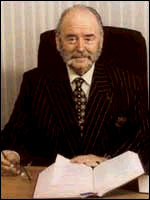 | | Vincent Burke |
James Maybrick also had a mistress in London.The relationship between Florence and James deteriorated and was accelerated by Florence meeting another man in her life. Florence purchased 12 dozen fly-papers, soaked them to obtain from them arsenic, claiming later it was for her complexion. Maybrick’s health deteriorated rapidly and he finally died. They discovered at the autopsy a presence of arsenic in his system.
Florence stood trial at St George’s Hall on July 1899 and was found guilty of murder and sentenced to death. She was reprieved at the last moment and served 15 years’ imprisonment. Mr Justice Steven, who presided at the trial, seemed to be trying her along with the jury for adultery rather than murder because the evidence against her was wafer thin because of course Maybrick had taken arsenic himself. This is regarded as one of the most famous cases of a miscarriage of justice and remains a concern to crime historians to this very day. Florence Maybrick was extremely fortunate and her life was saved by having as counsel Sir Charles Russell, who believed in her innocence and during the long years of 15 years imprisonment he visited her on a regular basis, pleading constantly for her to be released. Liverpool’s St George’s Hall has seen the presence of some of the greatest counsel this country has ever produced. Marshall Hall, Sir Patrick Hastings, F.E. Smith, the local man, who rose to be Lord Chancellor. Charles Russell certainly compared favourably with any of them and I believe Florence owed him a great debt for believing as I believe that she should never of been convicted for this murder. On her release, after 15 long years, she returned to her native America, wrote her life story and died in 1941. She returned to this country once and that was to see the Grand National. " |