 |
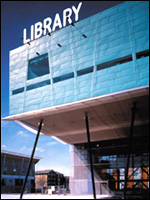
| Alsop's Peckham Library - Stirling Prize Winner 2000 |
Despite fierce competition from the likes of Sir Norman Foster, Sir Richard Rogers and Edward Cullinan, the Alsop scheme was chosen to sit alongside the existing Liver, Cunard and Port of Liverpool buildings.
The trio have become symbolic of former maritime wealth and civic pride throughout the cash-strapped 1980s.
Having won the Building of the Year award in 2000 for the striking, stilt-walking spaceship that is Peckham Library, Alsop's designs punctuate a global landscape with colourful, eye-catching yet practical alternatives.
Projects such as the Ontario College of Art & Design (a checkerboard monolith that hovers between Toronto streets and sky, supported by giant, rainbow knitting needles) provide a welcome foil to the drab sameness that swamps cities in a slurry of grey concrete and dull brick.
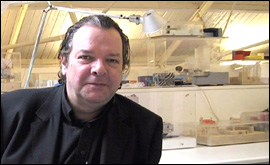
"We can see from history that we [architects] have the capacity to make life really miserable, and we've had enough of that thank you," says Alsop amidst the bustle of his Battersea studio.
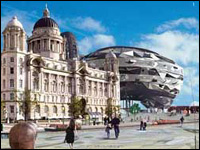 |
| Impression of the future esplanade |
"But there are some, and I hope I can count myself among them, that actually bring a little joy and delight into the world."
In describing the development process Alsop insists upon involving local community members from the earliest stages through to completion; young and old, although a minimum drinking age may be required...
"Wine or beer are usually involved, as is painting, drawing, describing and listening to each other," he says with a smile, eager to massage thoughts and opinions from his partly-pickled contributors. At least it makes a change from a suggestion of truth-or-dare.
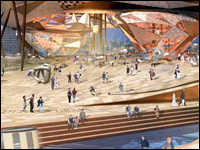 |
| Piazza outside the Fourth Grace |
"I try and create a sense of being at a party.
"It seems to me that what you build is the result of a process, and if the process is boring, the results are going to be boring. If it's exciting and enjoyable, then you might end up with something optimistic."
On the basis of this argument it would seem the citizens had a ball if what Emma Bockes writing for The Guardian describes in awestruck tones as a 'diamond knuckle duster' is anything to go by.
Yes it's bold, in-your-face and nothing like the more ornate neighbours. But without brave and arguably beautiful projects such as this, cities wither and die.
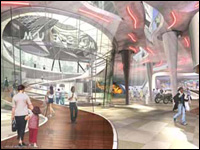 |
| Artist impression of Fourth Grace interior |
Progress, change and possibility are the lifeblood of any metropolis.
In rejecting this for a mock-Tudor vision of Britain, composed of miniature St Mary Meades (home of Miss Marple), not only will murder mysteries reach epidemic levels but Liverpool will lose out to Manchester, Glasgow, Newcastle and the punchbag that is London.
All are cities committed to a new architectural rennaisance led by landmark projects such as this.
"I don't think any other city in Western Europe declined to the same degree as Liverpool," says Alsop of the economic and cultural stagnation to afflict the region in recent decades; now finally on the turn.
"If you take the peak of its history, its extreme wealth and civic pride, all of those things which it had... to fall to such an extent was a scandal."
 | "Of course Liverpool is doing well - compared to 20 or 30 years of complete rubbish."
Click here to listen |
His practice is currently involved in the large scale redevelopement of huge swathes of the Northern England. Bradford city centre is about to combine an unrivalled, classical heritage with a dramatic step toward achieving urban vim. A manmade lake, no less!
Even Barnsley is queuing up for a new slap of warpaint, although city planners are erring over Alsop's typically exuberant proposition: to recreate an Italian hill town including inhabited 'city wall' of a mile-and-a-half circumference.
And why not?