Sikhism is the fifth largest religion in the world, and half a million Sikhs live in UK. Leicester is home to nearly 11,800 of them, but how much do you know about what it means to be a Sikh? BBC East Midlands Today takes a look at the Sikh faith, starting with the five Ks...Sikhs have a distinctive appearance due to a set of items that are meant to link the individual to the community and to God. They are known as the five Ks: 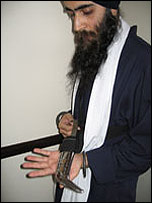 | | A Sikh man with the holy dagger, the Kirpan |
- Kesh (the uncut hair) - a sign of completeness and saintliness
- Kangha (the comb) - a sign of cleanliness and used to remove dead and broken hair from the scalp, once in the morning and once in prayer
- Kara (the steel bracelet) - a sign of restraint and gentility and that the Sikh is linked to the Guru
- Kachera (the shorts) - a sign of modesty and worn by men and women
- Kirpan (the sword) - a sign of fearlessness, righteousness and freedom that is worn by men and women, but is only allowed to be used as a last resort for defensive purposes.
Watch the second part of BBC East Midlands Today's series, looking at the langar and Sikhism's relationship with the environment...The Langar is an open kitchen found in all Gurdwaras, which provides free vegetarian meals after Sikh services. The concept of the Langar was started by Guru Nanak, and it is based on the principles of charity and fellowship. 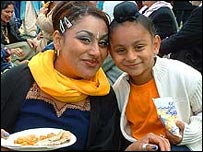 | | Sharing food at the langar |
The food is eaten sitting on mats on the floor to symbolise the denouncing of rank - everyone is equal. The story behind Langar is that Guru Nanak's father gave him 20 rupees to do business, but he came across some hungry people who needed food and he spent all of his money feeding them. Sikhs believe that those 20 rupees multiplied into millions, so it is from this first act of generosity that everyone is fed today. Read about the Langar organised by students at the University of Leicester, only the second ever university-based Langar in the country:Food, protection and shelter are themes that occur throughout the Guru's teaching. Inspiration for these ideals is taken from the environment, and trees have special significance: - Trees provide shade for weary travellers - Sikhs believe a person should provide comfort for others
- Trees often have beautiful flowers - Sikhs believe a person should have good characteristics that will attract other people to be around them
- Trees bear fruit that a hungry person can eat - Sikhs believe that a person should bear the fruits of God's knowledge so that others can benefit from that knowledge in the future.
Watch the third part of BBC East Midlands Today's series, which discovers how one local man upholds the values of Sikhism both in his spiritual and daily lives...| "It's actually just a fantastic role, in that it fits in with the religion...that's like defending yourself, your family and your community." | | Amarjit Singh Sanghera, Police Community Support Officer |
Amarjit Singh Sanghera is a Police Community Support Officer. As a baptised Sikh he feels it is his duty to adhere to the ideals of Sikhism, like serving the community: "It's actually just a fantastic role, in that it fits in with the religion...that's like defending yourself, your family and your community, and that fits in really really well with the police role. I'm really thrilled with the role and I enjoy what I do for the community." The Sikh faith also says that if a person is weak or vulnerable it is a Sikh's duty to protect them in any way, and Amarjit is pleased his job allows him to do this. Sikh FestivalsOn 5 January Sikhs celebrate the birthday of the tenth Guru, Govind Singh Ji. It's one of the holiest days in the Sikh calendar, as Guru Govind Singh Ji played a monumental part in the development of Sikhism. BBC Leicester's Natalie Martin went to Guru Nanak Gurdwara in Leicester to find out more about how Guru Govind Singh Ji's birthday is marked...Guru Govind Singh Ji was one of the founders of the Sikh faith, and it was on his instruction that Sikhs wear the five Ks. 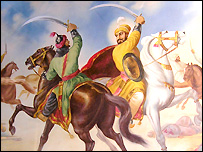 | | Guru Govind Singh Ji in battle |
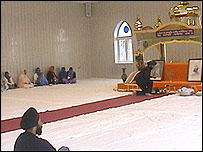
He was the last human Guru, and on his death he nominated the Sikh scripture, which is called the Guru Granth Sahib, as the next Guru. The holy book is treated by Sikhs as a human Guru, and is deeply loved and respected. On Govind Singh Ji's birthday, Sikhs go to their Gurdwara and eat and pray together. The elders teach children about the significance of the day and donations are brought to the Gurdwara. It is an important social gathering as well as a holy day. VaisakhiAnother of the biggest festivals in the Sikh calendar is Vaisakhi, which marks the beginning of the Punjabi and Nepali New Year. It is celebrated on 13 or 14 April and also commemorates 1699, the year Sikhism was born as a collective faith. There are often parades through the streets and Sikh families will attend their Gurdwara. BBC Leicester's Nancy Cole went to a Gurdwara in Leicester to find out what goes on there to mark Vaisakhi...When a person arrives at the Gurdwara the first thing they are asked to do is cover their head, and then remove their shoes. Next, they must wash their hands because they've touched their shoes, and then wash their feet. Sikhs follow this code as a mark of respect and to keep the scriptures fresh in their minds. On Vaisakhi, Sikhs will go upstairs to the divan hall, which is where the Guru Granth Sahib (Sikh scripture) resides and where Sikhs pay their respects. The room is adorned with decorations and there is a throne for the holy book as it is regarded with so much respect. When Sikhs enter the room they kneel on mat and touch their forehead to the ground. They will then greet the assembly, walk around the holy book and then take their seat on the ground with everyone else. Everyone then eats before they begin their worship. Street paradeOn Vaisakhi, Sikhs also parades through the streets in traditional yellow and blue dress. BBC East Midlands Today went along to two Vaisakhi street parades in the East Midlands...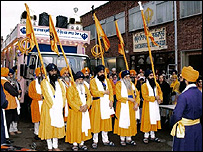 | | Vaisakhi procession through Leicester |
Thousands of people turn out for the street parades, which often visit all the Gurdwaras in the city. Leicester's Vaisakhi street parade took place on Sunday 22 April 2007, and travelled from the Guru Nanak Gurdwara on Holy Bones to the Guru Tegh Bahadur Gurdwara on East Park Road. Take a look at the photographs of Leicester's 2007 Vaisakhi parade...It attracted even larger crowds than in Derby and Nottingham, as Leicester has the largest Sikh community in the East Midlands. |