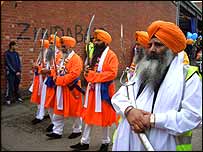
This year was extra special as it was the 20th Anniversary of the parade through Leicester. Take a look at our gallery of the parade...The procession wound round the streets of Leicester starting from the Guru Nanak Gurdwara (temple) in Holy Bones, and made its way to the Guru Tegh Bahadar Ghurdwara on East Park Road via the City Centre. | "I was amazed at the level of skill these students were able to convey of their religious heritage." | | Dharma Panchal |
Heading the procession were the Panj Piaras (Five Beloved) traditionally dressed each carrying the flag of Sikhism. People young and old participated in the walk, it was fantastic to see diversity shared by so many as new faces joined in and celebrated. Festival backgroundPeople of Leicester were amazed at how large the festival had grown since it started in 1986 with a gathering of less than 1,000 Sikhs. 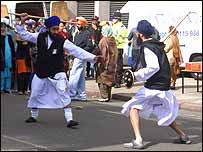 | | Sword fighting |
Twenty years on and the festival is well established in the fabric of Leicester’s multi-cultural city. Vaisakhi, also known as Baisakhi, is the holiest day in the religious calendar for Sikhs as it celebrates the establishment of the Khalsa (universal personhood), in 1699 by the 10th Guru, Gobind Singh, and the Sikh New Year festival. Sword fightingAt stages of the walk demonstrations of sword fighting took place. I was amazed at the level of skill these students were able to convey of their religious heritage. For the Sikh community the New Year represent a time of rebirth, renewal, equality and strength. 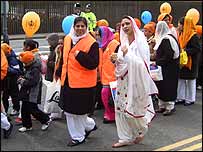 | | Women and children in the parade |
Khalsa was established to bring national sovereignty, to demolish walls of prejudice, man and man, woman and man, religion and religion, bringing down the barriers, and creating a peaceful community by which all can live together. To sum up...The organisation was outstanding, volunteers served food and drinks to both spectators and those celebrating. Onlookers viewed the procession with interest, taking photographs and video clips with their mobile phones, as the float sang loud and the people marched with honour and pride. The Sikh New Year, Vaisakhi, this year takes place on 13 April |