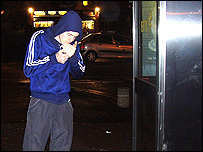
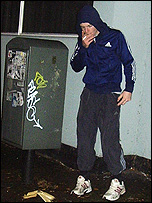
'Badge of Honour'According to Home Office figures, 4 in 10 of those ASBOs were breached. According to slightly less official sources, an ASBO has become, to some at least, tantamount to a 'badge of honour'. They are fast becoming an intrinsic part of 'chav' culture. Clearly, ASBOs are not having the desired effect in all cases. So, whilst the government get on with consulting their drawing board, I think it is about time someone asked the teenagers (you need only be 10 years old to get an ASBO you know) what they think. Point of View: TeenagersMy interviewees were a group of Year Nine students from Heathfield High School and Winstanley Community College. I asked them what would deter them from behaving in a way that might attract an ASBO. There was no shortage of suggestions, from the extreme (corporal punishment, interrogation and national service), to the more sedate, such as community service orders. The teenagers were just as forthcoming with ideas when I asked them how they would intend to enforce something like a community service order. In a similar vein to recent anti-truancy measures, they suggested making the parents suffer repercussions. They also suggested giving offenders fines that they would pay back when they reach 18, or could then alternatively repay by undertaking community service. Sound suggestions? These teenagers certainly seemed to have well-considered and perceptive solutions. Point of View: ExpertsHowever, there didn't seem to be any harm in getting a second opinion, so I talked to an expert, Roger Smith. As well as being a professor at De Montfort University, Roger Smith has previously been a probation officer, written books and articles on youth justice and is a member of ASBO Concern, an alliance of people with concerns over the use of anti-social behaviour orders. | "Is it fair to hold parents to ransom? Is it always their fault?" | | Dr Roger Smith, De Montfort University |
On the surface, there didn't seem to be much common ground to be found between the teenager's suggestions and what works in Professor Smith's experience. In response to the proposal of slapping fines or some kind of community service debt on offenders, he pointed out that a similar system of fining or giving points to speeding drivers doesn't always seem to work as a deterrent, so why would it be any different here? Professor Smith went on to point out that a fine, particularly one that doesn't have to be repaid until the age of 18, doesn't make a connection between the crime and the solution. In relation to the idea of introducing repercussions for parents he asked: "Is it fair to hold parents to ransom? Is it always their fault?" Professor Smith went on to say: "This is not just a one shot approach. You have to look at the reasons." "A knee-jerk reaction"ASBOs give offenders recognition. The point Roger Smith makes is that if offenders are lacking positive recognition in their lives, then the fact that ASBOs have become badges of honour to some is understandable. This reminded me of an interesting point that one of the school children I spoke to made. He said that he didn't really feel the need to undertake any antisocial acts as he was too busy at after-school societies and sports clubs. Professor Smith was keen to advocate more practical solutions to the ASBO debate, such as sending young offenders on programmes where they do a variety of activities every day. He said that more positive results could be achieved from diverting government money in this direction, rather than it "being spent on pleasing the public with a knee-jerk reaction to social unrest." Surely this teenager I spoke to is a perfect example of this kind of thinking. "No quick fix"Perhaps we should be showing more patience towards people submitting to antisocial behaviour. However, if the kids on your road keep smashing up the bus stop, patience quickly wears thin - this is the dilemma facing the government. Clearly there is no quick fix. Personally, with the power of the ASBO seemingly on the wane, I think it is time to give the heavy hand of the law a rest, and offer a fair chance to the alternatives. |