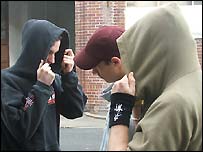
ASBO stands for anti-social behaviour order. According to the Crime and Disorder Act 1998 they're issued for behaviour which causes harassment, alarm or distress to one or more people who are not in the same household as the person the order’s against. Graffiti, abusive and intimidating language and dealing drugs are some of the forms that anti-social behaviour can take, and punishments range from prohibiting a person from going to a certain area to ordering them not to shout or swear at their neighbours. So why are ASBOs being seen as a badge of honour? BBC Radio Leicester's Helen Babbs went to talk to some young people in Leicestershire about anti-social behaviour and the perceptions of older people…Nathaniel, 15, from Leicester says that some people see an ASBO as a symbol of being tough: "If you’ve got a couple of ASBOs, some people see them as a badge of honour because they're like 'Yeah I'm big – I wanna always be known as a big man.'" He thinks that the Government should invest more money in amenities for young people, but can understand why it sometimes doesn't happen. | "If you've got a couple of ASBOs, some people see them as a badge of honour because they're like 'Yeah I’m big – I wanna always be known as a big man.'" | | Nathaniel, 15, Leicester |
In the area where he lives, as soon as a new facility arrives, it's destroyed: "We got a half pipe put in the park. Someone came and got a chainsaw and put a hole in the side of it and in the top of it, so people can't use it. What's the point in giving people something if they're just going to disrespect it?" However, Nathaniel doesn't think that it's fair that all young people are tarred with the same brush. He says that older people view young people as "one threat", and says that teenagers shouldn't be stereotyped as a troublemakers or gang members just because they're wearing a hoodie or baseball cap. Helen Babbs had a chat to Jane Melville, the Prevention Manager for the Leicestershire Youth Offending Service.Jane agrees with the argument that older people should not generalise about the behaviour of youngsters. She says that only a small proportion of young people are misbehaving, and the majority are conducting themselves in an acceptable way. For the few that are causing the problems, Jane thinks that they need to be educated about the effects of their behaviour. They might not realise that some people are frightened by what they're doing, and need to realise that they have a responsibility not to intimidate those around them. |