To the Greek refugees who founded Syracuse in 734BC, the town must have seemed like paradise. With its natural port, one of the biggest in the Mediterranean, abundant water and fertile land, it was certainly very attractive.
Today one of the most impressive testaments to the Greek presence in Syracuse is the magnificent Greek amphitheatre, which is still being used for performances today.
The present theatre was built in the 3rd century BC, by Damacopos, although some sources suggest that another theatre had existed in the same place since the 5th century BC. Angela Barbagallo, of the Fondazione Istituto Nazionale del Dramma Antico, a national organisation for the promotion of classical drama, explains that the open-air theatre played a crucial role in the religious and social life of Ancient Syracuse. And it was important on an international level too: Aeschylus' Persians was premiered here.
And today they're still packing them in. As well as visiting foreign tourists, enchanted by the beauty and majesty of the location, audiences include students from all over Italy and fans of classical theatre of every age. As evening falls, casts and crews of the dramatic amphitheatre recreate the magic that filled the theatre over one thousand years ago.
Under the setting sun, with pine trees looking over the painted backdrop of the circular sand stage, the present seems far away, and the essence of the story takes centre stage.
Performing in the theatre in the summer of 2000 is Elisabetta Pozzi, one of Italy's leading actresses, who is taking on the role of Euripides' tragic heroine Electra. For her, performing here in Syracuse is an experience like no other. She attributes the special atmosphere and intensity felt by the actors working in the space to the human wall of people that encircle the stage. The thousands of pairs of eyes focused onto that one area create, she says, a physical feeling of shock for the actors, a feeling she believes is shared by the audience who themselves appreciate the special nature of the performance.
Electra performed here, and Electra in another, smaller theatre, she says, seem so dissimilar as to be different works. Here, in Syracuse's great amphitheatre, the full, dramatic character of grand classical theatre is developed to its fullest.
Links
The Amphitheatre
Read up on the history of the Amphitheatre.
Theatre Guide
Find out about the works performed at the famous theatre.
Siracusa
Italian language site of the town with links to the theatre and other famous monuments.
These links do not constitute an endorsement by the BBC of the companies, their services or products. The BBC is not responsible for the content of external sites. 




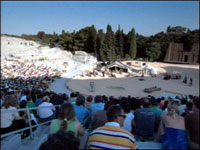 The Greek amphitheatre