Today most of this work is undertaken by specialist picking machines or by foreign students who are accommodated in bunkhouses on the farms.
In previous times it was the Gypsy Travellers who provided much of this workforce, moving from farm to farm throughout the summer picking cherries, strawberries, blackcurrants, peas and beans.
Then in September it was hop picking followed by top fruit and finally potato picking-up before finding a place to stop for the winter.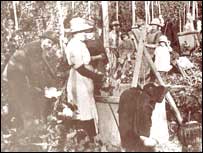 | | 19th Century hopping |
But it was Kent's most famous crop, the hop, that required the biggest army of temporary workers. It had been introduced to the county during the 16th century and by 1724 there were 6,000 acres of hop gardens in East Kent alone.
In common with many crops, they needed special attention at certain times so it was not just at picking time that hop growers required extra labour.
Hops don't naturally find their way up the strings and so in springtime the new shoots have to be 'trained' or 'twiddled' to encourage them to climb.
This was a considerable task that had to be undertaken within a comparatively short period and it came at a time in the spring when there was much else to be done on the farm, keeping the locals busy.
So across the county, the Travellers pulled on to the hop farms to do this first seasonal job of the year that required an additional work force. When it came to harvesting the bines an even bigger workforce was required and although it is well known that Eastenders from London came in their droves for the annual hopping, at the end of the last century they only represented a third of the 250,000 necessary pickers.
In addition to the 'home dwellers', the bulk of the rest were itinerants and Travellers from as far afield as Ireland. For the local Romany Gypsies hopping was it was an important source of income. The glorious days of hand hop picking finally came to an end during the 1960's after a period of intensive agricultural mechanisation that had begun during the second world war. |





 Hartlake memorial:hop picking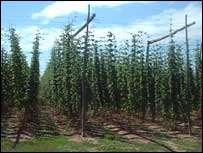
 When the spring come we'd come up and do the hop training, we used to dress them first, used to have the hoes and knock them out you know and cut them off. Then we used to hang on until the hop training, after we'd done the hop training we'd just run up the Derby and then we'd come back and go cherry picking.
 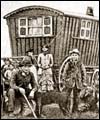 We used to go from one job to another, do the summer's work right through and then we'd get to the hopping. After that we'd got a job of apple picking and then when they'd finished about November or something we used to go potato picking up, we used to pick them up a shilling a bag.