 | 28 October 2014 |

| |
| BBC Homepage | | |
| |||
| Contact Us | | |
Great Storm 1987You are in: Kent > Weather > Great Storm 1987 > "We were stuck for about 6 hours" 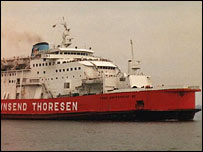 "We were stuck for about 6 hours"The cross Channel Ferry Free Enterprise V was the last to leave Dover harbour that night. Confronting huge seas and winds of up to 150 mph, Master of the ship Tony de Ste Croix was forced to sit it out... "I was on nights on the P&O ferry Free Enterprise 5...Joining time was 2030 that evening. Prior to leaving home in Hawkinge that evening I watched the weather forecast on BBC.
When I saw the synopsis chart and heard Michael Fish say that there was not going to be a storm I said to my wife that I felt that we were in for something a little more severe than he had forecast. I joined the vessel along with the rest of the crew at 2030 hrs. It was fairly windy at the time, SW'ly 35 knots with a forecast of SW'ly 7/8 possibly 9. We completed the first round trip to Boulogne wthout incident and reasonably on time. I was on the vehicle deck at 0300 prior to the next sailing at 0330 when one of the government census ladies (they travel on board from time to time and ask passengers questions, the government compile tourist statistics from the answers) walked on board. She asked me what the conditions were likely to be during the round trip to Boulogne, as they would not have to travel if conditions were likely to be too rough and the vessel delayed. I said that the wind was 40 knots at the time and that it was likely to increase, but the weather would not be too severe. They decided that they would travel. My ship was in no. 2 berth, and at that time we berthed bow in at nos. 1 and 2 berths. The method of leaving the berth was to steam stern first from the berth out into the middle of the harbour and then bow first out through the Eastern entrance. At sailing time 0330 we were all ready to sail from no. 2 berth. The second officer was stationed aft on the after mooring deck. He kept me advised of distances from objects astern as it was not possible to see directly astern from the bridge. This was standard practice. Just prior to leaving the berth I asked Dover Port Control what wind they had. They stated SW'ly 35 gusting 45 knots. Good enough for me I thought. As I manoevred the vessel astern and the stern cleared Pier A, the second officer screamed down the microphone to the bridge that he could no longer stand up. Wind must be getting stronger I thought. As I steamed full astern out into the centre of the harbour another vessel outside asked port control for the wind. Port control said that it was 100 knots plus and the port was closed. Too late for me, the only way was out. I steamed out through the Eastern entrance with all 3 engines at full ahead. Once clear of the entrance I turned south westerly towards Boulogne. The sea developed very rapidly and I was only able to proceed a couple of miles. I then hove to with the bow into wind, all three engines on half ahead but not making any headway. To try to make headway would have damaged the vessel. We remained in the same position for about 6 hours, bow on to mountainous seas. I had a total of 23 passengers on board. I invited them all onto the bridge from time to time (no terrorism in those days) so that they could see that although it was very rough, it was perfectly safe (probably safer than being ashore as it turned out). I also allowed them all to phone home on the ship's VHF to advise friends and family that they were safe, but would be rather late. (no mobiles in those days). They all loved it. After about 6 hours the wind started to abate and we were able to make steady headway. We arrived at Boulogne at about 1200 hours. The wind had abated to about 60 knots by that time but it appeared like gentle zephyrs after what had gone before. At it's peak it had gusted to 135 knots on the ship's anemometer. When we docked back in Dover at 1600 that afternoon I decided to drive along the coast road to look at the Hengist which had beached just east of Folkestone. I had been listening to the events on the Hengist on the VHF whilst I was hove to. That ship had a very lucky escape. It could easily have been an absolute disaster." last updated: 11/10/07 You are in: Kent > Weather > Great Storm 1987 > "We were stuck for about 6 hours" 5 DAY FORECAST The latest forecast for your area from BBC Weather [an error occurred while processing this directive] [an error occurred while processing this directive] |
| | About the BBC | Help | Terms of Use | Privacy & Cookies Policy |
