 | 24 September 2014 |

| |
| BBC Homepage | | |
| |||
| Contact Us | | |
Great Storm 1987You are in: Kent > Weather > Great Storm 1987 > Rescue and tragedy in Dover 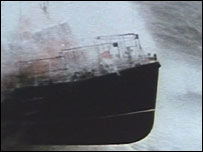 The Lifeboat 'Rotary Service' Rescue and tragedy in DoverDuring the night of the Great Storm, the Dover lifeboat battled against deadly winds and waves to rescue men from a sinking ship. This is the story of those involved.  For the staff at the Dover coastguard and RNLI station, there was no reason to suspect that the night of 15/16th October 1987 would be any different. The forecast after all gave no cause for alarm. »WATCH«
At about 5 am on the 16th, acting coxswain and mechanic of the Dover lifeboat Roy Couzens and the rest of the RNLI crew got the call. Reports of a cross-Channel ferry, the 'Hengist', having broken free of its moorings near Folkestone were causing real concern. 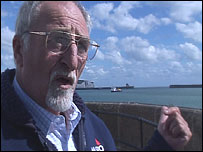 "The biggest wave I'd ever seen" Roy Couzens By this time, it had become clear that this was no ordinary storm: “one of the crew, as he came out of his house, his chimney fell down and went through his car,” recalls Couzens. Sawn in halfBut another ship was in graver trouble. The 'Sumnia', a 1,500-tonne general cargo vessel had lost power and was trying to use its anchors to steer itself out of trouble. Such was the strength of the wind, the anchors failed and the Sumnia struck the Southern Breakwater in Dover harbour. There were six crew on board. Stuck between the breakwater and pounding 60 ft waves, she was effectively being sawn in half.
The crew of the lifeboat 'Rotary Service' were having problems of their own. One of the craft's propellers had got caught on a submerged rope and it wasn't until a team of divers had braved the tumultuous waters and cut the rope, that the lifeboat was able to get under way, albeit with reduced power. "There was no visibility whatsoever," continues Couzens. "To look into the wind was almost impossible without being shot-blasted by the spray". Monster waveWorse still, one of the western lighthouses had been extinguished by a monster wave. The harbour was now churning with foam and spray, a diesel barge was partially submerged and releasing its fuel, and the water was strewn with debris. 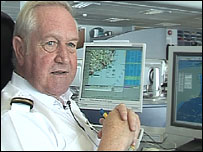 "A voice said - I think we're going over" Pete Leg By 05:30, wind speeds were averaging 60-70 knots with gusts of up to 120 mph. Dover Coastguard's anemograph recorded a feather trace where the needle touched 135 knots, the strength of a category five hurricane. The Sumnia was now in dire straits. Pete Legg was working as deputy watch manager for Dover coastguard and was struggling to track the vessel by radar. The Dungeness receiver had been knocked out by the winds and at Dover, the windows of the control room high up on the cliff top were bulging and cracking, opaque with salty spray. "We lost the radar echo completely so I called the Sumnia up directly and asked them if they were ok. They were somewhat hesitant and then a voice said 'I think we're going over' - and that was the last communication we had with the Sumnia." Capsize situationAt that time an enormous wave came over the lighthouse and washed two men off the forecastle of the Sumnia. "I brought the lifeboat round and we picked the guys up on the move," says Couzens, for whom the decision to persevere with the rescue was instinctive. "You are there for the preservation of life at sea. You wouldn't commit your crew knowingly if there was a chance of them going out and not surviving. The sea conditions were extreme but we still had four men unaccounted for..." The Sumnia was now breaking up and being dragged outside the harbour. Conditions were horrendous. It was still dark. "My second coxswain said 'Roy, watch this one' - and from my starboard side I saw the biggest wave I've ever seen in my life. It hit and sent the boat onto its port side and for a minute I thought we wouldn't get to the top of the wave. I thought we were going to be in a capsize situation." "At that moment I saw daybreak." SubmergedIn the dim light of October the 16th, the Rotary Service fell 20-30 ft into the wave trough and for a moment was submerged. Couzens distinctly remembers one of the lifeboat's lights glowing green through the boiling black water. He also remembers the sharp pain as his chest slammed into the throttle: "If you can imagine dropping onto concrete from 20 ft, it was quite a shock. I thought I had broken a rib or punctured a lung." The Sumnia disappeared and the four remaining crew jumped into the freezing, frenzied water. The captain was never found. Another body was found two days later on the breakwater. The other two were swept back over on to the harbour-side. Re-entering the harbour, the lifeboat spotted a life jacket with someone hanging upside-down inside it. "One of the crew said he thought he was dead but I told him to get resuscitating - and they resuscitated him and he survived," says Couzens. Trouble breathingThe Rotary Service landed their three survivors; the tug 'Deft' having picked up another. Although the crew were shaken, some in shock, and with Roy Couzens now in considerable pain, the lifeboat went out again to search for the two remaining seamen. But Couzens was now having trouble breathing and the acting second coxswain Michael Abbot returned the boat to shore. "No one can foresee what's going to happen," adds Couzens, "and the way in which you cope with that is really down to the training and the caliber of the people you are with. Nobody once questioned that they weren't going to go out there with me and I feel very proud of that." Back at the Dover Coastguard control room, it was time for a change of shift: "I never realised what damage was being done at the station until I went out at the end of the watch and found all the windows on my car smashed," recalls Legg. "The whole thing had been pebble-dashed where pebbles had actually blown up over a 300 ft cliff and hit the car - we've never seen that before of since." Roy Couzens had suffered a burst blood vessel behind his heart and lay recuperating in the bed next to one of the crew of the Sumnia, who owed his life to the crew of the Rotary Service. For his outstanding seamanship, great skill and courage, acting coxswain Roy Couzens was awarded a Silver Medal by the RNLI. Each of the other members of the crew, acting second coxswain Michael Abbot and lifeboat-men Geoffrey Buckland, Dominic McHugh, Christopher Ryan, Robert Bruce and Eric Tanner, were each awarded a Bronze Medal. last updated: 04/10/07 You are in: Kent > Weather > Great Storm 1987 > Rescue and tragedy in Dover 5 DAY FORECAST The latest forecast for your area from BBC Weather [an error occurred while processing this directive] [an error occurred while processing this directive] |
| | About the BBC | Help | Terms of Use | Privacy & Cookies Policy |
