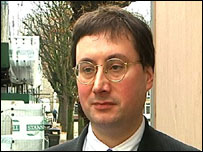
Each of the 15 Senatorial Candidates took time out of their campaign to speak to BBC Radio Jersey's Home Affairs Producer Hamish Marett-Crosby about their election platform and what they would do if they were elected. Name: Stuart Syvret
Party: Independent Read a transcript of the interview with Stuart Syvret below or listen to it using Real Player. Why are you going for an island mandate? I’ve proven my ability as a states member over the past fifteen years. I’ve been highly effective as a back bench where I have brought several major changes through the States, like freedom of information – things of that nature. I’ve enjoyed the past five years being president of a major committee – Health and Social Services, and I certainly hope to intend to be able to carry on working on behalf of the community. So, why vote Stuart Syvret as opposed to the others? Well, I have a proven track record, I was a deputy for three years and I have been a Senator for twelve years. During that time I have proven my ability to work tenaciously as a back-bencher. I have succeeded in stopping things like stealth taxes being introduced, I have succeeded in convincing the States to introduce a competition law. I’ve brought about some important changes to the machinery of government and as a committee president I have led the Health and Social Services Committee through what has been a difficult period for the service, because of change of clinical governance regimes, dramatic change in the way healthcare is delivered across the United Kingdoms, so that has had an impact on us too. And of course it’s been during a period when States money is much much tighter than it used to be, and no advanced country in the world delivers a health service with a static or fairly static budget, but nevertheless we have managed to run the island’s Health and Social Services and balance the books each year. So, I think I have got a pretty good proven track record. On the basis that you are re-elected you will be setting off next year into the unknown. Maybe not entirely unknown, what do you think are the main problems that will be facing you and your colleagues? The main problems facing the island are the economy and taxation without question. The move to the 2010 regime is going to have dramatic impact on the way the taxation system works in the island, and its cost could have a knock on effect upon the economy in a number of different ways. Certainly we’ve got to try and do what we can to limit public expenditure, because with the forthcoming new tax regime realistically it’s unlikely that the present levels of public expenditure and direct taxation are going to be sustainable. So we are going to have to look, and look again, at making sure that we are spending tax payer’s money efficiently. And we are going to have to introduce of course new ways of raising tax revenues which is not going to be popular, a number of issues have to be addressed there; but nevertheless those are the kind of issues that the community now has to face up to. I think it is going to be difficult because the community is used to having things fairly comfortable and we are now moving into a difficult period and a period of uncertainty. Amongst all these issues you’ve raised, what will be your priorities assuming you are going to be there in the States? My priorities would be to have a transparent inquiry into all of the taxation options that face the community because I’m not persuaded that the Finance and Economic Committee has done enough work, deep enough or broad enough work, looking into taxation issues. So, that would be the first thing I would wish to pursue. Secondly I would instigate a renewed Fundamental Spending Review on just how much tax payer’s money we are spending and where we are spending it, to make doubly sure that it is being spent in the most efficient ways possible. I would like to do that from a position of being Chief Minister. I’ve already said that I would be a candidate for the post should I get re-elected, and I have very clear ideas about the tasks that are facing the community. How do you think the ministerial system of government is going to bed down? I’m sure there will be teething problems but I hope and expect that it is going to work. A lot of the success, or otherwise, of the ministerial system will hinge around how effective the scrutiny function is going to be against the concentrated power of the executive. That is absolutely vital if we are not, in fact, going to have the States Assembly, the island’s parliament marginalised and the executive could be going off and doing exactly as it pleases. So we are going to have to have the scrutiny function to be working absolutely effectively and efficiently, that’s why we need things like a much tougher Freedom of Information law. So if we don’t have that kind of access to information then scrutiny is not going to work. Also scrutiny has to become a critical friend; it has to avoid becoming in essence an ipso facto party political tool just to use to cause arguments with. As long as the scrutiny function does work efficiently and effectively, then I can see the ministerial system of government working and working effectively. It will almost certainly make things happen more speedily than was the case in the past, but that of itself is not necessarily a good thing. A faster decision making if the decisions you are making are actually wrong, is not going to be the best thing for the community. I have asked all the other candidates who they will be supporting for Chief Minister, let me put it the other way round, if you were not elected would you work with whoever is elected instead? Certainly, I would be perfectly happy to take on a ministerial post, my preference were I not to be Chief Minister would be carrying on to be Minister of Health because the island’s Health and Social Services systems are in a state of flux at the moment, it’s a transitional period, we are moving forward towards modernising significantly the island’s Health and Social Service provisions, so I would certainly be prepared to work with anybody who was chief minister on the understanding that I retained my independence and free speech. | 






 SENATOMETER

 Watch the