Dr Chris Bellamy examines what happened, and explodes some enduring myths concerning this crucial conflict. The Battle of Britain 1940
In the summer of 1940, the German Luftwaffe attempted to win air superiority over southern Britain and the English Channel by destroying the Royal Air Force and the British aircraft industry. This attempt came to be known as the Battle of Britain, and victory over the RAF was seen by the Germans as absolutely essential if they were eventually to mount an invasion of the British Isles. The Germans had overrun Belgium, the Netherlands and northern France in May 1940, using the Blitzkrieg ('Lightning War') technique that relied, among other things, on close coordination between ground troops and the air force. Although the Luftwaffe proved very competent in this role, it was not trained or equipped for the longer-range operations that became part of the Battle of Britain. It is widely believed that had the Germans succeeded in their aim of destroying the RAF, they would have been able to invade Britain relatively easily. This was, after all, at a time when the country was the only European power resisting Nazi Germany, even though she did enjoy massive support from her Commonwealth partners. 
Never in the field of human conflict has so much been owed by so many to so few. |
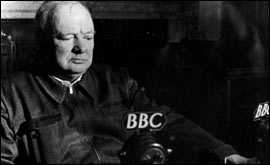
The Soviet Union did not enter the war against Germany until June 1941, and the United States didn't get involved until December of that year. It was this state of affairs that lay behind Winston Churchill's famous speech to Parliament on 20 August, right in the middle of the concerted German air attacks on southern Britain, in which he said, 'Never in the field of human conflict has so much been owed by so many to so few.' Although the fear of a German invasion was real, it was perhaps unfounded, however, as German plans were in fact somewhat amateurish - when planning the air attacks they made the mistake of regarding the Channel as a relatively minor obstacle, little more than a wide river crossing. In addition even if Hitler had achieved his aim of destroying the RAF, Germany might still have failed to establish a foothold after any invasion, because the British Royal Navy was enormously strong, and very capable of repulsing German troop ships. Suppression of the British air force would have been the first difficult step to a German victory, but it was not the only factor, and the British would have found they had plenty more tricks up their sleeve. There was nothing to stop them from withdrawing their aircraft northwards, out of range of the German fighters, if they started to lose the air battle, keeping the aircraft in reserve to counter an attempted German invasion.
More on the history of the Battle of Britain from theBBC History World War Two website.
|