| 13 November 2014 |

| |
| BBC Homepage | | |
| |||
| Contact Us | | |
HistoryYou are in: Isle of Man > History > The Clerical Medical Parish Walk 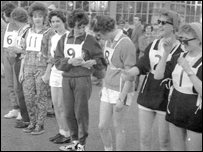 The Clerical Medical Parish WalkIf walking to the corner shop for a pint of milk is the sum total of your weekly exercise you may not be ready for the biggest walking event in the Isle of Man. Take a look back at how the Parish Walk has evolved over the years. The Clerical Medical Parish Walk is an established, annual sporting event on the Isle of Man. In many ways it is unique, involving an 85 mile race-walk around the 17 parishes of the island, within 24 hours. Many competitors enter for the fun of it although it is a recognised race and is subject to standard race-walking rules. Entrants also have the option of finishing at any stage but typical targets are Rushen after 19 miles or Peel after 32 miles. Here is a short history:The Parish Walk can loosely trace its history back to 1852, although in 1848 the Manx Sun published an account of Harry Kermode who walked from Patrick to Ramsey, a distance of 48 miles. Quite an achievement for an 84 year old man! 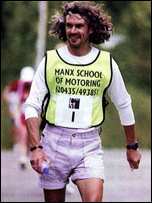 Robbie Callister Four years later the paper published an article entitled ‘a summer’s day journey’, recording the exploits of coroner, John Cannell of St Barnabus who set off on horse back, covering 90 miles 15 hours. Later that year, in 1853, he undertook a similar journey on foot around the Island’s 17 parishes. Many of the Island’s great Victorian eccentrics attempted other walking challenges including WT Teare of Ramsey who seems to have eaten his way around the parishes. The first Parish Walk comparable to today was in 1913. Organised by the Isle of Man Times and the Manx Sporting Club it was called the Parish Walking Match. The intervention of the war prevented any repetition of the event until 1923 following the revival of the Isle of Man Road Run. On this occasion there were only two walkers, Harry and Gerald Bridson. Despite the same name that’s where the similarity ended. Working man Harry walked in a dark tweed suit while the flamboyant and wealthy Gerald with his bushy ginger beard flowing in the breeze wore large white shorts and a waistcoat. 1960 saw a revival in road walking and in the Parish Walk. Few events on the Island aroused as much public interest as the first modern Parish Walk in that year. From the start the roads were crammed with motor vehicles and spectators. Even through the night the walkers received much encouragement from those who had elected to spend the night by the roadside instead of in bed. 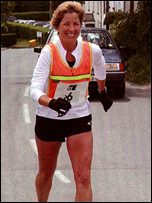 Sue Biggart In 1963, when the Beatles were topping the music charts, Flt Sgt Eunice Davies of RAF Jurby and Irene Cottier became the first women to complete the gruelling 85 mile course. Flt Sgt Davies finished in just under 21 hours. There was no walk scheduled for 1965 and the seamen’s strike in May 1966 led to its cancellation that year, making a welcome return to the Walk in 1967. Although numbers grew slowly it is unlikely that the Parish Walk would have reached the level of participation, exposure and success without sponsorship. Despite it popularity throughout the 1960s and 1970s it failed to attract significant numbers. Fortunes changed in 1979 when a major sponsor, Mylchreest Motors funded the event, guaranteeing its future success. Disaster loomed however when the company decided to change direction in 1990 and moved its sponsorship budget into motor sports. Boundary Harriers committee member, Murray Lambden had to move fast. He wanted to make the event bigger and better so he approached Clerical Medical International and a five year sponsorship deal was brokered. School teacher, Gordon Vale was the winner of the first CMI Parish Walk, finishing the course in an impressive 17 hours 55 minutes, an hour ahead of his nearest rival. The new sponsor was delighted with its first venture which attracted a record 155 starters, including 60 women. 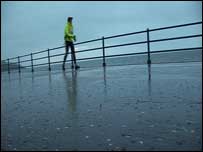 Bethany Clague on Douglas Promenade The following year the numbers grew again to 176 entrants although only nine finished the complete course in unsettled weather conditions. Numbers continued to grow as did the profile of the event and 2001 was a new starting point for the Parish Walk. It had a new look to it, a record 728 entrants and a new start point ~ the National Sports Centre. This entailed a complete lap of the 400 metre track and half of the tarmac perimeter before venturing into Castletown Road to Braddan. Although the new route still covered 85 miles it avoided Douglas Town Centre and its traffic congestion. It did however cause a few headaches for the organisers who had to perform a balancing act by moving its limited workforce from stage to stage as the walk progressed.  2008 champion Jock Waddington By 2002 the number of walkers had increased to a record 967 who, with spectators, filled the National Sports Centre to capacity. The line up included the event’s most successful competitors ever, John Cannel and Derek Harrison who between then had won no fewer than 11 Parish Walks. By 2008 the numbers had increased to over 1,600 and the walkers braved monsoon-like conditions, raising thousands of pounds for charity. The winner was Jock Waddington and one lady walker, Bethany Clague, enjoyed herself so much she walked the course twice. The 2009 race commences at the National Sports Centre at 8am on Saturday 20th June. For entrance details please visit www.parishwalk.com (Extracts for this article were taken with permission from the definitive history of the Parish Walk, 'A Walk Through Time' by Dermot O'Toole. The book is currently being updated for the event's 50th Anniversary and will be re released for Christmas 2010.) last updated: 28/04/2009 at 16:06 Have Your SayDo you have any memories of the Parish Walk? [an error occurred while processing this directive] You are in: Isle of Man > History > The Clerical Medical Parish Walk |
| | About the BBC | Help | Terms of Use | Privacy & Cookies Policy |