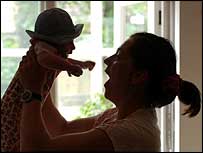
SURROGATE MOTHERSWhat drives the women who conceive children they know they'll give away? Inside Out gets to the heart of surrogate motherhood with the first hand experience of two mothers from West Yorkshire. DevastationInside Out Reporter Sophie Hull met two friends who arranged their own surrogacy.  | | Ruth's medical problems left her feeling incomplete |
Sarah Lewis of Leeds, was devastated after medical problems left her unable to have more children. She says, "We felt our family wasn't complete". Sarah and her partner John let family and friends know they were considering surrogacy. FriendsRuth Langford, a mother of three teenage daughters, stepped in and offered to have a child for the couple. "When I heard about their situation I thought, ‘I could do that.’" Ruth bore baby Joseph two and a half years ago through ‘traditional surrogacy’, one of two surrogacy methods: - Straight/traditional surrogacy
- The egg of the surrogate mother and the sperm of the intended father are used. Conceiving is easier this way but it is often emotionally harder.
- Host/gestation surrogacy
- The egg of the intended mother is combined with the sperm of her partner. The surrogate mother is almost like an incubator for another couple's baby. An IVF clinic must be used. It is harder to conceive through this method but often emotionally easier.
Ruth is Joseph’s biological mother, a fact which both say will never be kept from Joseph. Ruth says many people don't understand her reasons for giving him away. "People say I gave away my child, but he was never mine to give away." MotivationInside Out has learned that early findings of a new study are proving Ruth's attitude is quite common. It suggests that women are unlikely to form a maternal bond with a child they know will be brought up by someone else. Carol O'Reilly of Surrogacy UK confirms these findings. After having three children of her own and three surrogate babies for childless couples she says it's simply an act of generosity. She says, "If someone close to you needed a kidney you'd give it, so why not use your womb to provide someone with a better life?" GenerosityIt is illegal to become a surrogate mother commercially in the UK. 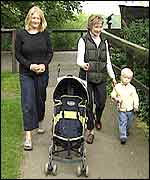 | | Joseph enjoy a walk in the park |
This deters most women who are becoming surrogate mothers for reasons other than the immense gratification they feel at giving others the joy of a child. It is also illegal to advertise for a surrogate mother in the UK. So many surrogate mothers are friends or relatives of the intended parents. This makes the relationship even stronger. Happy familyFor Ruth and Sarah, the situation works perfectly. Joseph is a happy child who is lucky enough to have a ‘biological’ and a ‘real’ mum. Ruth can feel satisfied in the knowledge that she has made the Lewis family complete and very happy. | 



 Inside Out - Yorkshire & Lincolnshire: Monday 28th October, 2002