GRAFFITI MAESTRO | | Fast becoming a vibrant, new art form |
It's the latest in contemporary art and it comes straight from the street. Graffiti art has made the leap from the subway to the gallery. Inside Out meets spray man Arron Bird. When most of us think of graffiti, we think of weird, squiggly writing on walls and subways. It may be illegal out on the streets, but graffiti art is becoming a serious art form indoors in art galleries. It's also increasingly being used for promotional and advertising campaigns.
Inside Out investigates with the help of one of Britain's leading graffiti artists, Arron Bird. Getting started Arron Bird, alias Temper, comes from Wolverhampton, and first tried his hand at graffiti in the 1980s as a teenager. 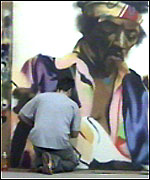 | | Arron Bird works on his Too Good to Die Young art collection in his studio |
Hip hop culture inspired him to get spraying, "The whole thing was a bit inspiration to me. I sort of felt a connection with the whole hip hop thing because of the lifestyle that I was leading." "It was a way of doing something more positive than anything else," he says. Arron Bird's first works were illegal tags on walls, which he describes "as a great training ground". "As soon as I pressed the nozzle on my first aerosol experience it was like finding God or something. "I was some snotty nosed kid with an attitude in a subway, late at night pressing the nozzle of car paint." Art attack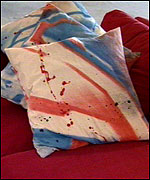 | | Graffiti art in its most creative expression |
These days Arron is more likely to be seen in an art gallery or talking to high profile clients. His pieces sell for £10,000 each and the corporate work keeps rolling in. Back in 2000, Arron's artwork graced one hundred million cans of Sprite, a move which raised his profile dramatically. "It was quite a big achievement for graffiti in general," he says. Arron has also been commissioned by art collectors including ex- footballer Ian Wright and the advertising company Saatchi and Saatchi. For Saatchi, he designed a whole office environment including soft furnishings, wall surfaces and decorations. King of the spray cansIn 2002, Temper became the first graffiti artist to be given a solo exhibition at Birmingham's Museum and Art Gallery. 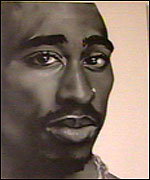 | | Spray can art - a striking image from TheGood Die Young collection |
Last year he moved into an artist's studio in Birmingham's Jewellery Quarter. Arron's also making a name for himself with his exhibitions including The Good Die Young featuring striking portraits of famous icons in black and white. It was inspired by the artist's own experiences, and the death of several members of his family. His follow-up exhibition Too Good To Die Young continues the theme and includes homages to Kurt Cobain, Jimi Hendrix and other pop culture icons. Street rootsGraffiti art has its roots on the streets of America's urban centres such as New York and Chicago. In the 1960s and early 1970s, young people in New York City radically altered the tradition of writing their initials on neighbourhood walls. But Temper isn't the first artist to take graffiti into the gallery. The American artist Keith Haring 'legitimised' graffiti art by displaying it in major art galleries back in the 1980s. 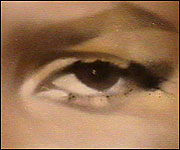 | | Temper turns his attention to capturing the essence of his subject using spray cans |
And fellow American pop art guru Andy Warhol was also fascinated by graffiti, street art and popular culture. So could Temper be the Andy Warhol of the hip hop generation? His Decade and Popcorn collections certainly look set to establish him as a major international artist. And with several exhibitions under his belt, Arron's star is clearly in the ascendant. The future's bright... So what's the future for graffiti art? It's already demonstrated that it's fresh, spontaneous and innovative, but can it survive? Graffiti art has a problem with its image. Its critics claim that graffiti art on the street is messy, ugly and ruins the environment. It's also illegal.  | | Temper hopes that young graffiti artists will follow in his footsteps |
The challenge for artists like Temper is to find legal places to do it, and to change negative attitudes towards graffiti art. "A lot of people have actually stopped the growth of graffiti either because it's illegal or because the arts foundations have stopped us going into their world, because they don't understand it. "It's my job to keep on growing and keep on opening the doors up," he says defiantly.
Temper's work demonstrates that a spray can is every bit as creative as a brush and oil paint. He's certainly starting to open the floodgates for the graffiti art movement with his striking, highly sought-after images. | 



