RETURN TO ROMANIA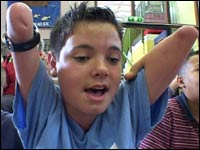 | | Rescued & brought to England |
This week Inside Out followed disabled orphan Cornel Hrisca-Munn as he returned home from Worcester to Romania to visit his family. But what did he leave behind and why? Cornel Hrisca-Munn was born disabled, with one complete leg and severely-shortened arms.
As the son of a poor family living in Romania this doomed him to life at an orphanage. Cornel was cared for at an institution in Suceava until aid workers Doreen Munn and her husband found him - aged about 7 months. Cornel was lucky enough to be able to come to England and find a better quality of life. But what about those he left behind?
Romania is a country still recovering from years of upheaval. 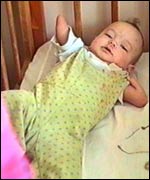 | | Cornel as a baby |
Once considered the 'bread basket of Europe', the policies of former dictator Ceausescu led to a huge and unsustainable rise in the birth rate. Many families suffered severe economic hardship, lack of material resources, inflation and unemployment. As a result it became common for children - particularly those who are disabled - either to end up on the street or to be sent away to orphanages, many described by witnesses as 'hell holes'. The orphanage which would have been home to Cornel as he grew up In Romania - Siret - was described by one visitor as smelling worse than a toilet and being a breeding ground for rickets, tuberculosis and even polio. Now derelict, it was once home for nearly 2,000 children A new hope - Noua ViataOn his return to Romania Cornel visited the new orphanage - Noua Viata. It is a radically better place, with good care, schooling, and facilities for the children living there. 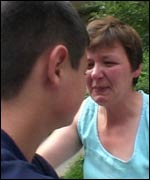 | | Cornel greets his birth mother |
He also visited his birth parents, and showed a complete lack of resentment towards them for giving him away at birth. But still the future for other abandoned children living in Romania is far from rosy. Recent statistics from the National Authority for Child Protection and Adoption (February 2003) show that 42,777 children in Romania live in public or private residential institutions. 76 per cent of them are between 10 and 18 years old. A global problemAnd Romania is not the only place where children are suffering. Which is why Cornel swam a personal marathon to raise money for Ali Abbas, the Iraqi boy injured in the war earlier this year.
| ROMANIA FACT FILE | It is located between Bulgaria and Ukraine It has cold, cloudy winters with frequent snow and fog; sunny summers with frequent showers and thunderstorms The infant mortality rate is 18.4 deaths/1,000 live births The unemployment rate is 8.3% It has 1 million internet users Principle exports include textiles and footwear, metals and metal products, machinery and equipment, minerals and fuels The capital city is Bucharest |
About 25 people are killed or injured by abandoned munitions every month in Basra alone. In northern Iraq, the figure is about 190 casualties each month. Like Cornel, Ali Abbas is the 'lucky one'. Back home there are many more children in need of help. Cornel meets Ali
It was an emotional moment when Cornel met Ali for the first time. The two children have much in common, and it is that shared experience that led Cornel to raise the thousands of pounds he did for Ali's treatment.
Now, in a sense he has 'paid forward' some of the good fortune he received in being able to grow up with a loving family in England. And he has also shaken off the ghosts of the past by returning to the family he once was forced to leave behind. | 



