MENINGITIS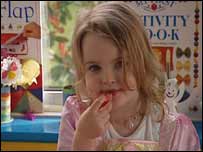 | | Lydia Cross, a year on from an attack of meningitis |
Like any little girl on her birthday Lydia Cross is proud to be the centre of attention.
But it's a day her parents Tony and Jodie feared they might not see. "We always treasure every birthday with our little girls," says Jodie. "Because we were so close to losing them, it makes it all the more special."
Lydia nearly lost her life to a deadly disease. She survived but the infection led to her having both legs amputated. We catch up with her and her family and see how their lives have changed. Family tragedy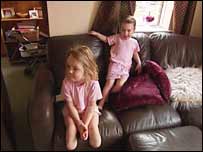 | | Lydia and Milly have both contracted meningitis |
Over a year ago both of the Cross's daughters, Milly and Lydia, contracted two different types of the deadly disease meningitis. They both pulled through, but life for Lydia would never be the same again. We first brought you Lydia's story six months ago. Late one Friday night in 2003 she became ill with a temperature of 105 degrees. Seeing their child so ill, Lydia's parents took her to their local doctor that weekend. "She was hallucinating and believed that spiders were crawling over her skin," remembers Tony. At the hospital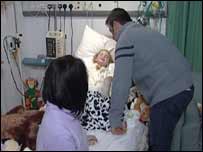 | | Jodie and Tony feel that doctors were too slow spotting meningitis |
They took her to their local hospital, in Chippenham. She was seen by doctors from the out of hours GP service. On Sunday she was worse so they took her back. A different GP saw Lydia and said she just had an ear infection. On Monday Lydia was finally admitted to hospital. She had meningitis and her life now hung in the balance. Meningitis and septicaemia| Meningitis Facts | Meningitis is the inflammation of the membranes around the brain and spinal cord The disease is caused by a bacterial or viral infection Viral Meningitis is the most common form of the disease in the UK and is usually less severe than the
bacterial strain Bacterial Meningitis can be life threatening and is caused by a range of different bacteria There are vaccines available to prevent certain strains of Meningitis but not every form of the disease is covered Around 10 to 25% of the population are carriers of the meningococcal bacteria Source: The Meningitis Trust |
Meningitis is an inflammation of the tissues that cover the brain and spinal cord. It can be caused by either a viral or bacterial infection. The bacteria that can cause meningitis live naturally in the throats or noses of about one in ten people, without causing them any illness. It's even higher among young people - almost one in four carry the deadly germs. In a few people, however, the bacteria manage to evade the body's immune defences. They manage to get through the lining of the nose and throat and find their way into the bloodstream. Once there, the germs can cause meningococcal meningitis. The same bacteria can also cause septicaemia, a type of blood poisoning. Septicaemia often accompanies meningitis, and either can be fatal. Septicaemia can also reduce the amount of blood reaching the body's vital organs. Hospital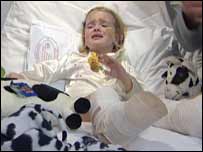 | | Lydia had to endure a three-hour operation to remove her legs |
Lydia suffered full organ failure and was put on drugs to keep her lungs, heart and kidneys functioning. She managed to survive the initial trauma, but the septicaemia had also struck other parts of her body. Her legs were left so badly damaged by the septicaemia that she had to have them amputated just below the knee during a three-hour operation. A year onA year on, we catch up with Lydia on her way to pre-school. The progress she's made is astonishing. She is now using her new artificial legs to walk with, but she hasn't stopped there. 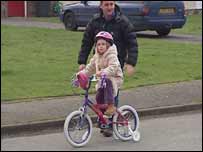 | | On the road again - Lydia takes to two wheels |
Lydia has also taken to two wheels to get around. Riding a bike was hard to master but now she's quite comfortable negotiating the roads around her home. "It's good to see her so happy and enjoying herself - at one point we didn't think she'd get there," says Tony. Like most little girls she also loves horses. Her parents have taken her horse-riding, and Lydia is thrilled by her time in the saddle. "I don't know how she manages," admits Jodie. "It must be like walking on stilts and that's what it's going to be like for the rest of her life." Fund-raisingAt the moment the family have to fund-raise to pay for Lydia's legs. She uses specialist artificial limbs which are made for her by a company in Dorset. They cost £6,000 a pair and she needs a new pair every six months. In the future she will also need specialist swimming legs and sports legs if she is to join in the activities other children enjoy. In order to cover the cost Tony and Jodie raise funds through sponsored events, such as sponsored rides and walks, as well as running coffee mornings and the like. Campaigning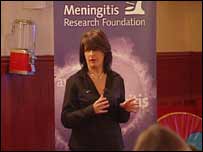 | | Jodie now helps make others aware of meningitis |
Lydia's parents now try to educate people about the dangers of meningitis. Tony and Jodie give talks on behalf of the Meningitis Research Foundation. But reliving the trauma is not easy for either of them, as Tony explains: "It pulls bits out of you that you don't want to keep going over. "Doing things like this brings it all back to the fore." They try to make parents aware of the signs of different strains of meningitis. Because the diseases develop so quickly, it is vital that parents can recognise the signs and symptoms so they can get medical help as soon as possible. Doctors give antibiotics immediately to anyone they suspect of having meningitis or septicaemia. Quick diagnosis and response can save patients from the full effects of the disease. It can kill very quickly if it is not recognised and treated in time.
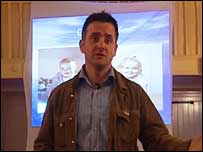 | | Tony gives talks about how to spot the deadly disease |
Tony says, "Lydia went down hill and we thought she is not well there is definitely something wrong
high temperature, hallucinations, obviously that is down to the temperature that is why the doctor was quite easily casting it aside, he went 'no it's just the temperature'." Jodie and Tony are also putting pressure on the NHS to revamp how it deals with young patients. They want to see experts on children to be based in every hospital. Jodie says, "Hopefully I will be having a meeting with the head of Paediatrics for the NHS to get something done so at least it can not happen, we hope, to other children". CompensationJodie and Tony believe that Lydia was not diagnosed with meningitis fast enough. So far the local Primary Care Trust has looked into the case. In its own internal report the Kennet and North Wiltshire Primary Care Trust said no individual doctor was to blame. However this isn't enough for the Cross family, they want proper compensation and vehemently disagree with the report. Their fight to ensure a good future for their daughter continues. | 



 Inside Out - West: Monday March 7, 2005