PROSTATE CANCER - BRIAN CHAPLIN'S BATTLE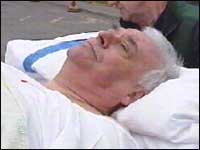 | | Will his treatment be available locally? |
Of the 22,000 men diagnosed with prostate cancer every year, half will die. Yet when Brian Chaplin was diagnosed with the disease, he declared himself the luckiest man alive. Inside Out finds out why. Brian Chaplin - engineer, musician, actor, town councillor and now fund-raiser and campaigner. You could never accuse Brian of leading a quiet life. So when Brian is diagnosed with prostate cancer - he is not going to take it lying down. Brian finds out about a treatment known as Brachytherapy. It is a targeted therapy in which radioactive seeds are implanted into the prostate. Unlike other cancer treatments, Brachytherapy has very little side effects - if any at all. 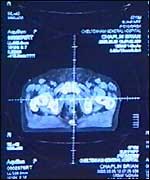 | | Radioactive seeds are implanted into Brian's prostate |
Up for a challengeFor Brian Brachytherapy is the ideal treatment. But there is one drawback. The treatment Brian wants is not available locally on the NHS. "When I mentioned Brachytherapy to Brian and told him if that was his preferred option he would have to go to Leeds, I could see a look of despair in his eyes," says Dr Hugh Gilbert, Consultant Urological Surgeon. "Fortunately I could see Brian takes challenges well." And indeed he does. | PROSTATE CANCER THE FACTS | * The prostate is part of the male reproductive system located below the bladder and in front of the rectum. * The causes of prostate cancer are not understood but studies have found that a number of risk factors are associated with the disease:
1. Age - Prostate cancer is primarily a disease of older men and the relative risk increases with age. 2. Family history - A man has a higher risk of developing prostate cancer if his father or brother had the disease. 3. Dietary factors - Prostate cancer has been associated with the consumption of meat and dairy products. 4. Testosterone - Elevated testosterone levels have been linked to the promotion of an existing prostate tumour rather than to tumour initiation. * Symptoms - Early prostate cancers often cause no symptoms. Due to the fact that the prostate surrounds part of the urethra, if the prostate becomes too big for any reason it can affect urination and this is an important general symptom to be aware of.
Symptoms relating to the process of urinating include:
- problems starting urination
- problems with urinating
- increased frequency of urinating
- pain when urinating
- blood in the urine
Other symptoms include:
- problems having an erection
- pain during ejaculation
- blood in the semen
- persistent pain in the lower back and hip |
Brian has challenged himself to raise enough money to open a Brachytherapy unit at Cheltenham General Hospital. Battle of willsWhile Brian battles with local health authorities, doctors battle with Brian's cancer which unfortunately is on the move. A course of radiotherapy at Cheltenham is needed to prevent any cancer cells migrating beyond his prostate. The next stage of treatment is Brachytherapy. To benefit from Brachytherapy, it is essential that the cancer is diagnosed as early as possible. "I had a pain in my back which I thought was a kidney stone," explains Brian. "I went to see my GP and he said that it was probably a kidney stone but I think you ought to be checking out other things as well." For his Brachytherapy treatment, Brian has to travel across the country. Targeted treatment Catheters are inserted into Brian's prostate allowing radiation to be delivered directly into the tumour. Radioactive seeds are implanted into the prostate which burn out the cancer cells. The technique may be slightly uncomfortable, but lack of side effects make this short discomfort well worth it. "He may still have some side effects from the external side of the treatment," explains Consultant Oncologist and Radiotherapist, Peter Hoskin. "There may be a bit of bruising when the catheters are removed, but surprisingly, there usually isn't that much of a problem." Try and try againA few weeks after his treatment and Brian is back on the fund-raising trail and on his way to making a full recovery. 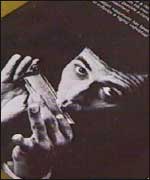 | | Brian had a varied career before his new role as a fund-raiser and campaigner |
Brian and the money-raising committee he formed succeed in raising £100,000 - the cost needed to open a Brachytherapy unit in Cheltenham. Brian's dream will soon be realised as the Cheltenham unit treats its first patients over the coming months. The unit has enough money to sustain it for the next two years - beyond that - the future of the unit is in the hands of the NHS. But if Brian has anything to do with it - the unit, like the men it treats, will have a long and healthy life. And as for Brian - we let him tell you why he is the luckiest man alive. "I'm lucky because I've been caught in time. One thing leading to another, I have found a treatment which will benefit all men in the future." | 



