A37 - A DRIVING BLACK SPOT 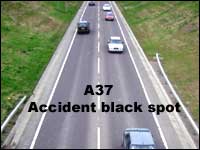 | | Six people were killed on this 17 mile stretch |
The A37 between Dorchester and Yeovil is one of Dorset's most dangerous roads. Last year six people were killed in crashes on this 17 mile stretch dubbed by locals as 'Death Valley'. The A37 is a notorious driving black spot. A combination of speed and a three lane carriageway make overtaking extremely hazardous and sometimes fatal. Dorset County Council is so worried it is now taking drastic action. The council is offering free driving lessons. The lessons however are not for novice drivers, but for regular users of the A37 who believe they already know the route like the back of their hand. Back to schoolToday the tutor is Dave Mullett, an advanced driving instructor and his pupil is Andrew Grassby.  | | Regular A37 drivers are being offered free driving lessons |
Andrew's stonemasonry business is right next to the A37. "I haven't taken a lesson in driving in any shape or form for about 30 years," says Andrew. "Hopefully it's going to make me a lot more aware of the dangers of this particular stretch of road." Many of Dorset's roads are single carriageways so drivers have little opportunity to drive fast. The A37 with its three carriageways is often taken advantage of by frustrated motorists. "With many single carriageway roads, drivers are actually constrained, and become frustrated," explains Dave. "When they do come to a good standard of road, they want to open up, and do so on the A37 which is a very fast route." Tragedy| ROAD ACCIDENT FACTS | In 2001 there were: - 313,046 casualties on roads in Great Britain*
- 3,443 people were killed*
- 37,094 were seriously injured*
- 272,509 were slightly injured*
- there were 228,825 road accidents involving personal injury. Of these, 34,749 involved
death or serious injury* - 70% of car drivers break the 30 mph speed limit**
- 85% of pedestrians struck up to 40mph are killed**
- At up to 20mph only 5% are killed** * figures supplied by The National Statistics Office ** Figures supplied by wiredforhealth.gov |
It is the speed of the A37 that has resulted in past fatalities. Last May, on the same stretch of road, 25 year old Robert Purnell was driving up the hill overtaking in the middle of the three lanes. At the same time, another car was coming down the hill in the same lane as Robert in a bid to overtake a caravan. Robert had just seconds to react. He swerved to miss the oncoming car and in doing so he lost control of the car. Robert's car spun around and went straight into the Isuzu Trooper towing the caravan. "To me it looked like a small explosion had gone off," says PC James Wedge, Dorset Road Policing Unit. "There was a large amount of debris across the road. Robert's car had been split in two." The inquest recorded a verdict of accidental death, although the coroner noted in court that Robert had been speeding. In this instance, speed and the three lane carriageway proved to be a deadly combination. One that left a family devastated and a young life cut tragically short. Lethal weaponIt is tragedies such as Robert's that the council, with the help of instructors like Dave, are hoping to prevent. "If drivers are given the right training, they can minimise the risks they take each and each time they try to join the A37," says Dave. 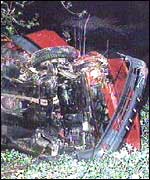 | | Travelling at high speeds reduces a driver's reaction time and can result in tragedy |
And even experienced drivers like Andrew can appreciate the benefits of further instruction. "I think everybody should do it," explains Andrew. "It has just made me much more aware of the dangers and the potential dangers that can arise when you're driving." It is not only your own driving that should be kept in check warns Dave. Other drivers can make silly mistakes with disastrous consequences. Whilst you may have no control over other people's behaviour on the road, you do have control over yours. To be safe on the road - all roads - you need valuable time to react to those around you and this means driving at a safe and appropriate speed. "If you were from outer space and you were looking at the human race driving in their cars, what are they doing?" says Dave. "They're sitting at the front of a metal box, with umpteen gallons of high octane fuel behind them, rushing around at high speeds." "We do it all the time, and not give it a second thought. But really we ought to because we are driving lethal machines." | 



