CHYSAUSTER - THE VILLAGE THE ROMAN'S FORGOT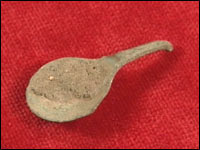 | | A rare relic of ancient Chysauster |
A spoon has been found at Chysauster, only the second metal object to survive on this site. With so little evidence, what can we say for sure about this ancient Cornish village? Chysauster is an English Heritage site just outside Penzance. Today the only living creatures there are archaeologists, day trippers, and the odd rabbit. But around 2,000 years ago it was a small Celtic village, built at the same time the Romans were colonising the rest of Britain. The site was occupied over a 400 year period between around 100BC and 300AD, probably by the Dumnonii tribe. It was made up of a group of stone huts complete with hearth stones and various household items. 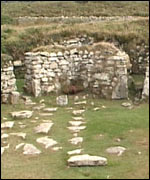 | | Not much remains of Chysauster |
The Romans didn't venture far beyond the Tamar so the Cornish were left largely to get on with their own affairs. The inhabitants survived by farming and livestock raising. Evidence of field enclosures show where cattle were prevented from getting at crops. The landscape hasn't changed much since that time - Celtic field patterns and mixture of arable and pastoral farming. The only clues as to what life was like in ancient Chysauster. Then recently a workman was sent to erect a new sign
When he cuaght sight of the metal object, he knew he'd found something of significance, but didn't know just how significant. Charlie Johns, County Archaeologist, was amazed. He passed the articat on to Carl Thorp, who identified it as a 2,000 year old spoon. The spoon, an alloy of copper and tin, was almost certainly made from metals found around Chysauster.
What made the find so amazing is that metal was so valuable in ancient times that it was normally recycled - leaving no trace of the past. 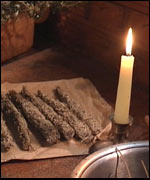 | | The spoon could have been used by herbalists |
The tin and copper trade was already well established by 40 AD. The Celts exchanged metals with the Romans for luxury goods at St Michael's Mount, the main port in the area at the time. But so much lay about the Cornish landscape there was no need to dig mines to find it. And perhaps this relative glut of metal led to the spoon's survival.
But this spoon they kept - so what was it used for?Some experts think it could have been a medicine spoon. The Celts had their own science and medicine, Celtic herbalists gathering and growing herbs to treat the villagers' ills.
Others believe the spoon may have had a more mundane use - for opening and scooping out the flesh of the mussels that grow all around the Cornish coast. Whatever the truth of the matter, one thing is for certain. The Chysauster spoon will give historians and archaeologists something to talk about over dinner for years to come.
| 



