PILL BOXES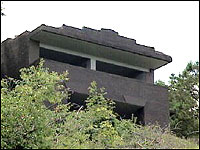 | | Fortifications and defences sprung up along the coast |
The South West was a prime target for invaders in the Second World War. Find out how it defended itself and the rest of the country against enemy attack. Early 1940 was Britain's darkest hour - the Germans were preparing to launch a massive invasion. Nobody knew where the enemy would strike first. The South West coast was a prime target and little seemed to stand in the Germans' way.
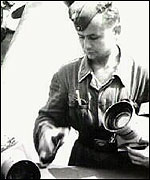
Inside Out investigates the defences and fortifications that helped to keep the enemy forces at bay. We shall never surrenderEveryone remembers Churchill telling the nation, "we shall fight them on the beaches, we shall fight in the streets, we shall never surrender." What most people don't know is that Churchill was worried that the nation didn't have enough defences to back up his rhetoric. 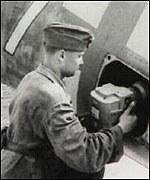 | | German pilot preparing for a bombing raid |
Following his speech, there was the biggest military building programme in British history. The mission was to make the country an impregnable fortress. Hundreds of defences, tank traps and gun batteries were thrown up frantically in just a few months along the coast of Britain. Over 18,000 concrete pill boxes were constructed, together with hundreds of miles of defensive ditches, airfields, gun emplacements, air-raid shelters, tank-traps, and bombing decoys. Pill boxes The South West's coastline changed beyond recognition in just a few months.
Small concrete forts known as pill boxes were some of the most popular defences built along the coast. They were usually the only piece of good cover in an area vulnerable to attack. Most pill boxes comprised a small room of about ten feet square and six feet high with walls of thick rough concrete with a door, over which a sheet was often draped. 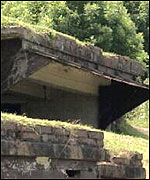 | | Pill boxes were strung out in lines across the landscape to resist enemy invasion |
They were basically a type of dug-out or bunker with look-outs and small slits for machine guns.
Each box was linked to the next by defensive ditches deep enough to stop a tank, or by natural features such as embankments, rivers and canals.
After the war the coastal defences were left to decay and rot, and many of them became overgrown.
Farmers were offered a demolition fee of £5 per pill box but demolition was often more trouble than it was worth. As a result hundreds of pill boxes remain in the South West countryside. A bitter pillToday's pill boxes are some of the most endangered buildings in Britain. 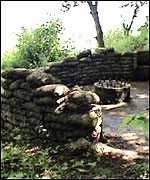 | | Pill boxes are of great historic and archaeological interest |
One of the most complete surviving lines of pill boxes - dubbed 'the Hadrian's Wall of the 20th century' - runs across the south western peninsula, from Seaton in Devon to Bridgewater in Somerset. It boasts about 280 surviving pill boxes with machine gun emplacements every few hundred yards. But many of the South West's pill boxes have become home to graffiti artists and vandals. Now the battle is on to protect what is left of these rare defences. The conservation battleEnglish Heritage is evolving a policy for listing and protecting these pill boxes, but very few have been given protection as historic buildings so far.
 | | Evidence from German pilots' records is helping to locate old pill boxes |
The emergency coastal battery at Brixham is now going to be a scheduled monument. It will be protected from being knocked down following a survey by English Heritage. Other sites aren't so lucky, and many are falling literally into the sea. The Defence of Britain project has been working to save the remaining pill boxes from demolition. Recording the South West's forgotten defences has been a mammoth task but the group has been painstakingly documenting the old pill boxes. New evidenceOld photographs provide valuable clues for the Defence of Britain volunteers trying to find where the overgrown defences once lay.
We now know what the Germans knew about the South West's defences thanks to an amazing recent find in a second hand book shop by Dorset publisher Nigel Clarke. 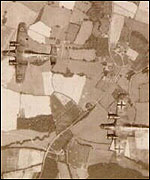 | | Wartime flying mission over South West England |
He has unearthed thousands of photographs taken by German pilots in the run up and during the war. The pictures show targets in the South West, and reveal just how much the Germans knew about British defences.
As a result, one of the main finds has been the old Taunton pill boxes which are barely discernible to passers-by.
Some enthusiasts believe that there should be better interpretation of these defences, possibly even a monument or blue plaque. With increased conservation, there is now a good chance that some of Britain's most important surviving wartime defences will continue to survive for years to come. | 



