SARK AND MERVYN PEAKE 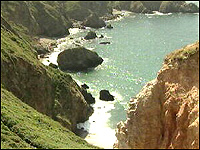 | | The island's stunning scenery was an inspiration to Mervyn Peake |
Step back in time as Inside Out visits Sark, the smallest of the Channel Islands and home to writer and artist Mervyn Peake in the 1930s. Life on Sark goes along at a much slower and gentler pace than on the mainland. The only way to get around is by horse and carriage, tractor or by bike. There are no cars on the island, giving Sark a tranquil, timeless air. It's almost as if the island has been frozen in time. The harbour looks exactly as it was in 1933 when a 22 year old artist and writer Mervyn Peake arrived at its cliff-edged harbour. The stunning scenery was to provide an inspiration to Peake's life, his painting and his writing. Small is beautifulSark is the smallest of the four main Channel Islands, located about 80 miles south of the English coast. 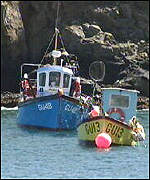 | | Sark is the smallest independent feudal state in Europe |
Whilst only three miles long, and a mile and a half wide, the island boasts some of the most picturesque coastlines anywhere in the world. Inside Out took a step back in time, and went in search of Peake's Sark. Our guide for the trip is Sebastian, Mervyn Peakes eldest son. Sebastian spent his childhood on the island just after the Second World War with his dad, mum, brother and sister. His father travelled to Sark in 1933 when his former art teacher Eric Drake invited him to join an artists' colony. The naked artistMervyn Peake cut an unconventional figure on the conservative island. One story that has been circulating for the last 60 years is that Peake used to paint naked on the headlands. 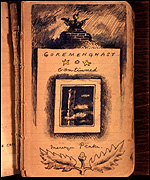 | | The original Gormenghast book with Peake's illustrations |
It's a rumour recalled by Sark artist Pat Toplis. "He went about in the noddy... he really did and he wore a sombrero, just a sombrero," says Pat. Peake was widely seen as eccentric during his two years on Sark. One of his portraits so enraged a local that he was threatened with a lawsuit.
In another incident Peake punched someone who dubbed his clothes effeminate. In search of GormenghastPeake wrote part of the epic novel Gormenghast whilst on the island, and there's no doubt that he drew inspiration from the scenery around him. 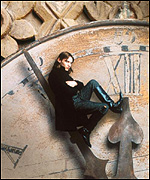 | | Gormenghast is now a cult amongst modern audiences |
"The island became... very much part of his mythological landscape," said Peake's confidante Gordon Smith. Another influence was Peake's landlady, Miss Renouf. The writer immortalised the white bird that sat on her shoulder as Mr Chalk in Gormenghast.
The castle in the cult classic also draws from Sark, being described as "irregular as the coastline of a squall-rent island."
Other locations in Gormenghast can also be found on Sark including the 'Twin Fingers' where Sark begins and 'the Bluff' narrows. The artist at workPeake worked in his own gallery whilst on the island. The first exhibition held at the gallery was opened by La Dame de Sercq in August 1933. 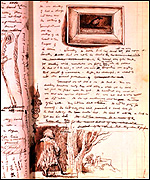 | | Mervyn Peake drew inspiration from the light, scenery and nature on Sark |
One of the local journalists from the Guernsey newspapers wrote of "'a young man still on the sunny side of 22 whose versatility and imagination place him in a class of his own." The reviewer also detected the influence of working on Sark, adding that "the effect of light brings to his pictures, a vivid, alive and arresting quality". In 1934 Peake exhibited with the Sark artists at London's Cooling Galleries. Return of the nativePeake moved back to mainland Britain in 1935 after he was offered a teaching job at the Westminster School of Art. In London Peake met and married painter Maeve Gilmour. When war broke out in 1938, Peake became a war artist and one of the first people to visit the Belsen concentration camp. 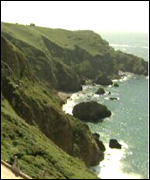 | | The tumbling drops from the cliffs inspired Peake's dark writing |
After the Second World War, Peake returned to Sark, drawing inspiration from the scenery for his illustrations and writing. Peake also completed the novel Titus Alone on the island which was remains a popular classic to this day The dark side of the island provided inspiration for Peake's novels according to his son Sebastian. "I think the colour of the cliffs for instance - it's dark, it's black and leads down to stony beaches on many of the north western parts of the island." Although Peake spent his last years on the mainland, there's no doubt that the magical and dramatic island of Sark was a major influence on his life's work. | 



