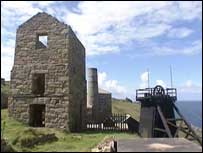
CORNWALL'S TIN MINESThey say that if you look in any hole in the ground around the world you'll find a Cornishman looking for metal. Nowhere in the world is hardrock mining so engrained into the local culture than Cornwall. In the 18th and 19th centuries the men who dug and the women who worked up top produced millions of tons of copper and tin, valuable commodities which were exported around the world. Growth of miningThe phenomenal growth in mining was made possible by the harnessing of new technologies. Cornwall became a hotbed of experimentation, attracting Britain's top engineers. But it was a native son, Richard Trevithick, who developed high pressure steam engines, used to drain water from the deep mines- and eventually to power the world's first road vehicle. The importance of this mining heritage will hopefully be recognised soon with the awarding of world heritage status to nine areas of Cornwall and West Devon. This would place the mine engine houses, Methodist chapels, surviving smallholdings and all the other remnants of the area's industrial past on a par with the Great Wall of China and the Pyramids. A new World Heritage SiteThe archaeologists in charge of the bid have surveyed more than 2,000 engine houses, although there are also remnants of the associated industries, the ports, mineral tramways and mining villages included in the bid. 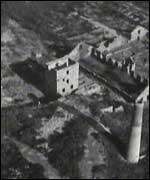 | | Remains of former mines are common |
The Methodist preacher John Wesley spoke many times at Gwennap Pit, in the heart of the richest mining district in the world, to thousands of miners. But there were rival attractions in the newly-emerging towns - beer halls and gin palaces sprang up. Millions have already been spent on conserving some of the engine houses and other sites, but millions more are needed. It's hoped that the awarding of world heritage status by 2005 will attract that funding. Life inside a Cornish tin mineThe tin mining heritage of Cornwall is now a distant memory but what was the life of a Cornish tin miner like? 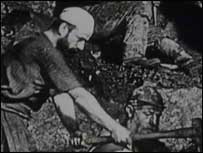 | | A miner's life was hard and brutal |
Men often began underground work at the age of 12. Younger boys and women, or "Bal maidens" as they were known, worked mainly above ground breaking rock. 7,000 children employed in 1839. There were 340 mines employing 50,000 people in 1862. Most mines were cramped and hot, with temperatures underground sometimes reaching 60 C, with air that could barely sustain a candle. Mines were small, cramped and vertical. They were no cages to haul miners up and down. Access was by a ladder. Miners often snuffed their candle and worked in complete darkness in order to conserve air. Death and injury were a fact of everyday life. Rockfalls and explosions not uncommon. Many miners developed Bronchitis, TB and rheumatism from their time underground. Few miners fit to work beyond age of 40. | 



 Inside Out - South West: Monday 16th September, 2002