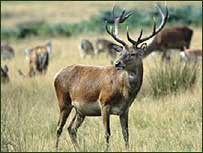
STAG HUNTING - NEW EVIDENCE OF SUFFERING The South West is the most common- if not the only - area of the UK where stag hunting with hounds takes place. Inside Out reveals startling new evidence about the extent to which hunted deer suffer. SufferingThe story begins in 1997 when Professor Patrick Bateson - one of the country's foremost animal behaviour experts - was asked by the National Trust to study whether hunted deer suffer. He concluded they did, especially in the final stages of the chase. As a result the National Trust banned stag hunting on its land. Not surprisingly, Professor Bateson's work was challenged by hunt supporters who were enraged by the ban. Stung by the criticism, Professor Bateson has now reviewed his initial findings. Professor Bateson claims that having looked again at his observations, the deer become tired and start suffering as long as two and a half hours before the end of the chase. He says; "We could see just how well they could jump fences and whether they started to look tired." "More often than not, it was taking more than 90 minutes and up to 2 and a half hours from when they are first observed [as suffering] to when they are killed."
Professor Bateson says his findings could be used to make hunting less cruel. Perhaps by imposing a time limit on hunts. Pro-hunting oppositionTom Yandle, chairman of the Devon and Somerset Staghounds, still rejects the idea that deer suffer for more than a few minutes. He says; "We could make the hunts shorter but they would be ineffective." "We do have to cull animals and it takes a long time to separate the chosen deer from the herd at the beginning of the day's hunting."
Government decision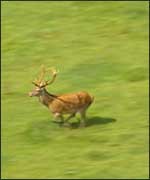 | | A hunted deer attempts escape |
Professor Bateson’s evidence has now been handed to the government as it decides whether to ban the hunting of foxes and deer. Professor Bateson believes further scientific study could provide a way forward for both sides. But the government is under pressure to finally bring to an end to years of debate on hunting. So time for research may be running out. The hunt processEach stag hunt is different. The process presented here is just a typical hunt, as observed by the Inside Out team... - The harbourer chooses the deer to be hunted, often the night before.
- The harbourer sets out on horseback with approx. 11 'tufters'. These are older, experienced staghounds.
- They rouse the deer and start the hunt. To begin, the stag easily outruns the hounds.
- Once the stag is separated from the herd and is being pursued alone, the job of the harbourer is done.
- The rest of the pack are brought from the kennels to persue the stag and other riders join in.
- At the end, the stag is often tired and will find water to stay in. This is called 'standing at bay'.
- The stag should be shot at close quaters. There have been reported incidents of packs attacking the stag.
- The hounds are given the deer's innards as a 'prize'. The remaining carcass is kept for human consumption.
Hunts can last a couple of hours or much longer. Each occasion will be slightly different. Not all hunts are 'successful'. Sometimes the stag gets away. Some research suggests that even if the animal escapes, it may die later due to injuries sustained during the hunt. | 



 Inside Out - South West: Monday 9th September, 2002