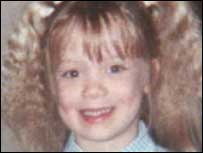
CLAIRE MCVEY - CJD'S YOUNGEST VICTIMIn January 2000, Claire Mcvey became the youngest victim of Variant CJD, the human form of BSE. Two years after her daughter’s death, Claire’s mother Annie is still struggling to get support and recognition for the forgotten victims of CJD - the carers. Inside Out looks at the rise of Variant CJD, the symptoms and the support available for those caring for or mourning the loss of loved ones from the disease. Variant CJDVariant CJD is a form of transmissible dementia and differs from other forms of CJD (see fact box on left). It has received a lot of media attention over recent years, but has been around for much longer .. - Early 1920s
- CJD is first recognised by two German neurologists Creuzfeldt and Jakob, the namesakes of the disease.
- Following decades
- It is a rare disease with an estimated UK occurrence of 30-50 cases per year.
- Dec 1984
- Cow number 133 on Stent farm Sussex becomes the first confirmed victim of BSE the animal strain of CJD.
- Feb 1985
- Cow 133 dies.
- Nov 1986
- BSE is first formally identified by the Central Veterinary Laboratory.
- April 1988
- The Government establishes the Southwood committee to look into BSE. It concludes that BSE is probably spread in animal feed.
- May 1990
- Chief Medical Officer says beef is safe to eat.
- July 1993
- 100,000th case of BSE in Britain.
- May 1995
- First death from Variant CJD.
- March 1996
- Government announces suspected link between BSE and the human equivalent CJD . The EU announces worldwide export ban on all British beef.
- March 1998
- A public inquiry into the origin and spread of BSE and CJD opens in London.
- Jan 2000
- Claire Mcvey, age 15, dies of Variant CJD.
- August 2002
- 92 deaths in Britain to date from definite Variant CJD . 22 deaths from probable Variant CJD.
SymptomsAlthough symptoms are diverse across patients, a number of similarities have been found when sufferers’ brain were examined under a microscope. According to the Crentzfelt-Jakob Support Network, most had lost nerve cells in the brain leading to a spongy appearance. There are many symptoms of Variant CJD, which can broadly be split into two categories… Physical symptoms: - Unsteadiness on feet
- Development of uncontrollable jerky movements
- Progressive stiffness of the limbs
- Incontinence
Mental symptoms: - The progressive loss of mental abilities
- Mood swings
- Loss of awareness of surroundings
The incubation period for the disease is years rather than weeks or months. Therefore, the symptoms get progressively worse over time. MedicineAccording to the Crentzfelt-Jakob Support Network, most people with CJD die within six months. But in about 10 per cent of cases it can last between two and five years. At present, there is no known cure for CJD despite considerable, ongoing research. There are some medicines which make the last few weeks easier for sufferers. SupportAs Variant CJD disease is rare, victims and their families can feel particularly isolated. The CJD Support Network was founded in 1994 by relatives of people suffering from the disease. It aims to "provide accurate information, practical and emotional support and to promote good quality care of victims."
The Support Network also runs a national helpline, providing information on all forms of CJD. Research is ongoing to tackle and treat the devastating effects of the disease, which may provide some comfort to Annie Mcvey and the other relatives of victims. CJD Support Network helpline:
01630 673973 | 



 Inside Out - South West: Monday 30th September, 2002