THE UNKNOWN AIRMANIn September 1940 a young RAF pilot died in the Battle of Britain when his plane crashed in a field near the village of Chart Sutton in Kent. The pilot was a courageous airman who paid the ultimate sacrifice for his country. No one knew his name and he became known as the unknown airman. Thanks to an amazing piece of detective work the identity of that airman was finally revealed. A wartime detective storyAviation archaeologist Andrew Saunders uncovered the name of the missing pilot fifteen years ago with a remarkable search. He discovered that the unknown pilot was a man called Robert Shaw. Robert Henry Shaw represents all the men who lost their lives in the batle of Britain. Runnymede Memorial has records of 20,000 airmen like him who have no known grave. In memory of heroesEvery year the villagers of Chart Sutton commemorate the memory of the missing airman. 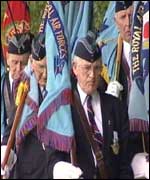 | | Commemorating the war dead |
The ceremony is more than just a tribute to one person. Over the course of the war, the RAF lost 70,253 men and women in action. In addition, 22,924 personnel were wounded. On 3 September 1940, the day that Robert Shaw crashed, the RAF incurred substantial losses over England. Of the 707 planes in service that day, 20 aircraft were lost. Ten pilots were killed or listed as missing in action. The enemy also suffered badly with 25 planes destroyed and ten damaged. Action in KentMuch of the Battle of Britain action on
3 September 1940 was over Kent. There were 600 enemy aircraft in the air that day. The weather was good and the British launched 123 patrols and 729 sorties inspite of heavy airfield attacks by enemy. At 9.15 am on 3 September 1940, more than 20 enemy aircraft approached Deal in Kent. They were intercepted by an air squadron off North Foreland. A further sortie of about 80 enemy planes flew up the estuary followed by other raids on North Weald where damage was caused. 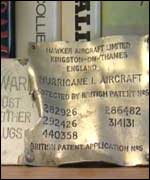 | | Fragments in time |
Another small raid was made towards Maidstone and on Biggin Hill but no definite target was singled out. Later that morning, thirty enemy aircraft headed inland at Deal and North Foreland, and then flew on to Manston which was bombed. Early that afternoon, six enemy raids were active off the Kent coast but were driven off by four British fighter squadrons. It was in the morning raids that Robert Henry Shaw lost his life. It is to him and many others that we owe a huge debt of gratitude. CreditsThanks to the Imperial War Museum, London. | 



 Inside Out - South East: Monday 30th September, 2002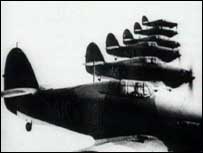
 REALPLAYER REQUIRED