THE CHANNEL TUNNELWhen the Channel Tunnel opened in 1995 there were several things left over. One is the B6 Tunnel Boring Machine - a gigantic drill which is enjoying its retirement in Folkstone. There was another leftover that few people know about. A piece of ‘Kent’ that did not exist before - a piece of Kent in France. Inside Out investigates this territorial conundrum and the history of links between these two places. TerritorialThe French end of the Channel Tunnel surfaces in Coquelles, Calais. 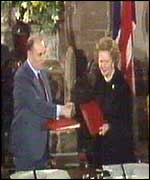 | | Thatcher and Mitterand pave the way for the Channel Tunnel |
A location which is arguably ‘confused’ about its nationality. Although this is actually France, British laws apply here. This is because Margaret Thatcher and Francoise Mitterand signed the Treaty of Canterbury in 1986. Olugbenga Udungan lectures in international law at the University of Kent. He says; "There are important extra-territorial rights which are exercised by the UK in France, which are ground breaking from the perspective of international law." "Furthermore, any infringement of UK laws will be seen as if had occurred on UK territory .. It constitutes part of the UK."
Kentish characteristics There are other reasons why one could argue that there is a piece of Kent in France, - Kent Police have an office in Coquelles
- Clocks are set to local Kent time
- The UK even has its own state lines in Coquelles. One side is France, the other English
Activities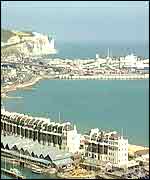 | | Customs on the coast |
The questionable area in Coquelles is not used for stereotypically French activities such as drinking wine and eating moules mariner. It is home to the UK control zone where Immigrations and Customs and Excise officers work. Their role is to stop prohibited and restricted goods coming into the UK. This includes, - Illegal pornography
- Drugs
- Firearms
They also aim to stop people abusing the system and bringing back smuggled alcohol and tobacco to be resold in the UK. Historic linksThis interesting link between the two shores is just one of many throughout history .. - 1347
- Edward III captured Calais. Sovereignty was granted to the English 13 years later. It became an important military and trading post.
- 1557
- Under the reign of Queen Mary I, the Duke of Guise marched on the city of Calais unexpectedly and recaptured it for France.
- 1880
- The first attempt to link England and France was started, but was abandoned by English prime minister William Gladstone. He was advised that it was a risk to English national security.
- 1943
- Various German rocket attacks were launched on Kent from Calais during the war.
What's in a nameIf this place is so ‘British’, one could ask why it is named Coquelles. Arguably, Cockles would be more appropriate, says Inside Out presenter Paul Ross. But although Coquelles has some significant British characteristics, Olugbenga Udungan explains it is undisputedly French. "If you look at it from the perspective of International Law… Britain does not own any part of France."
"Coquelles it is then", says Inside Out presenter Paul Ross, "It was a nice thought while it lasted though." | 



 Inside Out - South East: Monday 14th October, 2002