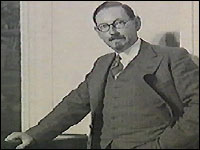
BEHIND THE LIVERPOOL LENSHis photographs have remained hidden treasures to most enthusiasts, but that is all about to change as The National Trust gets set to open Edward Chambre Hardman's former house to the public for the first time. When he died in 1988, Liverpool photographer Chambre Hardman left behind a legacy of over 200,000 negatives and photographs spanning his lifetime. A compulsive collector, Hardman never threw anything away so his house was full of thousands of items, almost untouched since before the World War II.  | | Sara Burdett from The National Trust worked to restore Hardman's home |
Sara Burdett, the Project Curator for the National Trust commented, "It is unique. It is a very rare survival of a photographer's studio from the early part of the 20th Century." Saving a memoryAccess to Hardman's work was almost lost to the public forever when the trustees looking after the collection ran out of money four years ago. It was the joint efforts of The National Trust and Liverpool Council that have ensured his memory will live on. Hardman's collection of prints and negatives are now being stored and conserved at the Liverpool Record Office, with some of his collection being on permanent display at his former home as a lasting tribute. 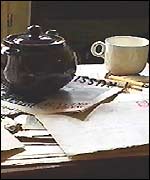 | | Contents of the house remain largely untouched |
As Sara explains, "We take the same care with a property like this
as we would do with a mansion property. "Things in here are just as fragile, therefore they have been restored
and looked after in a similar sort of way." As well as seeing what an extraordinary life Chambre Hardman led, his former home is also full of hundreds of interesting artefacts from days gone by. "In the cupboards in the kitchen we still have the war time rations," said Sara. The man himselfAlthough not a name immediately recognised by many, Chambre Hardman was perhaps one of the North West's most important photographers of the 20th Century. | "The average 'snapshotter' just isn't prepared to put in the time". | | Chambre Hardman |
Born in Ireland, Hardman moved to Liverpool in the early 1920s after serving in the Indian army where his passion for photography was discovered.
A love of landscape
He became known across the country as a gifted portrait photographer, taking pictures of stars such as Ivor Novello and Dame Margot Fonteyn but it was his love of landscape that will be remembered by many. | Black and White | Hardman was a traditionalist who refused to use colour film, opting to work only with black and white. To overcome the demand for colour photographs at the time, Hardman employed a team of women to hand paint his portraits for clients. |
In an interview recorded shortly before his death, Hardman revealed the secret behind his photographic compositions, binding sky and earth together perfectly. "It's very simple
you've always just got to be in the right spot at the right time," he said. "Sometimes you have to wait for a couple of hours for the sun to come around or the clouds to be in a certain position." However the key to Hardman's acclaimed works wasn't just in the way he took the photographs. He explained, "I don't suppose there is a single one of my photographs which hasn't had hours of experimentation in a dark room." Remembering a legend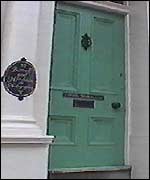 | | Chambre Hardman's former house has been painstakingly restored |
Over £1m pounds has gone into restoring Chambre Hardman's home and studio in Liverpool's Rodney Street. It will ensure that generations to come will be able to take a step back in time and appreciate one of Liverpool's finest artists. Sara Burdett comments, "He was a prominent Liverpool photographer and now we'll be able to say to people 'come and have a look at where he worked, at the images he produced and the fantastic place he actually lived in'."
You can take a look at some of Chamber Hardman's photographs in our photo gallery. |