DOWN'S SYNDROME - SOURCES OF SUPPORT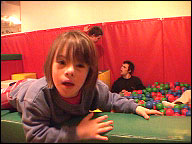 | | FUN | Chloe Bell plays in the ball pool at home with her family |
The Down's Syndrome Association exists to support people with Down's syndrome, their family and carers as well as providing information for those with a professional interest. Sources of helpMost of those involved in providing a service to people with Down's syndrome and their families are employed by Health Authorities, Education Authorities or Social Services. The independent sector, including many voluntary agencies, is growing in significance, however. The following information on support is provided by The Down’s Syndrome Association. Support available in the very early days If the baby is unwell they may go the special care baby unit where a range of professionals including nurses and physiotherapists will be involved.  | | Alex Bell has adopted seven children with Down's syndrome |
Some parents, who feel they cannot cope with the fact that their baby has Down's syndrome, want to talk through the possibilities of fostering or adoption with a hospital social worker. It is unusual that parents proceed with adoption once they have got to know their baby. However, approximately 10-15% of couples do place their child for adoption or foster care. The community midwife and health visitor will be the first professionals to visit the family at home. They can offer: - Emotional support
- Advice on practical ways of coping with difficulties such as feeding problems
- Information on Department of Social Security (DSS) benefits Local services.
These early days can be very stressful, but after the initial shock there is often a period of positive adjustment and optimism. Parents can be reassured that research shows that stress is not a necessary consequence of parenting a child with Down's syndrome. It is true, however that family life, when there is a child with Down's syndrome, may be more stressful if the child has extra difficulties such as medical problems, or where there are pressures such as a shortage of money, or support. There is no evidence that brothers and sisters develop more behavioural problems than in other families, or that there is more rivalry or jealousy. The parents may be anxious to know what their chances are of having another child with Down's syndrome. For this information they can be referred to a genetic counsellor at the hospital. The staff at the national office of the DSA always welcome parents to visit, to talk, and look at the literature available. Support available as the child is growing up The health visitor will continue to visit. She will work closely with the general practitioner who will look after the general health of the whole family and make any necessary referrals. Regular appointments will probably be made, with the paediatrician at the local child development centre (CDC). Medical specialists may be involved if specific medical problems exist. A speech therapist, physiotherapist and occupational therapist may well have a role in the CDC, the family's home and later in the child's school. A social worker may not automatically call, but a visit can be requested. They can offer help which includes: - Information on holidays and respite care
- Advice on claiming and managing money.
The DSS benefits that the family may be awarded include Disability Living Allowance and Invalid Care Allowance. A Portage, or educationally based preschool teaching service, may be available for assisting with education, and later, of course, the school teacher. An educational psychologist can advise about learning and behaviour, and will be a key person in the assessment of the child's special educational needs. Some areas will have a community team for people with learning difficulties (or community mental handicap teams as they were originally and still often are known). This can include: - Social workers
- Mental handicap nurses
- Psychologists
Other professionals who may be involved include: - The school nurse and school medical officer
- The child psychologist
- Welfare rights advisors
- Nursery nurses and play workers
The parents may wish to meet other families who have a child with Down's syndrome. They can do this through their local branch of the Down's Syndrome Association. The Down's Syndrome Association also have information available on their website on support available for the adult with Down's Syndrome For more information, contact:
The Down's Syndrome Association
Tel: 020 8682 4001
www: The Down's Syndrome Association (The BBC is not responsible for the content of external websites) | 



 Inside Out - North West: Monday 3rd February, 2003