REMEMBERING A SENSATION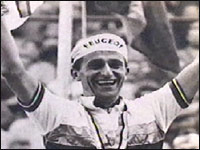 | | His death was plagued with controversy |
Tommy Simpson was one of Britain's most successful cyclists, yet his memory is plagued with controversy after he "rode himself to death". Tommy's nephew Chris Jackson joins Inside Out to follow the story and see how it has affected the cycling world. Cycling has been one of the more controversial sports for some years, with rumours and scandals erupting on a regular basis. Certainly the death of Tommy Simpson rocked the profession all those years ago, but has anyone learnt from his story? As a cycling enthusiast like his uncle, Chris Jackson follows in the footsteps of Tommy's final days before turning his attentions to modern cycling as a whole. A sporting giantIn 1967 Tommy Simpson was at his peak. He was 29 years old, fit, strong and had an instinct for winning as his first training partner Len Jones can testify. "When I did beat him he sometimes wouldn't talk to me for a week or a fortnight," he says. Tommy Simpson was the first British person to make his mark in the world of European cycling and became known as a sporting "giant". But for some, the way he died has tarnished his name and diminished his achievements. 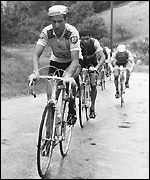 | | Tommy Simpson: The first Briton to wear the yellow jersey and finish in the top 10 in the Tour de France |
Friday 13, 1967 was the 13th day of that year's Tour de France and racers were tackling the treacherous 6,000ft (1829m) Mt Ventoux. In the searing heat Tommy Simpson began weaving across the road before slipping off his bike. After ordering onlookers to, "Put me back on my bike" Tommy continued only a short distance before he collapsed and lost consciousness. He was airlifted to a local hospital but never regained consciousness and died later that day. Tommy Simpson's death shocked participants and those involved in the race, but it was the discoveries after his death that shocked the world. An autopsy showed that Tommy had traces of amphetamines in his blood. Investigators also discovered more of the drugs in his hotel room and the pockets of his jersey. The way things wereIn the wake of Tommy Simpson's death the International Union of Cycling (UCI) banned the use of any performance enhancing drugs in the sport. Yet many people don't think it was taken far enough and a blind eye was still turned to drug use. Len Jones told Chris that his uncle certainly wasn't alone in taking performance enhancing drugs. | "I was told 'you're nearly there on your own abilities but if you just start taking a little bit you'll win the big races'." | | Len Jones |
Len was also pressurised to take part but refused. In the years leading up to his death Tommy Simpson was based in Belgium, where he became close friends with Albert Beurick who ran a bar and hostel for cyclists. After 37 years Albert still finds it hard to talk about the death of his friend but he does tell Chris that his uncle spoke about drugs often and that it was not a taboo subject.  | | Cyclist Paul Kimmage lifted the lid on drug taking in his book "Rough Ride" |
Yet now it has become a taboo subject. Many people involved in cycling admit there is a problem, yet few want to speak out about it. One person who doesn't want to sweep drug use under the carpet is Irish cyclist Paul Kimmage. "I have used amphetamines on three occasions and I wouldn't have believed the difference it made until I tried it. "It was astonishing really," he comments. Having noticed such a difference when using the drugs Paul can fully understand how they could lead someone to push themselves beyond their limits. But with few others who are willing to openly admit to the problem more people could find themselves pushing that step too far, as Tommy did. "People talk about the dangers of Formula 1 and climbing Everest but the numbers would bear no comparison to those who are killed each year as professional cyclists," says Paul. ScandalousIt seems scandal is never far away from the sport of cycling. David Millar, perhaps the UK's most successful cyclist since Tommy Simpson, was given a two-year ban in August 2004 for using banned substances, and many top European stars have faced drug bans during their careers. Yet interest in the sport is on the up. After Britain's medal winning efforts in Athens the public have become interested in cycling. September 2004's Tour of Britain attracted huge crowds nationwide, with fans turning up to watch their Olympic heroes strut their stuff. But do even Olympic stars turn a blind eye? | | Team Great Britain is making a point of keeping drugs out of the sport |
David Brailsford from the GB team comments, "I think it's fair to say the problem exists
and I think once you accept there is a problem you can go out and openly try to do something about it." David says that Great Britain is doing something about it, with new programmes being put into place that will affect anyone who wants to represent their country in the sport. Under the new system all riders in Team GB will have to submit to monthly drugs tests. "That way we can ensure that anyone who rides for Britain is clean," explains David. Paid for resultsPart of the problem in cycling circles is that many teams are sponsored, so they have to show results to survive. It is a different environment to national teams and competition for that elusive sponsorship dollar is fierce. Even David Brailsford from Team GB admits the difficulty. "If people feel there is a possibility of fast-tracking results it can be difficult to resist the temptation." | "The only way to combat it is if all sponsorship companies refuse to give contracts to riders involved in drugs." | | David Brailsford |
Tommy Simpson was a cyclist who pushed himself to the limits to keep winning as that would ensure the continuation of his own sponsorship, but have things changed? The only way to stop widespread drug usage is for the money to stop, after all - money talks. Looking to the futureThere is no doubting that Tommy Simpson's drug use wasn't a one off. It is widely known that cyclists of his era used performance enhancing drugs on a regular basis, partly because there was no stigma attached to it. 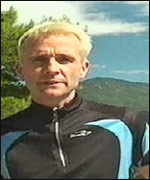 | | Keen cyclists like Chris Jackson want the sport's image improved |
What is surprising though, is that the sport still hasn't got rid of drug use. Chris Jackson is hopeful for the future of cycling and feels that there is some progress being made, albeit slowly and perhaps rather late. The International Cycling Union is getting tougher on drug users and events such as the Olympics, where drug testing is prolific, can only help to keep drug use in check. Lets hope that in the near future this sport, often plagued by controversy, can become one famous for its heroic feats of athleticism and known for its clean image. | 



