THOROUGHBREDS AT CALKE ABBEY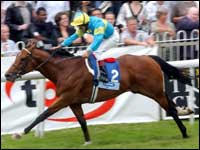 | | Falbrav ridden by Darryl Holland comes home to win The Coral-Eclipse Stakes |
Calke Abbey's place in racing history is not well known. It stumbled into the history of the sport of kings. When he was a child Sir Harry Harpur, of Calke Abbey, ordered a groom to put down a stallion named Squirt because it was suffering with a bad hoof.
The groom refused and Squirt lived. Squirt sired Marsque, but Squirt died six weeks later. Marsque went on to sire the never beaten Eclipse, the founder of the richest bloodline in today's multi-million pound Horseracing industry. Eclipse
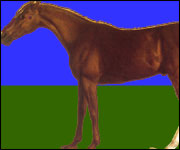 | | The founding sire of horse racing - Eclipse |
Horseracing has many legends, equine as well as human.
Few, however, come close to matching the story of Eclipse.
80% of modern thoroughbred racehorses have Eclipse somewhere in their pedigrees.
He had an almost freakish speed and ability, was unbeaten in his racing career and endowed his sons and daughters with his talent.
He made his owner one of the most famous men in England and Eclipse was painted by George Stubbs and other leading artists of the day.
Eclipse was bred by HRH Duke of Cumberland at his Cranbourne Lodge Stud and was foaled in 1764 during a total eclipse of the sun. Newmarket Heath
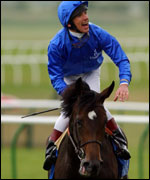 | | Frankie Dettori wins the 1000 guineas at Newmarket |
Newmarket is the UK's premier horse racing town.
It is a good bet that most of the thoroughbreds people come to see race at Newmarket are related to Eclipse, whose skeleton is displayed in Newmarket's National Horseracing museum.
In the 'Eclipse' stakes at Sandown, since it began in the 19th century, almost every horse taking part is a direct descendant of Eclipse.
Breeding is the purpose
For more than 250 years, English sportsmen have enjoyed the spectacle and competition of horse racing.
Horses were matched against each other to win a purse (stakes racing) and the outcome was also gambled on by owners and connections.
| British Group One races in 2003 | 2,000 Guineas
(1m, Newmarket, May)
1,000 Guineas
(1m, Newmarket, May)
Lockinge
(1m, Newbury, May)
Coronation Cup
(1m 4f, Epsom, June)
Oaks (1m 4f, Epsom, June)
Derby (1m 4f, Epsom, June)
St James' Palace
(1m, Royal Ascot, June)
Queen Anne (1m, Royal Ascot)
Prince of Wales
(1m 2f, Royal Ascot, June)
Gold Cup (2m 4f, Royal Ascot, June)
Coronation Stakes
(1m, Royal Ascot, June)
Golden Jubilee
(6f, Royal Ascot, June)
Eclipse (1m 2f, Sandown, July)
July Cup (6f, Newmarket, July)
KG VI & QE Diamond Stakes
(1m 4f, Ascot, July)
Sussex Stakes
(1m, Goodwood, August)
Nassau (1m, Goodwood, August)
International (1m 2f, York, August)
Yorkshire Oaks
(1m 4f, York, August)
Nunthorpe (5f, York, August)
Sprint Cup (6f, Haydock, September)
St Leger
(1m 6f, Doncaster, September)
Fillies' Mile (1m, Ascot, September)
Queen Elizabeth II
(1m, Ascot, September)
Cheveley Park
(6f, Newmarket, September)
Middle Park
(6f, Newmarket, September)
Dewhurst (7f, Newmarket, October)
Champion Stakes
(1m 2f, Newmarket, October)
Racing Post Trophy
(1m, Doncaster, October) |
To discover the best colts and fillies, the Pattern system of Group One races was devised. Group One racingGroup One races for two, three-year old and older horses allow the best of each sex to be identified.
Two year old colts race against each other, at level weights. It is a similar pattern for fillies.
The Dewhurst Stakes, raced over seven furlongs at Newmarket, each autumn, is widely considered to identify the best two year old colt in training. Guineas and DerbysFor three year old colts, the 2,000 Guineas is a prelude to the Derby. These races identify the best colt which is generally retired to stand at stud.
For three year old fillies the 1,000 Guineas is a prelude to the Oaks. These races identify the best filly which may go straight to the life of a breeding Mare. This 'Performance testing' ensures the maintenance of high quality racehorses, notwithstanding the closeness of breeding. The 'Best' is bred to the 'Best'It is because all racehorses are descended from a narrow bloodline that the 'Pattern' racing programme is essential to the future of horseracing.
The operation of Pattern races is the responsibility of Racecourse Stewards, who are trained, approved and advised by Jockey Club Officials. The Jockey ClubThe Jockey Club was founded in 1752 by a number of wealthy racing and horse breeding gentlemen.
As Members included some of the most influential men of the day, the Club naturally acquired authority and prestige.
Needing somewhere to gather in Newmarket, a building known as the Coffee Room was constructed on the site of the present Jockey Club premises in the High Street, and in time Newmarket became known as the Headquarters of British racing.
Once the Jockey Club was established and began to exercise authority, its affairs were conducted by three Stewards and this practice continued for nearly 200 years. Back to Chatsworth 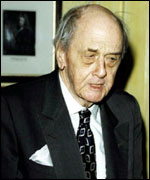 | | The Duke of Devonshire continues the Chatsworth tradition |
Spending on the sport of kings continues at Chatsworth House in Derbyshire. There is a link to Eclipse here too.
The present Duke of Devonshire has enjoyed great success as a racehorse breeder and owner.
Squirt's sire was at Chatsworth and his brother, Flying Childers, a great racehorse, is portrayed in an impressive painting hung at Chatsworth House. Leonard Childers of Cantley Hall, Doncaster bred the famous Flying Childers which was later sold to the Duke of Devonshire.
Flying Childers was never beaten and is still regarded as one of the fastest horses ever raced.
Flying Childers retired to stud at Chatsworth, Derbyshire covering mares owned by the Duke of Devonshire.
Chatsworth House was too far away from the main breeding centres of Yorkshire and the East of England for Flying Childers to make an impact on future generations of racehorses. |  | | This week's stories | The Pilgrims' Way
Take a journey on one of the South East's most historic routes. Cornish tea
Inside Out goes behind the scenes at Cornwall's tea plantation. Storm chasers
Join the storm chasers in search of Yorkshire's worst weather.. | |
| Free email updates | Keep in touch and receive your free and informative Inside Out updates.
Subscribe
Unsubscribe | |
|



