GARDEN TREASURES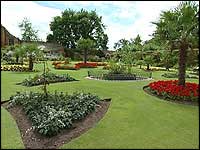 | | Treasures at the bottom of the garden |
What treasures lie at the bottom of your garden? Join Inside Out as we make some incredible discoveries, unearthing the hidden gardens of the past. Gardening, food and clothes are all subjected to the whims of fashion. What's new and modern today is old and outdated tomorrow. But what was it like a few hundred years ago? Well gardeners at some large estates across our region have been making some incredible discoveries. Anne Davies visits three estates across the region - Clumber Park in Nottinghamshire, Calke Abbey in Derbyshire, and Lyveden New Bield in Northamptonshire to see the work going on to uncover some historic gardens of the past.
Nottinghamshire and Clumber Park
North Nottinghamshire was once the abode of many famous kings and dukes. Sherwood Forest provided good hunting and later, shooting. 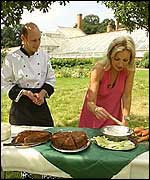 | | Clumber - blooming marvellous - and that's just the food! |
One famous resident of this area was the Duke and Duchess of Newcastle who owned Clumber Park. The park has almost 4,000 acres of farmland park, woods, grassland, heath land, marsh, streams and a lake and is home to a wide variety of wild life.
Anne's first visit takes her to the park as work is taking place to restore an historic kitchen garden. Historians are recreating the garden as it once was.
But restoring gardens is not without its difficulties - one of the challenges the National Trust faces is knowing how far to go with recreating the past. Calke Abbey
Nowhere is this more of a challenge than the next estate at Calke Abbey in Derbyshire. It was acquired by the National Trust in 1985 and was the house that time forgot needing extensive repair.
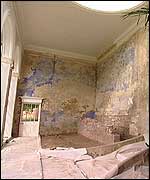 | | The Orangery - restored to its former glory |
The property was lacking in modern amenities and cluttered with the collected family paraphernalia of centuries.
It shows the faded finery, peeling wallpaper and diminished glory of a country home which saw its prime in previous centuries.
One of the long running restoration projects has been the orangery; the cultivation of orange trees which has been going on there or 18 years.
They've also recreated a stunning walled flower garden.
Lyveden New Bield
This takes us to our final property in Northamptonshire. Lyveden New Bield is a surviving Elizabethan garden lodge and is a moving testament to the strength of one man's religious faith.
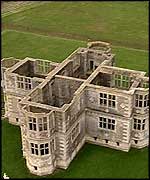 | | Lyveden - stunning aerial view of house and gardens |
Sir Thomas Tresham was a Catholic in a Protestant's reign and built the house to represent his beliefs. This resulted in him spending 15 of his last 25 years in prison under house arrest.
The building was never completed, and work stopped in 1605 following his death.
Today the lodge and garden are virtually as they left it - providing a rare insight into the garden designs of the Elizabethan period.
Lyveden is believed to have one of the oldest surviving garden designs in the country and the restoration team are using modern tools to discover the hidden landscape.
To their surprise historians have unearthed the original mounds, watercourses and terraces. Blooming great.
It's clear that these gardens are more than just a beautiful part of landscape. They hold fascinating tales and their very creation is part of our history which only now is being discovered.
Chris Gallagher from the National Trust tells Inside Out "Our gardens are very important for the English Landscape. They're as valuable as a Titian or Rembrandt and are worth preserving."
It would be interesting to see what future generations make of our gardens and the discoveries. Hopefully they will find the gardens in 'blooming marvellous' health thanks to the green fingers of today's gardeners and restoration teams. | 



