Whirligig
A tribute to a much-loved Saturday teatime children's favourite, 75 years on.

On Saturday November 25 1950, BBC Television planted its flag in hitherto-unoccupied scheduling territory. The BBC was still at this point the UK’s sole television service, operating only two transmitters, in London and the Midlands. Gradually expanding their efforts, now – for the very first time – they began broadcasting regular programmes at 5pm on Saturdays.
Islands in the Schedule
The new slot was very much an island. Sport was regularly shown on Saturday afternoons, and there were of course programmes in the evening, but previously there had almost always been a long gap of nothing in between. Now, however, as part of a BBC plan to launch children’s shows at 5pm every day of the week before the end of 1950, there would be a programme each Saturday at that time – although still with a gap of blank screens immediately before and after.
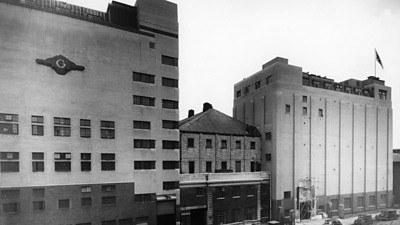
This expansion had been made possible by the BBC’s new studio complex at Lime Grove in West London. So keen were bosses to get the new junior programmes underway that the Children’s Department, set up in early 1950, had been assigned the very first studio to operate there, Studio D.
If anyone has heard of Lime Grove Studio D now, it’s generally in connection with Doctor Who beginning there in 1963. By then, it was regarded as cramped, old and unsuitable – but in 1950 it was a very different story, with the studio a spacious, modern luxury. So coveted was it that in 1952 children’s programmes would be relegated to the smaller Studio H, so prime-time dramas could be made in Studio D.
Mr. Turnip
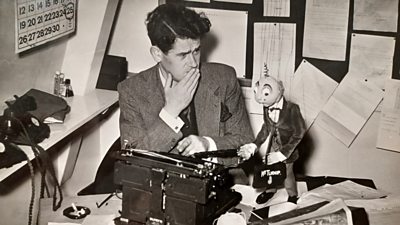
The very first Saturday BBC children’s programme, and by far the most successful in that slot in the 1950s, was Whirligig, created by producer Michael Westmore – one of the initial seven children’s producers recruited in the spring of 1950. Containing a variety of elements, it was linked together by presenters ‘HL’ and ‘Mr Turnip’, who became one of TV’s best-known double-acts of the era.
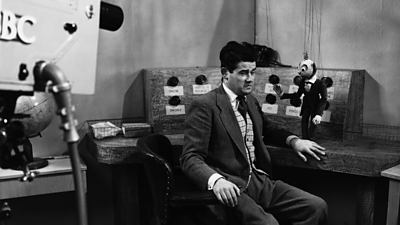
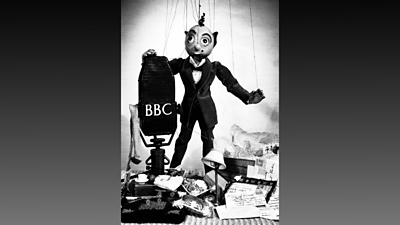
Mr Turnip was a puppet, officious but not unfriendly, with an impish sense of humour and a regular line in withering put-downs. His human sidekick, Humphrey Lestocq, was an actor who had come to fame in the late 1940s as Flying Officer Kite in the radio comedy series Merry-Go-Round.
In the first series of Whirligig, Lestocq would ‘call up’ each individual item by turning rotary faders on a control panel modelled on one of the radio mixing desks of the period. However, such was the popularity of the HL and Turnip linking segments that from series two this conceit was abandoned and the pair were effectively starring in their own sketches and sitcom segments between the other material. These were written by Peter Ling, who would later co-create Crossroads, with Turnip’s voice provided by Peter Hawkins – later the voice of the Daleks – and the puppet skilfully operated by Joy Laurey.
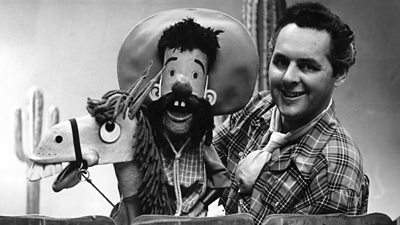
Whirligig had several recurring elements, including a magic slot with conjurer Geoffrey Robinson, music with the show’s resident accompanist Steve Race, and stories of the cowboy puppet Hank, told by artist Francis Coudrill. Coudrill also fancied himself as a ventriloquist, an art at which he wasn’t, in fact, particularly skilled – with Head of Children’s Programmes Freda Lingstrom noting in 1955 how “it has always been the chief anxiety of the producer to get him out of vision as soon as possible.”
But Coudrill was an engaging storyteller and talented artist, with his Hank puppet segments segueing into the cowboy’s adventures being told via two-dimensional cardboard versions Coudrill had made. These were moved over artwork backdrops he had also prepared, operated by graphic artist Alfred Wurmser, later to achieve recognition for his creative graphics across a range of BBC shows.
Success
The rapid success of Whirligig can be measured against its less fortunate companion in the Saturday slot. At this point it was not uncommon for BBC shows to operate on a fortnightly basis, and Whirligig initially alternated with a series called Telescope, which was intended to be the ‘enlightenment’ to Whirligig’s ‘entertainment’. Telescope, however, was beset with problems; overcrowded, messy, and filled with features which didn’t work. BBC bosses demoted its main presenter after two episodes and a disagreement saw it lose its own puppet character, ‘Butterball’, after three. It did, however, help to launch the TV career of Cliff Michelmore, parachuted in as presenter to try and save the ailing show early on.
The audience research report for Telescope’s first episode records how it “did not have anything like such an enthusiastic reception as Whirligig,” while by the following spring Whirligig was noted in another such report as “for many… obviously the favourite television children’s programme.” Telescope, with its ‘makes’ and educational items, was perhaps too much a kind of proto-Blue Peter, in a slot where more out-and-out entertainment was wanted.
Whirligig saw companies queuing up for licenses to make Mr Turnip merchandise, leading to a disagreement between puppeteer Joy Laurey and the BBC over who owned the character; her for building and operating him, or the BBC for producer Michael Westmore having invented Turnip and given Laurey drawings from which to work. Eventually a compromise was reached where Laurey and the BBC shared ownership, with one letter in the BBC files containing the rather sweet entreaty from Laurey that “No mention of these petty bickerings reach the ears of Mr Turnip whose charm and integrity must, I feel, be preserved, at all cost.”
Martian Hats
Drama was a part of Whirligig from the very start, initially with a ‘Write it Yourself’ serial where viewers were invited to send in storyline ideas for the next episode every fortnight. This element was, however, dropped towards the end of the first series, with Michael Westmore later explaining in the Radio Times that “latterly the plot has been entrusted to grown-up scriptwriters with less bloodthirsty tastes.”
For the start of series two of Whirligig in the autumn of 1951, the drama was a serial by husband-and-wife writers Hazel Adair and Ronald Marriott called Stranger from Space, notable as Britain’s first ever television science-fiction series – as opposed to the previous occasional one-offs in the genre. It arrived on screen 12 years before the very same Studio D at Lime Grove also saw the launch of the UK’s most famous such series, Doctor Who.
Stranger from Space demonstrates the shoestring budget such productions then had, as well as the precarious nature of live transmission and the difficulty there can be in establishing facts about long-ago programmes for which so little material survives. The tight budget is illustrated by a list of costume requirements surviving among the BBC paperwork, which rather charmingly notes that “we shall be having papier-mâché hats made for the Martians.”
Some reference works refer to the first series of Stranger from Space as having had eleven episodes, two with the same title, information taken from the Radio Times listings. In fact, the reason why one episode ended up being listed twice is because another didn’t go out at all; when King George VI died in early February 1952, that week’s episode of Whirligig was cancelled. The schedule was knocked back a fortnight, hence the next episode being listed again for when it actually went out, and only ten were made in that series, although the Radio Times kept counting them up to 11.
Stranger from Space told the story of a friendship between Ian, a human teenager, and Bilaphodorus, or ‘Bill’ for short, a stranded Martian. The cancellation of the episode in the week of the King’s death caused a huge problem for the story, as permission had already been given for Brian Smith, who played Ian, to leave before the final few episodes to tour Africa with the Old Vic theatre company. However, the episode in which Ian was to have been written out was the episode which never happened, necessitating a hasty rewrite to explain the character’s sudden departure.
"Clearly a favourite programme"
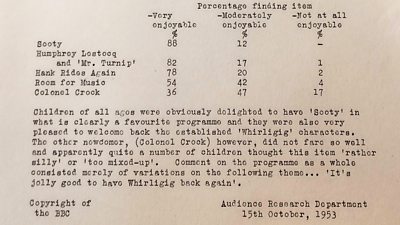
Whirligig initially came to an end in the summer of 1954 – although it’s not entirely clear why, as ratings and audience feedback were still strong. Indeed, BBC audience research found that viewers were particularly pleased that the popular puppet Sooty had joined the show for the 1953-54 run – “Children of all ages were obviously delighted to have Sooty in what is clearly a favourite programme.”
Whatever the reason for it, though, the cancellation was reversed the following year. When ITV arrived in the autumn of 1955 Whirligig was resurrected to help try and combat the newcomer. However, producer Michael Westmore had defected to commercial television, as did music man Steve Race, and although HL and Turnip were present and correct, a wrangle over money meant there was no Francis Coudrill and Hank. The revived Whirligig lasted for only a single series before coming to an end for good at the end of June 1956.
Whirligig was always broadcast live, and not so much as a few seconds of it survives in the BBC’s archives. 27 years after the series ended, however, in July 1983 Joy Laurey, Peter Hawkins and Humphrey Lestocq reunited for an HL and Turnip scene in a puppet-focused edition of the BBC Two series Six Fifty-Five, an episode also featuring Francis Coudrill and Hank. This all doubtless delighted those watching who, by then grown-up and nearing middle-age, had once been faithful viewers of the BBC’s first ever Saturday teatime series.
Paul Hayes is a writer and radio producer and author of the forthcoming book When Saturday Came, the story of the BBC’s Saturday teatime children’s slot from 1950 to 1963.
