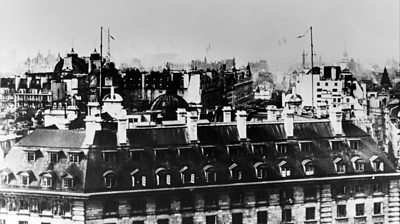

While celebrating the 100th anniversary of the BBC, our mind should also go to the unique story of one of its fathers: Guglielmo Marconi, the inventor of wireless communications, born in Bologna (Italy) in 1874 and raised in the outskirts of the city of towers.
Since he was a teenager Marconi started to dream that he would become an inventor, and he chose electromagnetism as his playground: a thriving field in the last decades of the 19th century! Today’s equivalent would be an 11 year old child playing with Artificial Intelligence applications, with a keen desire and vision for future glory.
Working alone in the attic of Villa Griffone in Pontecchio, the “Stanza dei bachi”, with the only help of tutors and of the scientific journal L’Elettricità, he started to develop and refine transmitter and receiver equipment with a clear objective in mind: overcoming physical obstacles with wireless telegraphy, something that no one else had so clearly envisioned before.
While he certainly took advantage of many individual devices and concepts developed by the great physicists of the time, including James Clerk Maxwell, Heinrich Hertz, Oliver Lodge, Edouard Branly and others, the young Marconi had the unprecedented intuition of adding the antenna to an overall transmit-receive system: this was the key for success of the world’s first experiment of non-line-of-sight wireless telegraphy!
In 1895, Marconi was able to close the link across the Celestini’s Hill, right in front of Villa Griffone, covering a distance of less than a mile. The wireless revolution had started.
There is no gap in Marconi’s character between the Inventor and the Entrepreneur. Immediately looking for protection of his intellectual property as well as for venture capital, Marconi moved to London in February 1896, at the age of 22.
The young man found crucial support in London through his maternal family connections: his mother, Annie Jameson, was a member of the famous Irish family of whiskey distillers, and was instrumental in providing Guglielmo with a fertile environment for a new venture.
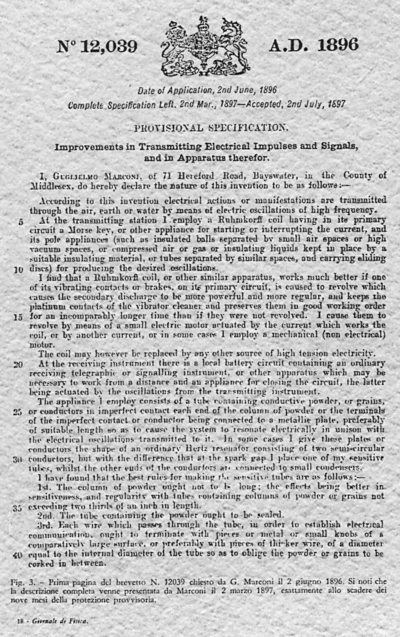
Later that year, he filed for the world's first patent for a system of wireless telegraphy, which was granted a year later. In July 1897 he founded the Wireless Telegraph & Signal Company (later renamed as Marconi's Wireless Co.). It would take as long as ten years of very significant investment for that company to break even, a clear sign of Marconi’s talent as an industrial leader.
But Marconi also maintained his place as a Scientist in the field of electromagnetism: his experimental activity led to constant improvements of his wireless communication system, in a quest for longer and longer communication distances.
By 1899 his signals had crossed the English Channel, and in 1901 he was able to surprise the world with an achievement that was deemed impossible: crossing the Atlantic Ocean with a radio link! On December 12, 1901, Guglielmo Marconi received on the coast of St. John's Newfoundland the first transatlantic wireless signal transmitted from Poldhu in Cornwall.
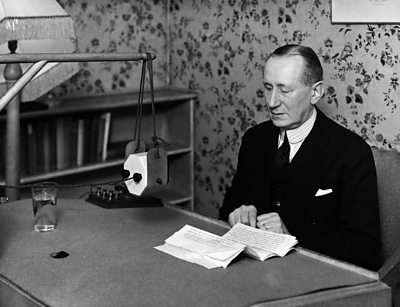
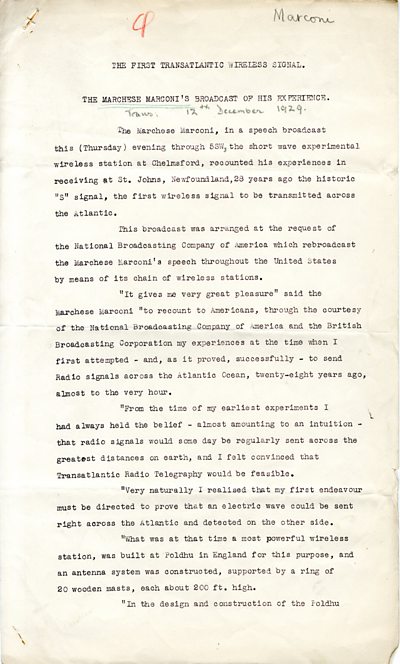
Some thirty years later, Marconi recounted the extraordinary intercontinental achievement in a radio programme:
From the time of my earliest experiments, I had always held the belief – almost amounting to an intuition – that radio signals would some day be regularly sent across the greatest distances on earth, and I felt convinced that transatlantic radio telegraphy would be feasible.
In 1909 Marconi shared the Nobel Prize in Physics with the German physicist Karl F. Braun. That year had begun with the rescue of 1,600 people from two ships that had collided off the Nantucket coast and over the years many more lives were saved at sea by Marconi's equipment operated by the "Marconi Men".
Immediately after the First World War the Marconi Company played a major role in establishing long-distance wireless connectivity. The ground was ready to imagine the birth of a new service: broadcasting.
On June 15, 1920 the Marconi Company made what is considered to be "the first pre-announced broadcast of public entertainment": a recital by the Australian opera soprano Dame Nellie Melba, who sang through radio from the Marconi premises in Chelmsford.
The company continued its experimental broadcasts throughout 1921, and on May 11, 1922 the London radio station, 2LO, started to send signals from the roof of Marconi house in the British capital. Six months later, that studio became the first station of the British Broadcasting Company that was incorporated on October 18, 1922.
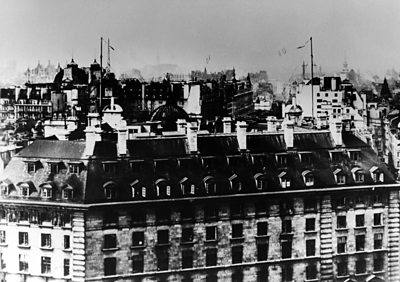
The initial BBC shares were held equally by six companies - Marconi, Metropolitan-Vickers, the Radio Communication Company, British Thomson-Houston, General Electric, and Western Electric.
The following year, Marconi started to test short waves on board his yacht "Elettra" and this led to the establishment of the directive beam system for long distance communication. In 1931, he began research into the propagation characteristics of still shorter waves, a trend which continues today with 4G, 5G systems and beyond.
On July 21, 1937 - the day of Guglielmo Marconi's state funeral - at 6.00 pm Rome time, all the BBC's radio stations, as well as several others in Italy and in America, went off the air for two minutes to pay a unique tribute to the man who was recognised worldwide as the father of radio communications.
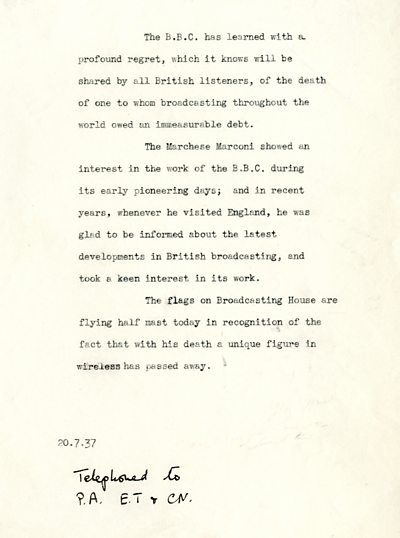
The sadness for his early departure and the great respect for Marconi’s technical and entrepreneurial achievements are both clearly readable in the BBC archives:
The flags on Broadcasting House are flying half mast today in recognition of the fact that with his death, a unique figure in wireless has passed away.
Biography
Giovanni Emanuele Corazza is President of the Fondazione Guglielmo Marconi.
The Fondazione Guglielmo Marconi spreads knowledge of Guglielmo Marconi's work and promotes research and technical and scientific culture. It is based in Villa Griffone di Sasso Marconi in Bologna, the place where Marconi invented wireless communication in 1895.
