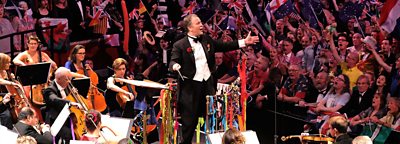
The BBC has been broadcasting the Proms since 1927, and from the outset the UK has enjoyed a wide range of music, both ancient and modern.
1927 - Where it all began
The Thirty-Second Season of the Promenade Concerts was the first to be broadcast and supported by the BBC.
With a potential 94% of the population within reach of a broadcasting station, following the opening of the Daventry transmitter, nearly everyone could hear a Prom for the first time. The concerts came from the Queen’s Hall, London with Sir Henry Wood (founder-conductor of the Proms) appearing with his Symphony Orchestra. The first item was Elgar’s Cockaigne Overture.
1930 - The BBC Symphony Orchestra is born
The origins of the orchestra date back to 1928, when Conductor Sir Thomas Beecham and the BBC proposed its creation.
But Beecham withdrew his support and the BBC continued to develop the idea, forming the orchestra we know today. A much smaller light orchestra, The BBC Wireless Orchestra, and a number of other ensembles, formed the basis for the new orchestra which became the lead orchestra for the Proms. The full BBC Symphony Orchestra gave its first concert on 22 October 1930, conducted by Sir Adrian Boult at the Queen's Hall.
1941 - Blitzed and bombed
The Queen's Hall next to Broadcasting House had been the home of the Proms since they began in 1895, and the BBC Proms from 1927 until 1941.
Sadly the 1941 Proms were never broadcast from the Hall, as the building sustained three hits by enemy bombing in 1940 and 1941. The final raid was a single incendiary device that proved fatal. The roof was soon ablaze, emergency services experienced difficulties with the water supply, and the fire quickly got out of control.
1947 - The TV debut
Sir Malcolm Sargent, Chief Conductor at the Proms from 1948-67 was excited at the prospect at televising the Proms for the first time in 1947.
His biographer, Richard Aldous, suggests that producers 'often struggled to find interesting shots to fill out a full concert programme'. There were concerns too about making performers and conductors 'stars' through television, and close-ups were used sparingly. However, Sir Malcolm embraced the medium introducing more spectacle for viewers at home.
1966 - The breakthrough of the 60s
Listeners to the Proms now take stereo for granted, but it was only in 1966 that a stereo Prom could be heard.
Experimental transmissions in stereo on the BBC’s Network Three were broadcast before that, but only to tiny audiences. The stereo season featured a performance of Wagner’s Parsifal (Acts 2 and 3) by the Covent Garden Opera Company. Listening to the Proms of 1966 is an interesting experience, as the music seems to spread further left and right, more than would be the norm today.
1970 - And then came colour
BBC Two was the first TV service in Europe to broadcast in colour, but it was not until 1970 that a colour BBC Prom was broadcast on BBC One.
1970 was a breakthrough year, as BBC One had seen a quick take up of the new colour service. The BBC Proms were keen to take advantage, yet BBC presenters still played down the fact that a programme was in colour, mindful that many viewers had yet to upgrade their TV set, and were still watching in black and white.
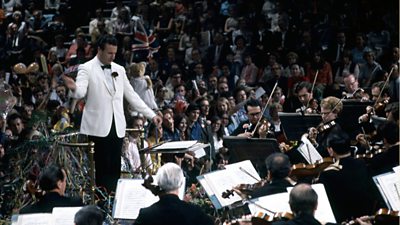
1980 - The Prom that never was
A decline in the UK economy in the late 1970s had put BBC budgets under strain.
The Corporation’s management decided to disband the BBC Scottish Symphony Orchestra and five regional orchestras to save £130 million. The decision met with strike action, and the 1980 Proms season opened without an orchestra. In all, 20 concerts that year were shelved, and further redundancies followed. Eventually, the strike was called off, but morale had sunk to an all-time low.
1989 - The Proms in HD
Prom 52, 2 September 1989 was a leap forward for TV coverage of the Proms.
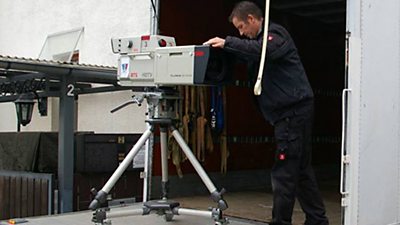
First the first time, at a ‘Viennese Night’ that year, cameras recorded the action in High Definition (HD), producing pictures of extraordinary clarity (1250 lines). Although the Prom was broadcast live on BBC Radio 3, no live TV broadcast was ever made that night, allowing space for the HD cameras to make their recording. Few concessions were made for the experiment - even the lighting generally available for ordinary televised Proms was not provided!
2002 - The future is digital
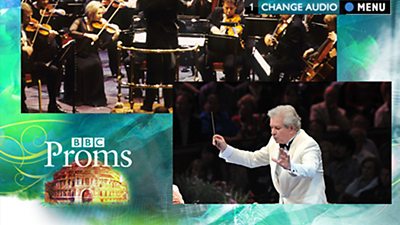
From 2002 the BBC started broadcasting the Proms on BBC FOUR, making the Proms more accessible.
From 2003, Digital satellite and Freeview allowed live Proms programme notes to be seen simultaneously as a concert was broadcast, Proms in the Park could be seen on BBC Red Button, and Proms radio broadcasts were available online for seven days. Remote cameras in 2010 opened up different orchestra viewpoints, and in 2015 radio broadcasts could be heard again online for 30 days.
2016 - Enter the world of 3D audio
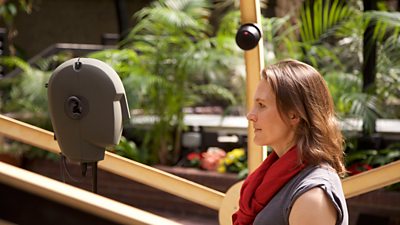
Dutch and American researchers first began experiments in binaural sound in the 1930s.
The idea was to mimic the presence and space of an original recording location by placing microphones in an apparatus that modeled the shape of the human head. Its use has been sporadic and only recently has it been adapted for the BBC Proms. In 2016, music from three concerts, including Stravinsky’s The Rite of Spring and works by Bach and Boulez, were broadcast in binaural sound.
2023 - Broadening the appeal
A new weekend festival at Sage Gateshead and Proms in all four UK nations were the highlights for Proms 2023.
A collaboration with the Royal Northern Sinfonia and conductor Robert Ames saw much more music played across North East England. Family, orchestral and chamber concerts featured, along with the Proms debut of Mercury Award nominee, Self Esteem.
In addition to the weekend of music at the Sage, there were local Proms at the Guildhall Londonderry, Aberystwyth Arts Centre, Dewsbury Town Hall, Perth Concert Hall and the Hippodrome in Great Yarmouth.
Every Prom at the Royal Albert Hall and the ‘Proms at’ chamber concerts across the UK were broadcast live on BBC Radio 3, and for the first time, the majority of concerts were available on BBC Sounds for 12 months.
2024 - Open access
Enter the Paraorchestra! The ensemble make their Proms debut on August 24 recasting the traditional classical format as an immersive experience - part of a weekend-long Proms festival at the newly opened Bristol Beacon. The mini festival is the start of a long-term partnership between the BBC Proms, Bristol Beacon and Open Up Music, which will focus on inclusive access to classical music.
Back at the Albert Hall in London, there's a new Doctor Who Prom and a new CBeebies Prom too - celebrating the best of BBC programmes, plus non-orchestral offerings in the form of Florence + The Machine, Sam Smith, and a disco night!
In total 90 Proms concerts mix the familiar traditional repertoire with more ground-breaking material - with a real emphasis on music for all.
Links
- BBC Proms homepageInformation about the latest BBC Proms season
- Proms performance archiveDelve into the long history of the world's greatest classical music festival
