

- Contributed by
- Dave Thacker
- People in story:
- Leonard Stanley Thacker
- Location of story:
- Salerno, Italy.
- Background to story:
- Royal Navy
- Article ID:
- A6173895
- Contributed on:
- 17 October 2005
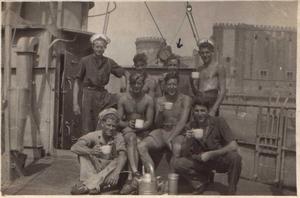
"The Flag Deck Tea Party". Len, arrowed with shipmates on HMS Thruster.
This story is submitted to the People's War Website by David Thacker, a volunteer from BBC Radio Northampton, on behalf of his Mother, Isabella, wife of the late Len Thacker, and has been added to the site with her permission.She fully understands and accepts the site's terms and conditions.
Firstly here are Len's words written in a W/T Operator's Log book, about his time in Salerno in 1943. He is believed to have written this soon after the war's end:
"This time we had Yanks and the invasion was preceded by a small exercise. We left Oran and were attached to the 8th Amphibious Force, United States Navy, under the command of Admiral HEWITT. The Americans, though in good spirits, were not anything like the Canadians. They seemed full of self-importance and lived mainly for their food. Their favourite question was “Is the 8th Army far away?”
On the way over, we were told the target this time was Salerno Gulf, south of Naples. I was disappointed because we ran a sweep about where we’d land and of all the luck I drew Albania. Anyway we were glad that this time it was something big. According to official reports, 3000 ships took part — far more than Sicily.
The day before the landings, as we drew near to Salerno, we learned of Italy’s surrender. It caused great surprise and a good deal of arguments as to what difference it would make. It made the position uncertain for, as Italy was now technically neutral, we couldn’t precede the landing with bombardment unless we met with resistance. Thus it gave Jerry the first shot.
Even so, we were warned to expect the Italian Fleet to interfere manned possibly by Germans. We were told he had 1500 planes on that sector which was held by the crack Hermann Goering Division.
Also we were warned of all types of torpedoes and mines, E-boats, rocket bombs etc.
We arrived off the beaches at about 4.30a.m. As at Sicily, it seemed quiet. Although we could see the small arms fire and heavy crashes as the RAF went in. On the British sector to our north a huge fire sprang up. We had met opposition.
At dawn we beached. We closed in through mined waters and I could see little gushers of water spout out of the sea. I was blissfully ignorant that these were enemy shells. Jerry was determined to stop anything reaching the beaches. Shells came uncomfortably close to us but we hit the beach unscathed and commenced to discharge our troops and equipment. The German 88millimetre guns were still very active, firing from houses just off the beach and from pillboxes in nearby mountains. Shells fell round us. One LST that came right alongside us stopped a direct hit on her bridge. Two or three fellows lay on the deck, their chests and faces covered with blood — dead. A small fire started, but was soon under control and she too unloaded. We had discharged our Ducks (amphibious lorries) about 8 hours before we beached. A radio message came, asking us for them, so what had happened to them?
We heard they were caught by terrific machine gun fire.
We landed all our tanks, vehicles and troops in an hour. As we withdrew from the beach we expected to receive attention from an 88mm gun which was firing at us most of the time.
He was situated up in a hill, but accurate fire from destroyers soon shut him up. All this time American cruisers and British monitors, cruisers and destroyers were blasting away. There were many air attacks, but the AA barrage was absolutely terrific and many planes were brought down. The British sector north of us had their share, but they didn’t meet so much resistance as we did. Later we learned that Jerry had expected us for 3 days and had rushed stuff to meet us. He’d even held a big exercise the day before. It was uncomfortable to see his guns blazing away only a few hundred yards from us.
After we left the beach, we just hung around all day. The Operation was badly planned. On all waves there were ships asking for smaller craft to unload them. The troops ashore too radioed back several times for ammunition and there were requests for mine detecting gear, a vital necessity.
That night we didn’t anchor but just drifted. What a shock. Next morning, when it was light, a look-out spotted a mine below the surface, ten feet away. Very gently we edged away from it, only to discover another just the other side of us. We moved very gingerly from the area and sent out a wireless call for the minesweepers. They came and exploded 11 or more mines in the area we had lay in. We must have passed right over some of them.
Then we left Salerno. We ran a ferry service from Sicilian and North African ports to Salerno, making altogether six trips. During these we landed British and American troops. The British were far the better men. On our second and third trips we landed big guns. One of these was the first big gun to open fire in the battle ashore. The Commanding Officer presented the shell case to our Captain as a souvenir. The confusion in unloading American ships was still going on throughout. Even up to the third trip the enemy was close to the beaches. Once he counter attacked and got to within one and a quarter miles of the beach. By this time Warspite and Valiant had joined the cruisers in shelling and Boy did they shell! There were still many air attacks but the barrage, now supported by the two battleships, was terrific, possibly the biggest ever, and many planes came down. Then Warspite was hit by a cunning trick. Me 109s flew over and whilst every one opened up at them, Junkers slipped in and hit Warspite. Only a slight hit and she continued shelling. We had several near misses but only one casualty from shrapnel. Afterwards we found a 20mm cannon shell had hit and penetrated an AA magazine but fortunately hadn’t exploded.
On our third trip, before we left, we saw the beginning of our offensive. From the British Sector, all down the coast, at what seemed every yard, our big guns started firing. This lines of guns stretched for miles and were firing as fast as they could re-load. The guns were only about three-quarters of a mile inland and the noise was terrific. As it grew dusk, it seemed like one wall of fire as far as the eye could see. We couldn’t see where the shells were landing, but huge fires started, some apparently oil stores or ammunition dumps. This must have been the big push for when we came again, they were pushing inland. Our remaining trips were comparatively quiet. There were still desultory air attacks, but we had fighters, chiefly Lightnings, out in far greater numbers. A U-boat was somewhere in the vicinity but lay low doing no damage.
On one trip back to N.Africa we spotted a mine and the three trips of our squadron circled round having some target practice.
During the last two trips we had heavy weather and some big storms. On the last trip, our sixth, we had the misfortune to overshoot and hit a pontoon hard crumpling up a bow door like paper. But despite this and the heavy seas we got back to N.Africa OK.
In a radio broadcast, our Captain stated that our Squadron (us and our two sister ships) had landed a total of 1400 vehicles and tanks and 6000 troops.
Although not such easy going as Sicily, it was far more interesting.”
Len copied into his log book a letter to the Captain from Captain Ross Ayers, US Field Army, O.C. of troops carried by Thruster:
“Dear Sir,
It might be of interest for you to know that the first American gun landed was from your ship. Our special thanks go to Lt May, for his instructions on sailing by the stars, made this possible after the guide had become confused by the heavy fighting on the beaches. We landed first even though we were scheduled to land third. We landed all guns and men without loss and lost only one man that day. The scrap was pretty hot, with tanks, automatic weapons and artillery, but we just punched it out with them until they gave ground. Since then we have had a scrap that tested the best in us, but we held on, gained our balance, and punched back again.
Give my regards to the Officers and men of your ship’s company. Many thanks to you all for our safe voyage. The best of luck to you and the troops you carry.
Sincerely,
Ross Ayers,
United States Field Army
8. October 1943"
© Copyright of content contributed to this Archive rests with the author. Find out how you can use this.


 Recommended story
 Story with photo